"Yellowtail" Isn't One Fish
In Japan one fish, buri, changes names as it grows and by region. In the US, several fish share the name amberjack. Hamachi, buri and kanpachi explained.
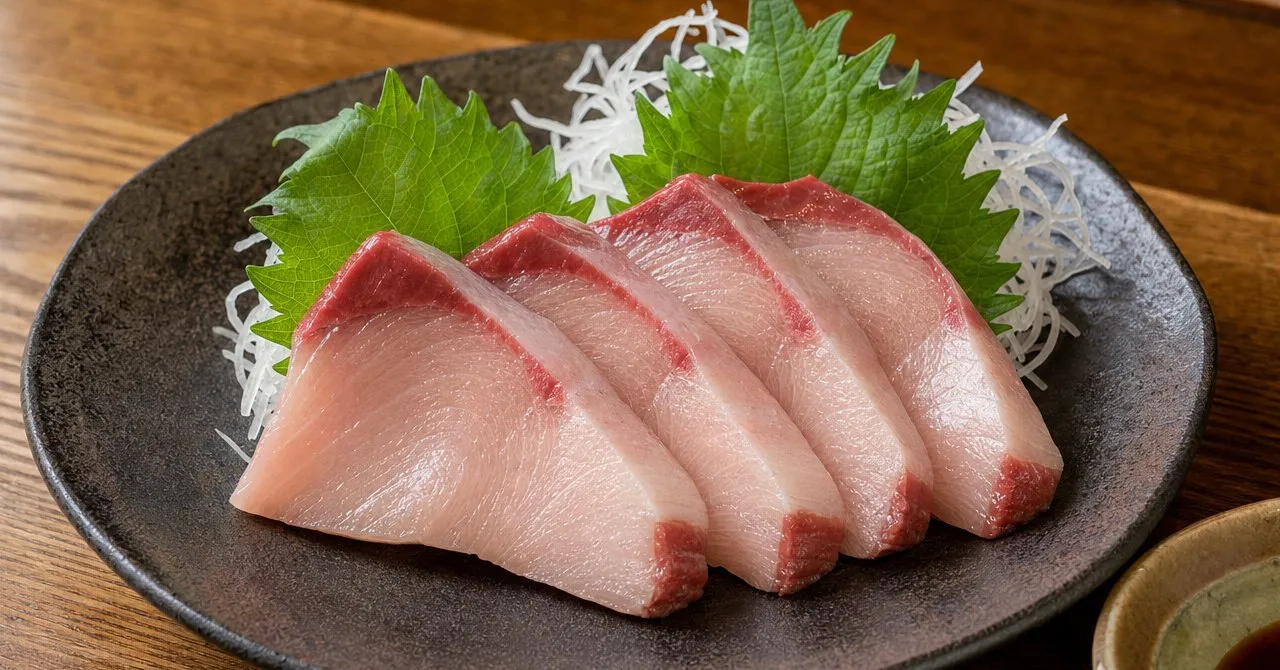
On a US sushi menu, “hamachi” and “yellowtail” usually sit side by side as if they were the same word. English explainers add that hamachi is the young fish and buri is the grown-up one. The Daily Meal, for example, describes yellowtail as “known as hamachi when young and buri when full-grown.” That’s partly right, but it skips the regional names and the way Japanese speakers use hamachi for farmed fish.
Japan and the US have opposite naming problems. In Japan, a single species, Seriola quinqueradiata, picks up a string of names as it grows, and the string changes depending on what part of the country you’re in. On top of that, “hamachi” is widely used in Japan to mean the farmed fish. In the US it runs the other way. Several different fish in the same genus get folded under one name, and under the FDA’s labeling guidance that name is “Amberjack,” not “Yellowtail.”
Here’s what each name means, where it comes from, and what you’re probably eating when you order hamachi in the US.
The short answer
- Hamachi and buri are the same species. Japan’s standard name for it is buri. Hamachi is one of its size names, mostly used in western Japan, and it is also commonly used to mean the farmed fish.
- Japan’s names change with size and region. In the Kanto region (around Tokyo) the sequence is wakashi → inada → warasa → buri. In the Kansai region (around Osaka) it’s tsubasu → hamachi → mejiro → buri. Other areas have their own.
- In the FDA’s Seafood List, the acceptable market name for buri is “Amberjack.” “Yellowtail” appears only as a cross-reference name. Of the related Seriola species covered here, the one the FDA lists with “Yellowtail” as its common name is a different fish, Seriola lalandi.
- US “Kanpachi” isn’t necessarily Japan’s kanpachi. Since 2023, “Kanpachi (Ocean-Farmed)” has been an acceptable US market name for Seriola rivoliana. Japan’s kanpachi is Seriola dumerili.
- Hamachi at a US sushi bar is generally described as farmed Japanese buri. SeafoodSource’s trade handbook says farmed Japanese yellowtail is sold in US sushi bars as hamachi, and sushiFAQ says most of it is farm-raised in Japan. The name doesn’t promise a young fish.
One fish, many names: shusse-uo
Buri is the best-known shusse-uo, or “promotion fish”: a fish that changes names as it grows, like someone moving up through job titles. Japan’s Ministry of the Environment, in its Seto Inland Sea education pages, starts with this point:
「…実は正式な名前(標準和名)はブリです。」 “Its proper name (its standard Japanese name) is actually buri.” — Ministry of the Environment, Setouchi Net
So hamachi is a common name, not the species name.
The Kanto and Kansai sequences
Chiba Prefecture’s fisheries pages and the Ministry of the Environment give the same two main sequences. The sizes are the Ministry’s rough guide.
| Approximate size | Kanto (Tokyo area) | Kansai (Osaka area) |
|---|---|---|
| About 20 cm (8 in) | Wakashi | Tsubasu |
| About 40 cm (16 in) | Inada | Hamachi |
| About 60 cm (24 in) | Warasa | Mejiro |
| About 80 cm (31 in) | Buri | Buri |
Treat the size boundaries loosely. Japanese reference works don’t agree on them. The Nipponica encyclopedia, for example, lists hamachi as a fish in the 15–50 cm class and puts inada and mejiro at around 40 cm. The Ministry notes that large buri reach about 80 cm in fork length and about 10 kg (22 lb).
Other regions have their own
The two-column table is the simplified version. The Ministry of the Environment says that on the Sea of Japan side, small fish are generally lumped together as fukuragi. In Toyama, whose Himi winter buri is famous, a University of Toyama humanities professor writing in the Sasakawa Peace Foundation’s Ocean Newsletter (2015) gives sequences such as kozukura → fukuragi → gando → buri, with a different name for the youngest fish in eastern Toyama. The same article counts 95 regional names for the fish.
The very smallest fish have a name too. Mojako are the fry that shelter under drifting seaweed. The Ministry of Agriculture, Forestry and Fisheries (MAFF) describes mojako fishing as netting the fry along with the drifting seaweed they cling to. At the fisheries cooperative it profiles, the season is mainly April. Those fry are a traditional source of stock for farming.
“Hamachi” often means farmed
This is the part English explainers usually skip. sushiFAQ, for instance, explains the age-based names (“an older yellowtail is referred to as buri”) and notes that most hamachi in sushi restaurants is farm-raised in Japan, but it doesn’t mention that Japanese speakers themselves often use hamachi to mean the farmed fish. In Japan, hamachi isn’t only a size word. Buri farming took off in western Japan, and the Kansai name followed the farmed fish into the national market. Heibonsha’s Sekai Daihyakka encyclopedia says that farmed production overtook the wild catch in 1971 and that farmed buri came to be called hamachi across the country, after the size at which it was shipped. The Ministry of the Environment puts it this way:
「養殖されたものをハマチ、天然のものをブリと呼んでいる場合も多いようです。」 “It seems that, in many cases, the farmed fish is called hamachi and the wild fish buri.” — Ministry of the Environment, Setouchi Net
JETRO, Japan’s trade promotion agency, says much the same: hamachi is often used to set the farmed fish apart.
So a Japanese speaker who sees “hamachi” might read it as “a mid-sized fish,” “a fish from western Japan,” or “a farmed fish,” depending on context. None of those meanings is “a different species from buri.”
Where farming started
Japanese public sources trace buri farming to Kagawa Prefecture, on the Seto Inland Sea, in the late 1920s. The Ministry of the Environment says it is generally thought to have started with fish stocked in 1927. Kagawa Prefecture’s own fisheries division credits 野網和三郎 (the prefecture gives the name in kanji only) with making it a commercial success in 1928, in Hiketa, and calls this a world first. The two dates describe slightly different milestones, so you’ll see both.
Farming has become a large part of the supply. MAFF’s magazine aff reported that farmed fish made up 54% of Japan’s 2017 buri-group production. The Fisheries Agency puts 2023 farmed production of the buri group at 124,000 tonnes.
How the US names the same fish
The US has no shusse-uo tradition. Its naming problem comes from the other direction: several fish in the genus Seriola share names.
The reference is the FDA’s Seafood List, which the agency describes as its “Guidance to Acceptable Market Names for Seafood sold in Interstate Commerce.” It gives three kinds of names for each species:
- Acceptable market name: in the FDA’s guidance, the name that “represents the identity of the species to U.S. consumers.”
- Common name: the English name used by scientific and fisheries authorities.
- Vernacular names: local or regional names. Each species page warns that these are “for CROSS REFERENCE ONLY, and generally not acceptable for product labeling in interstate commerce,” and that using them “may result in seafood misbranding.”
Here’s what the list says for four Seriola species:
| Species | Japanese name | FDA acceptable market name | FDA common name | “Yellowtail” in FDA list? |
|---|---|---|---|---|
| Seriola quinqueradiata | Buri (hamachi, inada, etc.) | Amberjack | Buri | Vernacular only |
| Seriola dumerili | Kanpachi | Amberjack | Greater Amberjack | Vernacular only (with “Great Yellowtail” and “Greater Yellowtail”) |
| Seriola lalandi | See note below | Amberjack | Yellowtail | Common name |
| Seriola rivoliana | Hirenaga-kanpachi | Amberjack or Kanpachi (Ocean-Farmed) | Almaco Jack | Not listed |
Three things stand out.
1. They’re all “Amberjack.” For US product labeling, “Amberjack” is an acceptable market name for all four species, so the label name alone doesn’t tell you which one you have.
2. “Yellowtail” belongs to a different fish. Of these Seriola species, the one the FDA lists with “Yellowtail” as its common name is Seriola lalandi. SeafoodSource’s Seafood Handbook, a trade reference, describes it as wild-caught off Southern California and Baja California and farmed in Mexico and Australia. For buri, “Yellowtail” is only a cross-reference name. It’s also listed as a vernacular name for kanpachi.
A note on S. lalandi: Japanese reference works link it to hiramasa, another prized sushi fish, but the classification has shifted. Shogakukan’s Nipponica says hiramasa was once treated as S. lalandi, and that a 2016 study split that group into three species, placing the Japanese fish in Seriola aureovittata. We’re not going to say which Japanese name matches which FDA entry. The point is simply that FDA’s “Yellowtail” and Japan’s buri aren’t the same species.
3. US “Kanpachi” can be a different species from Japan’s. The FDA added “Kanpachi (Ocean-Farmed)” as an acceptable market name for Seriola rivoliana in 2023. The change was required by Congress, in Section 774 of the Consolidated Appropriations Act, 2023 (Public Law 117-328), according to the FDA’s species page and its 2023 Seafood List guidance, as Food Safety Magazine also reported. The species page reads: “an acceptable market name of Ocean-farmed Seriola rivoliana is Kanpachi.”
In Japan, though, kanpachi is Seriola dumerili, a deep-bodied fish whose name is usually explained by a dark band on its head shaped like the character 八 (hachi, “eight”). Japanese references differ on whether the shape shows when the fish is seen from the front or from above. S. rivoliana has its own Japanese name, hirenaga-kanpachi (“long-finned kanpachi”), in the JAMSTEC marine species database. The Sekai Daihyakka encyclopedia notes that in Okinawa, where it is common, it isn’t distinguished from kanpachi. So the two are close relatives, but a US “Kanpachi” label is a legal market name for one species, while the Japanese word normally means another.
Being fair about it
None of this makes a “yellowtail” menu wrong. “Yellowtail” is a widely understood English name for buri. Major Japanese encyclopedias give it as buri’s English name, along with “Japanese amberjack,” and SeafoodSource notes that the word is confusing in English anyway, since it’s also used for flounder, tuna and sole. The FDA’s names are labeling guidance for seafood sold in interstate commerce. Its Seafood List guidance doesn’t address restaurant menus, and we haven’t confirmed how far its labeling rules reach into restaurants, so we’re not claiming any menu breaks a rule.
It’s also fair to say Japan groups these fish too, just not on the label. In Japanese fisheries statistics, buri-rui (“buri-type fish”) means buri, kanpachi and hiramasa combined. The Fisheries Agency’s aquaculture strategy uses that grouping.
What “hamachi” means on a US sushi menu
On a US menu, hamachi is usually a market name, not a size. SeafoodSource’s handbook says farmed Japanese yellowtail is “featured in U.S. sushi bars under the name hamachi.” JETRO’s 2025 export report says buri-group fish have taken hold in the US under the name “hamachi.” The US is Japan’s biggest market for them: 9,223 tonnes in 2023, and 58.4% of Japan’s export value for the category.
Two caveats. JETRO’s figures cover the buri group as a whole (buri, kanpachi and hiramasa), and the customs category can include other species too. And no source we found measures what share of the hamachi served in US restaurants is farmed. “Mostly farmed Japanese buri” is how these sources describe it, not a measured figure.
What this means in practice:
- “Hamachi” at a US sushi bar is generally described as farmed buri from Japan. It’s a market name, not a promise of a young fish.
- “Buri” is the same species. In Japan the name belongs to the largest size class, and the winter fish (kan-buri) are prized for their fat, as Chiba Prefecture notes. What a given US restaurant means by it is up to the restaurant.
- “Kanpachi” and “hiramasa” are different fish from buri. Japanese encyclopedias list summer as their peak season, the opposite of buri’s winter peak. In the US, “Kanpachi” may also be the ocean-farmed S. rivoliana.
- If you want to know, ask where the fish is from and whether it’s farmed. That tells you more than the menu name.
For how Japan’s own rules approach raw fish, see Is sashimi safe in Japan? and What “sushi-grade” fish really means.
Cooking with buri at home
In Japan, buri isn’t only sushi. It’s the classic fish for teriyaki and a standard item in the New Year’s box (osechi), as we explain in Teriyaki isn’t a sauce, which also has a buri teriyaki recipe.
At a US fish counter you may find it labeled “amberjack,” “yellowtail,” “hamachi” or “buri,” fresh or frozen. Any of those names may refer to the same species, and the same name may refer to different ones, so check the scientific name or the country of origin if the label gives them.
FAQ
Is hamachi the same as yellowtail?
Usually, yes. Hamachi is a Japanese name for Seriola quinqueradiata, which English speakers commonly call yellowtail or Japanese amberjack. In the FDA’s Seafood List, though, its acceptable market name is “Amberjack,” and of the related Seriola species, the one with “Yellowtail” as its FDA common name is a different fish, Seriola lalandi.
What is buri fish?
Buri is the standard Japanese name for Seriola quinqueradiata. It’s also the name for the largest size class, roughly 80 cm (31 in) by the Ministry of the Environment’s guide, at the end of the size sequence in both the Kanto and Kansai regions. Winter buri (kan-buri) is prized for its fat.
What’s the difference between hamachi and buri?
Same species. In the Kansai sequence, hamachi is a mid-sized fish (around 40 cm, or 16 in, by the Ministry of the Environment’s guide) and buri is the largest size. In Japanese markets, hamachi is also commonly used to mean farmed fish and buri wild fish, though that usage isn’t universal.
Is hamachi farmed?
In Japan, hamachi is often used to mean farmed buri. In the US, SeafoodSource and sushiFAQ describe the hamachi served at sushi bars as farmed fish from Japan. We didn’t find a measured figure for how much of it is farmed.
Is kanpachi the same as hamachi?
No. In Japan, kanpachi is Seriola dumerili, a related but different species. It has a dark band across its head and peaks in summer rather than winter. In the US, “Kanpachi (Ocean-Farmed)” has been an acceptable FDA market name for yet another species, Seriola rivoliana, since 2023.
Is yellowtail the same as yellowfin?
No. Yellowfin is a tuna. Yellowtail, in a sushi context, refers to Seriola fish such as buri. In English, “yellowtail” is also used for some flounders and other unrelated fish.
How this article was researched
The Japanese names and sizes come from Japanese public sources: the Ministry of the Environment, Chiba and Kagawa prefectures, MAFF, the Fisheries Agency and JETRO, plus Japanese encyclopedias on Kotobank and a University of Toyama researcher’s article. US names come directly from the species pages of the FDA’s Seafood List, the FDA’s 2023 update log and its Seafood List guidance. English-language descriptions of hamachi were checked against SeafoodSource, sushiFAQ and The Daily Meal. Japanese quotations were translated by us. Where sources disagree (size boundaries, the start date of farming, the scientific name of hiramasa, how kanpachi’s 八 mark is viewed), we say so instead of picking one.
Sources
Japanese sources:
- ハマチ — Ministry of the Environment, Setouchi Net: buri/hamachi names, sizes and farming history
- ブリ — Chiba Prefecture: buri names in Kanto and Kansai, season and fishing
- ハマチ養殖80周年記念事業 — Kagawa Prefecture fisheries division: the start of hamachi farming
- aff 2019年1月号 — MAFF magazine: buri farming and mojako fishing
- 養殖業成長産業化の推進 — Fisheries Agency: aquaculture strategy, buri-group production (PDF, 2025)
- 日本の農林水産物・食品 ブリ — JETRO: buri and the farmed “hamachi” usage
- 輸出品目別レポート(ブリ) — JETRO: buri export report, US market (PDF, updated 2025)
- 富山湾─その豊かな沿岸世界と内陸をつなぐぶり — Nakai Seiichi, Ocean Newsletter No. 347: buri names in Toyama
- ブリ — Kotobank (Nipponica, Sekai Daihyakka, Mypedia): names, farming, mojako
- カンパチ — Kotobank: kanpachi and hirenaga-kanpachi
- ヒラマサ — Kotobank: hiramasa and its scientific name
- ヒレナガカンパチ — JAMSTEC BISMaL: Seriola rivoliana
- カンパチ — Honda fishing field guide: kanpachi
US and English-language sources:
- FDA — The Seafood List
- FDA Seafood List — Seriola quinqueradiata
- FDA Seafood List — Seriola lalandi
- FDA Seafood List — Seriola dumerili
- FDA Seafood List — Seriola rivoliana
- FDA — Seafood List Updates for 2023
- FDA — Guidance for Industry: The Seafood List, FDA’s Guide to Determine Acceptable Seafood Names (PDF, 2023)
- Food Safety Magazine — FDA Publishes Updated Seafood List Guidance for Industry
- SeafoodSource Seafood Handbook — Yellowtail
- sushiFAQ — Hamachi Sushi (Yellowtail)
- The Daily Meal — Yellowtail vs. Yellowfin
This is part of our series on what English-language Japanese recipes get wrong — and why.