Real Wasabi vs. Horseradish: What's Actually in the Tube
Powdered wasabi is nearly all horseradish, and Japan's tourism agency says most non-"hon" products are too. What Japanese labels show about real wasabi.
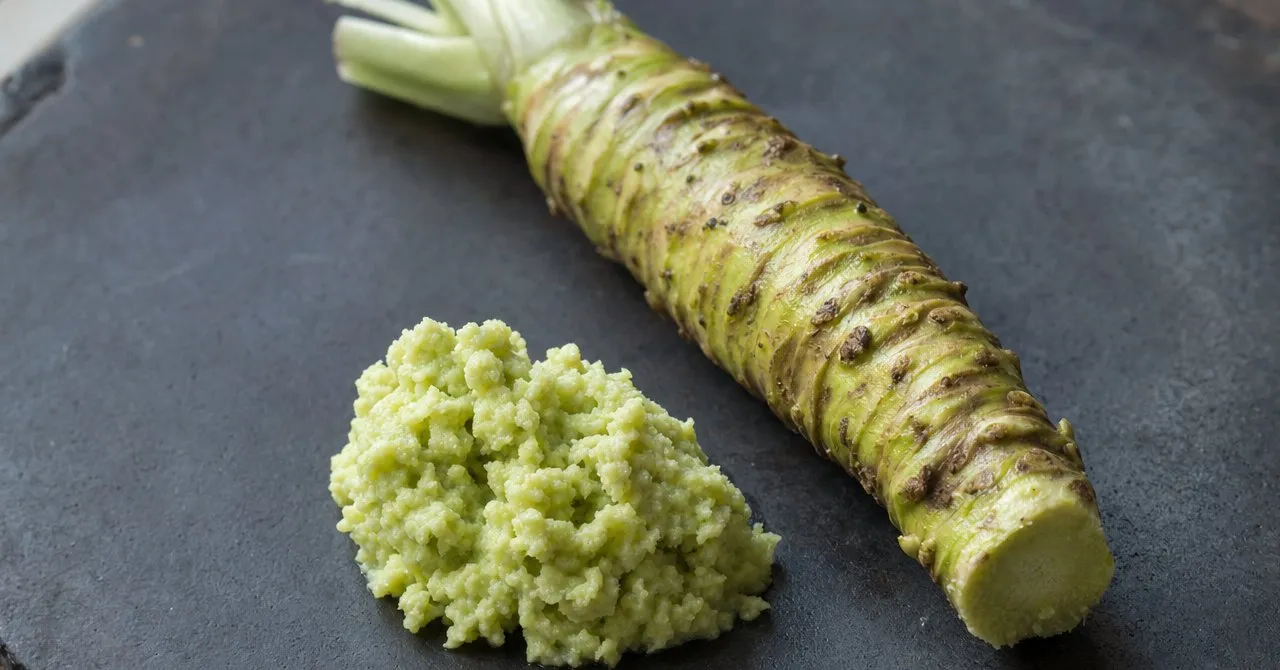
If you’ve read anything about wasabi in English, you’ve probably heard that the green paste next to your sushi is “fake”: horseradish, mustard and food coloring. Some articles go further and say that even in Japan, 95% of wasabi products are fake.
Part of that is right. Japanese encyclopedias say nearly all powdered wasabi is horseradish, and Japan’s tourism agency says most wasabi products without a “real wasabi” label are mostly horseradish plus additives. What the English articles leave out is that Japan has an industry labeling standard that tells shoppers whether real wasabi makes up at least half of the wasabi in the tube. And the “95%” figure traces back to one grower’s estimate, not to Japanese data.
The short answer
- Wasabi and horseradish are two different plants in the same family, the mustard and cabbage family (Brassicaceae). They share the same kind of pungent compound.
- Powdered wasabi is nearly all horseradish, according to Japanese encyclopedias, and according to the Japan Tourism Agency, most products without a hon (“real”) label are mostly horseradish too.
- Japanese tubes have a label code. Under a standard set by the Japan Processed Wasabi Association (Nihon Kakō Wasabi Kyōkai), hon-wasabi shiyō (“made with real wasabi”) means real wasabi is at least 50% of the wasabi in the product; hon-wasabi iri (“contains real wasabi”) means less than 50%.
- “95% of wasabi in Japan is fake” goes back to a wasabi grower’s estimate quoted in 2014 press coverage, not to a published statistic. We didn’t find a Japanese figure that confirms or refutes it.
- Fresh wasabi gets its heat when it’s grated, through an enzyme reaction, and the compound is volatile. Japanese sources describe grating it just before serving.
Two plants, one family
In Japanese, real wasabi is hon-wasabi (本わさび, “true wasabi”). Horseradish is seiyō wasabi (西洋わさび, “Western wasabi”). Calling horseradish a kind of “wasabi” is normal Japanese usage, which is part of why the English conversation gets muddled.
| Wasabi (hon-wasabi) | Horseradish (seiyō wasabi) | |
|---|---|---|
| Scientific name | Eutrema japonicum (Nipponica encyclopedia); many references and the maker Kinjirushi use the older Wasabia japonica | Armoracia rusticana (Kinjirushi) |
| Origin | Native to Japan, growing wild in mountain streams (Nipponica, S&B) | Europe; S&B says Finland, Kinjirushi says the region from Finland to the Caspian Sea |
| How it’s grown in Japan | In beds fed by mountain streams or spring water (sawa or mizu wasabi), or in cool, damp fields (hata wasabi) (Kinjirushi) | S&B says only in some areas, such as Hokkaido, where Kinjirushi says it’s called yama-wasabi |
| Color | Green when grated | S&B describes it as milky white, served with steak and roast beef |
| Heat | Same type of pungent compound | Japan Tourism Agency: sharper and longer-lasting |
Wasabi is the harder crop. The Japanese spice maker S&B Foods describes it as very sensitive to natural conditions, slow to reach harvest and low-yielding:
「「本わさび」は自然条件にとても敏感な植物で、育つ条件が限定されます。」 “Hon-wasabi is a plant that is very sensitive to natural conditions, and the conditions it will grow in are limited.” — S&B Foods
What a Japanese label tells you
In a Japanese supermarket, tube wasabi labels often carry one of two phrases. Kinjirushi, a Japanese wasabi maker, explains on its official Q&A page that these come from a unified standard the Japan Processed Wasabi Association, an industry group, sets for products that use these phrases:
「原料わさびのうち、本わさびの量が50%以上にあっては、「本わさび使用」とし、かつ、近接した箇所に「(本わさびに)西洋わさびをブレンド(又は混合)」の文を併せて表示すること。」 “Where real wasabi makes up 50% or more of the wasabi raw material, the label says ‘made with real wasabi,’ with a nearby statement that horseradish has been blended (or mixed) into the real wasabi.” — Kinjirushi, citing the Japan Processed Wasabi Association’s standard
Below 50%, the label says hon-wasabi iri and the nearby statement is reversed: real wasabi blended into horseradish.
| Japanese label | Romanized | Meaning under the association’s standard | Companion statement |
|---|---|---|---|
| 本わさび使用 | hon-wasabi shiyō | Real wasabi is 50% or more of the wasabi raw material | Horseradish blended into real wasabi |
| 本わさび入り | hon-wasabi iri | Real wasabi is under 50% of the wasabi raw material | Real wasabi blended into horseradish |
And for products with neither phrase, the Japan Tourism Agency’s database puts it plainly:
「「本」 わさびと表示されているものには沢わさびが 50 %以上含まれていますが、それ以外の製品では内容物のほとんどが西洋わさびや緑色の食用色素などの添加物です。」 “Products labeled ‘hon’ wasabi contain at least 50% sawa wasabi, but in other products, most of the contents are horseradish and additives such as green food coloring.” — Japan Tourism Agency, multilingual explanation database
Two details matter.
The 50% is of the wasabi, not of the tube. Kinjirushi’s wording is “of the raw-material wasabi.” A tube also contains things like oil, salt and starch, so a “made with real wasabi” tube is not half real wasabi by weight. The Japan Tourism Agency’s shorter version doesn’t spell out what the percentage is measured against.
It’s an industry standard. What we could confirm is that the rule comes from the association, as Kinjirushi describes it, and that it applies when a product uses one of the two phrases. We did not find whether it is backed by government labeling law, and we couldn’t reach the association’s own pages or S&B’s FAQ to check further. Treat it as the industry’s code for Japanese-market products, not a legal definition.
Some products go further. S&B’s page for its Honnama Hon-wasabi tube says the wasabi used in it is 100% real wasabi. Soba has its own share-based naming rule (see What “100% buckwheat” means for soba).
What’s in one export tube
Export tubes are labeled in English and don’t carry the Japanese phrases. Here is one example, from a UK grocer’s listing for S&B’s “Wasabi Horseradish Paste” (43 g, about 1.5 oz). It’s a retailer’s page, not S&B’s own, and the version sold in the US may be labeled or formulated differently. The listing gives these ingredients, in this order:
Horseradish 31.7%, humectant E420, rice bran oil, salt, dextrin, wasabi 4.5%, potato starch, water, flavouring, turmeric, thickener E415, acid E330, colour E133.
The color comes mainly from turmeric plus a listed color additive (“colour: E133”). On those numbers, real wasabi is about one-eighth of the wasabi-type ingredients, which would put it under hon-wasabi iri if the Japanese standard applied. The tube as a whole is about one-third horseradish; the rest is the other listed ingredients. We didn’t find an official ingredient list for the version S&B sells in Japan.
Powdered wasabi is the same idea in dry form. The Nipponica encyclopedia says nearly all powdered wasabi on the market is either dried, ground horseradish root mixed with chlorophyll, or horseradish powder with Western mustard and synthetic coloring added. Another Japanese reference on Kotobank, Shoku no Igakukan, is blunt:
「粉を溶いて使う粉ワサビは、ホースラディッシュという別品種のもので、このワサビとは異なります。」 “Powdered wasabi, which you mix with water, is made from a different plant called horseradish, and it is not the same as this wasabi.” — Shoku no Igakukan, via Kotobank
None of this is hidden. Japanese references describe horseradish-based powder openly, the industry standard spells out blends, and the export tube says “horseradish” in its name. The ingredient list is the place to look.
“Even in Japan, 95% is fake”?
The figure turns up in English articles about wasabi. A 2020 piece on Fine Dining Lovers says “in the US, more than 99% of what is sold as wasabi is actually this mix of horseradish, mustard and food colouring,” and “even in Japan, an estimated 95% of wasabi products are also fake,” with no source.
The numbers appear to go back further. A 2014 Philadelphia Inquirer post, summarizing a Washington Post story by Roberto A. Ferdman, attributes them to Brian Oats (as the Inquirer spells it), president of Pacific Coast Wasabi, a company that grows real wasabi: “The fake rate is 99 percent in North America, 95 percent in Japan.” We couldn’t open the Washington Post original to check the wording. Either way, it’s one grower’s estimate, not a market statistic, and we found no Japanese figure to check it against.
To be fair to the estimate, the direction holds up: Japanese references agree that most powdered wasabi is horseradish, and the Japan Tourism Agency says most non-hon products are mostly horseradish and additives. Where the English framing goes too far:
- “Fake.” In Japan, the industry standard means a tube that claims real wasabi has to say which way the blend runs, and horseradish is openly called seiyō wasabi. The ingredient list is where you see what a product is. “Fake” suggests deception; “mostly horseradish” is the more accurate description.
- The missing middle. Japanese shelves include tubes made mostly from real wasabi, labeled hon-wasabi shiyō, alongside fresh rhizomes. The real-or-fake framing skips that category.
Mustard is real but product-specific. Nipponica says some Japanese powdered wasabi adds Western mustard; the export tube listing above doesn’t list it. Check the specific package.
How fresh wasabi gets its heat
A whole wasabi rhizome isn’t hot. Kinjirushi says plainly that if you chew one straight from the field, you feel no heat. The heat appears when the cells are broken:
「わさびの辛味成分は、揮発性のからし油(イソチオシアネート)類です。」 “Wasabi’s pungent compounds are volatile mustard oils (isothiocyanates).” — Shizuoka Prefecture
Shizuoka Prefecture, where wasabi is grown mainly in water, describes the chain this way: grating physically breaks the cells, an enzyme already in the wasabi breaks down a mustard-oil glycoside, and mustard oil forms. Kinjirushi names the pieces: the enzyme myrosinase, the glycoside sinigrin, and the main pungent compound allyl isothiocyanate. Kinjirushi ties the volatility to the way the heat rushes up through your nose the moment you eat it. Horseradish has the same pungent compound, which is why it can stand in for wasabi at all.
What Japanese sources advise:
- Grate finely. Kinjirushi says grating finely gives strong heat.
- Start at the top. Kinjirushi says to grate from the end where the leaf stalks were attached, which it describes as brighter in color and stronger in aroma.
- Scrub, don’t necessarily peel. Kinjirushi suggests scrubbing the surface with a brush and leaving the skin on, since the skin is said to be hot. Because the skin can be bitter and darkens the grated wasabi slightly, it says you can peel it thinly if you prefer.
- Grate just before serving. The Japan Tourism Agency’s database says quality-focused sushi chefs grate the rhizome right before serving so diners can taste its natural sweetness.
How fast does the heat fade after grating? We didn’t find a Japanese primary source that gives a time. Fine Dining Lovers says grated wasabi starts “spoiling after about 15 minutes,” but cites nothing for it, so we’re not repeating that as fact.
Storing it: Kinjirushi says to wrap the rhizome in damp kitchen paper, put it in a plastic bag and refrigerate it, and that it keeps for one to two weeks. A Shizuoka wasabi producer interviewed in the farm ministry’s magazine aff gives a longer time: washed where cut, dried, wrapped and kept in the vegetable drawer, about one to one and a half months. Sources differ, so treat keeping times as approximate. The same producer mentions freezing grated wasabi shaped into a log and wrapped in plastic for long storage, with some loss of flavor, and notes that wasabi that grows slowly through late autumn and winter has more heat.
Wasabi in the US
Real wasabi can be grown in the US. Oregon State University Extension Service, with Washington State University and University of Idaho Extension, publishes a grower guide, Growing Wasabi in the Pacific Northwest (PNW 605), which describes the crop as having “potential for high returns for small-acreage growers.” We didn’t find official figures on how much is grown.
For shoppers, the practical points:
- Read the ingredient list, not the front of the box. On export tubes, look for “wasabi” (or Wasabia japonica / Eutrema japonicum) in the ingredients. If only horseradish is listed, it’s horseradish paste.
- If a percentage is printed, compare the two. The export listing above gives both, which tells you more than any front-label claim.
- On Japanese-market tubes, hon-wasabi shiyō means real wasabi is the majority of the wasabi content; hon-wasabi iri means it’s the minority.
- Fresh rhizomes are a different product from any paste. For a wider look at Japanese produce in US stores, see Japanese vegetables in US stores.
One thing wasabi doesn’t do, real or not: Japan’s Ministry of Health, Labour and Welfare says soy sauce and wasabi don’t kill Anisakis parasite larvae in raw fish. For what does, see “Sushi grade” fish.
FAQ
Is wasabi just horseradish?
No. Real wasabi (Eutrema japonicum, also listed as Wasabia japonica) and horseradish (Armoracia rusticana) are different plants in the same family. But powdered “wasabi” is nearly all horseradish, and the Japan Tourism Agency says most products without a hon label are mostly horseradish, so what you’re served is often horseradish.
What does “hon wasabi” mean on a label?
Hon-wasabi means real wasabi. Under the Japan Processed Wasabi Association’s standard, as Kinjirushi explains it, hon-wasabi shiyō (本わさび使用) means real wasabi is 50% or more of the wasabi raw material, and hon-wasabi iri (本わさび入り) means less than 50%.
Is 95% of wasabi in Japan fake?
The figure comes from a wasabi grower’s 2014 estimate, quoted in press coverage, not from a published statistic, and we found no Japanese figure to check it against. The direction is broadly right: most powdered wasabi in Japan is horseradish, and the Japan Tourism Agency says most non-hon products are mostly horseradish. But tubes made mostly from real wasabi, and fresh rhizomes, are also sold.
Why is tube wasabi green if it’s mostly horseradish?
S&B describes horseradish as milky white. The Japan Tourism Agency mentions green food coloring among the additives in non-hon products; the export tube listing above includes turmeric and a color additive; and the Nipponica encyclopedia says some powdered wasabi adds chlorophyll, or mustard and synthetic coloring.
Why does freshly grated wasabi taste different from paste?
Its heat forms only when the rhizome is grated, through an enzyme reaction, and the compound is volatile. Japanese sources describe grating it finely and just before serving. A paste is a different product, often based on horseradish, whose heat the Japan Tourism Agency describes as sharper and longer-lasting when you eat it.
Does wasabi kill parasites in sushi?
No. Japan’s Ministry of Health, Labour and Welfare says vinegar as used in ordinary cooking, salting, soy sauce and wasabi do not kill Anisakis larvae.
How this article was researched
This article is based mainly on Japanese-language sources: the official Q&A of wasabi maker Kinjirushi, S&B Foods’ official page on real wasabi, Japanese encyclopedias on Kotobank, the Japan Tourism Agency’s multilingual explanation database, Shizuoka Prefecture, the farm ministry’s magazine aff, and Japan’s Ministry of Health, Labour and Welfare. The export ingredient list comes from a UK grocer’s product listing, the origin of the “95%” figure from a 2014 Philadelphia Inquirer post, and the US growing information from an Oregon State University Extension publication. Japanese quotations were translated by us. We could not reach the Japan Processed Wasabi Association’s own materials, S&B’s FAQ or the original Washington Post story, and we found no market statistic on real wasabi’s share; where something couldn’t be confirmed, we’ve said so. Nothing here was kitchen-tested or tasted by this site.
Sources
- わさびのQ&A — Kinjirushi, wasabi Q&A (label standard, botanical names, pungency, grating, storage)
- わさびの豆知識|本生本わさびのこだわり — S&B Foods, about real wasabi and horseradish
- ワサビ — Kotobank: Nihon Daihyakka Zensho (Nipponica), Sekai Daihyakka Jiten, Shoku no Igakukan and other entries on wasabi
- わさび製品 — Japan Tourism Agency, multilingual explanation database, wasabi products (PDF)
- わさびについての豆知識 — Shizuoka Prefecture, wasabi facts
- わさび - 達人レシピ — Ministry of Agriculture, Forestry and Fisheries, aff magazine, December 2020, interview with a Shizuoka wasabi producer
- アニサキスによる食中毒を予防しましょう — Ministry of Health, Labour and Welfare, preventing Anisakis food poisoning
- Growing Wasabi in the Pacific Northwest (PNW 605) — Oregon State University Extension Service
- The Philadelphia Inquirer — post by Peter Mucha, Oct. 16, 2014, summarizing a Washington Post story on wasabi
- S&B Wasabi Horseradish Paste — Ocado product listing (ingredients)
- Wasabi vs Horseradish: Are They the Same? — Fine Dining Lovers