Silken Tofu Isn't Lightly Pressed Tofu: Kinugoshi vs. Momen
Japanese silken tofu is soy milk set whole in a mold with no holes, never pressed. How kinugoshi and momen are made, and how they map to US labels.
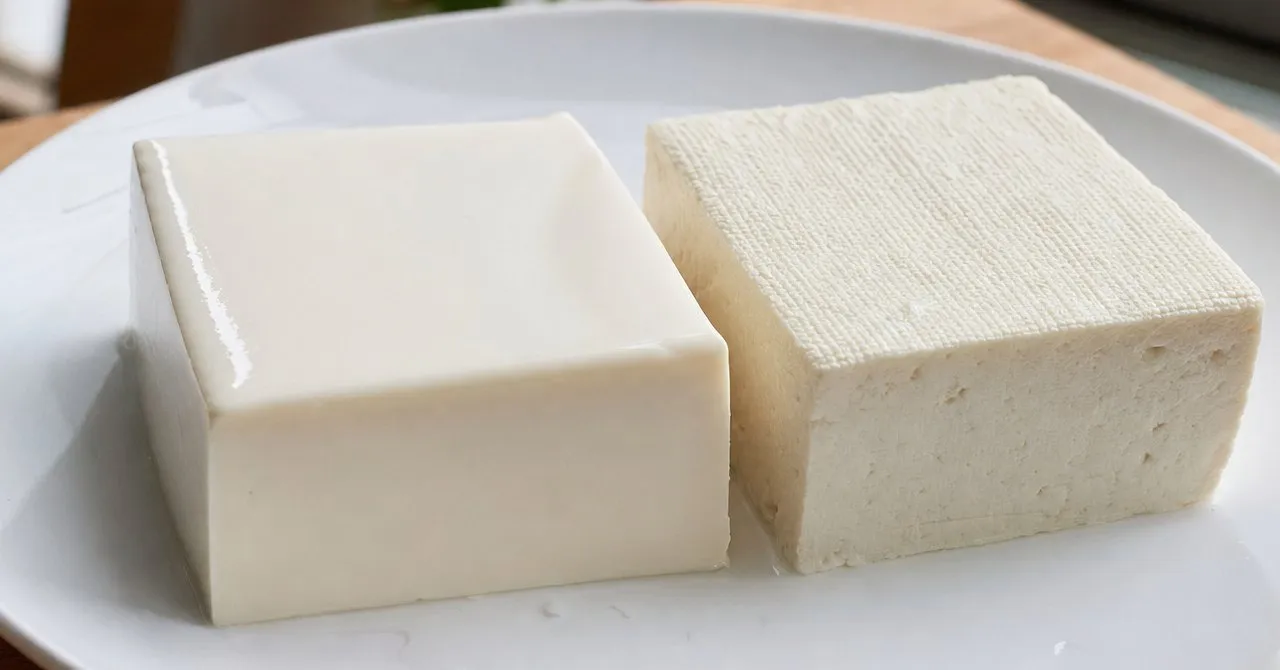
Some English-language guides line tofu up on a single scale: silken at one end, extra-firm at the other, with the difference coming down to how hard the curds were pressed. It’s a tidy picture, but for Japanese tofu it misses the main point.
In Japan, the two everyday kinds are made differently from the start. Momen (cotton) tofu is curdled, broken up, packed into a cloth-lined mold with holes and pressed under a weight. Kinugoshi (silken) tofu is thick soy milk that sets as one piece in a mold with no holes, with no cloth, no weight and no draining. It isn’t lightly pressed tofu. It isn’t pressed at all. And despite the name, it isn’t strained through silk.
The short answer
- Momen (木綿, “cotton”): soy milk is curdled, the curds are broken up and packed into a perforated mold lined with cloth, then weighted to press out water. The result is firmer, with a coarser texture and sometimes a cloth pattern on the surface.
- Kinugoshi (絹ごし, “silk-strained”): thicker soy milk and coagulant set together in a mold without holes. Nothing is broken up or drained. The result is smooth and holds more water.
- US labels don’t line up one-to-one with Japanese types. A “silken firm” box is still silken tofu, just a firmer version of it. A water-packed “firm” block is closer to momen.
How momen tofu is made
The Nipponica encyclopedia (Nihon Daihyakka Zensho) says the coagulant goes into the soy milk once it has cooled to about 158°F (70°C). The curd then goes into a mold box with small holes on all four sides, lined with cotton cloth. A drop lid and a weight go on top to press out water.
The Japan Tofu Association (Nihon Tōfu Kyōkai), the industry group, describes the same steps, breaking the curd up slightly before pressing, and what they do to the block:
「もめん豆腐はキメがやや粗く、布目や型のあとが残る場合があります。」 “Momen tofu has a slightly coarse texture, and the marks of the cloth or the mold sometimes remain.” — Japan Tofu Association
Momen means cotton, the cloth that lines the mold.
How kinugoshi tofu is made
Kinugoshi skips the breaking, the cloth and the press. The Nipponica entry:
「絹漉し豆腐は、木綿豆腐のように水きりをせず、豆乳全体を固めたものである。」 “Kinugoshi tofu is made by setting the whole of the soy milk, without draining it the way momen tofu is drained.” — Nihon Daihyakka Zensho (Nipponica), via Kotobank
The same entry says the mold has no holes. The dissolved coagulant goes into the mold first, the hot soy milk is poured in on top, and the whole thing is left alone to set. The Sekai Daihyakka Jiten encyclopedia adds two details: the soy milk is made thicker, with less water, and because no weight is used, the surface comes out smooth. Japan’s Food Safety Commission, in a 2018 feature on aseptically packed tofu, sums up kinugoshi the same way: since it isn’t pressed or drained, it has to start from concentrated soy milk.
That’s the core difference. With momen, water is pressed out after the curd forms. With kinugoshi, no water is pressed or drained out. The Japan Tofu Association notes that kinugoshi’s solids match the concentration of the soy milk, which is why it needs thick soy milk.
Not strained through silk
Read literally, kinugoshi does mean “strained through silk.” A Japanese-English dictionary site that uses EDRDG data glosses the word as “filtering or straining through silk cloth.” That’s accurate for the word, not for the tofu. The Nipponica entry says the name comes from the tofu being softer and wetter than momen, and adds that it is not strained through silk cloth. A tofu maker interviewed by Mitsubishi Electric puts it this way:
「…「絹」ごし豆腐は絹の布を使うわけではなく、食感が柔らかく、口当たりが絹のようになめらかだからという説が有力です。」 “…kinugoshi tofu doesn’t use silk cloth; the most widely accepted explanation is that it is soft and feels as smooth as silk in the mouth.” — Tamiya, Sanwa Tōsuian (tofu maker), interview published by Mitsubishi Electric
The Japan Tofu Association says the same about the cloth, and links the name to kinugoshi’s fine, silky feel and look, set against the texture of momen.
Other Japanese types: soft and packed
Japan has more than two kinds.
| Japanese type | How it’s made (per Japanese sources) | Texture |
|---|---|---|
| Momen (木綿) | Curd broken up, packed into a cloth-lined mold with holes, pressed under a weight | Firmer, coarser, may show cloth marks |
| Sofuto (ソフト豆腐, “soft”) | Per the Japan Tofu Association: curd left unbroken, put into a mold in large pieces, pressed and shaped | Between momen and kinugoshi; the association calls it “a soft momen” |
| Kinugoshi (絹ごし) | Thick soy milk set whole in a mold without holes; not drained | Smooth, fine-textured |
| Jūten (充填, packed) | Soy milk and coagulant sealed in plastic containers, then heated to set | Smooth; never rinsed in water |
For packed tofu, the Sekai Daihyakka Jiten says the soy milk and coagulant are sealed in plastic containers and then heated to set. The Nipponica entry gives about 194°F (90°C) for around 40 minutes in hot water, then cooling. The Japan Tofu Association adds that because packed tofu is never rinsed in water, more of its flavor stays in.
“Soft” is the slippery one. The Japan Tofu Association describes it as unbroken curd that is pressed, a soft momen. Nipponica instead groups soft tofu with packed tofu, set in packaging molds in hot water. So “soft” isn’t used consistently even in Japan.
The coagulants: nigari, calcium sulfate and GDL
All of these types start with soybeans, water and a coagulant. According to a study published in 2006 by the Tokyo Metropolitan Institute of Public Health, tofu makers have long used crude magnesium chloride from seawater, and refined magnesium chloride, as what’s called nigari. The Britannica Japan encyclopedia also uses nigari as the collective name for magnesium chloride, and notes that calcium sulfate is called sumashiko.
The Tokyo study says calcium sulfate and calcium chloride are also used, and that glucono-delta-lactone (GDL) has become common in packed and kinugoshi tofu:
「グルコノデルタラクトン(以下GDLと略す)が製造工程での使いやすさや,なめらかできめの細かい製品ができることから,充填豆腐や絹ごし豆腐の製造に多用されている.」 “Glucono-delta-lactone (GDL) is widely used in making packed tofu and kinugoshi tofu, because it is easy to work with in production and gives a smooth, fine-textured product.” — Tokyo Metropolitan Institute of Public Health, Annual Report vol. 57 (2006)
In that study, 30 of 33 tofu products bought in Tokyo in 2004 listed magnesium chloride on the label, and 11 listed GDL. Only three were momen, so it was a small sample, not a market survey.
US tofu uses similar coagulants. USDA’s school-meals guidance describes tofu’s basic ingredients as whole soybeans, water and “one or more food-grade coagulants (typically a salt or an acid).” Mori-Nu’s FAQ says tofu is usually set with “calcium sulfate or calcium chloride and GDL,” and its own silken tofu lists glucono-delta-lactone and calcium chloride.
US labels: silken, soft, firm, extra-firm
There’s no federal definition behind these words. USDA’s guidance says it directly: “Tofu does not have a Federal standard of identity.” It lists textures “such as silken, soft, firm, and extra firm” without defining them.
Without fixed definitions, some English-language explanations sort tofu by pressing alone. A guide on Fine Dining Lovers describes curds being “gently ladled into molds and pressed to varying degrees, depending on the style of tofu,” and says “less pressing and more moisture give you silken or soft tofu.” In fairness, the same guide notes that silken tofu “is not pressed in the same way as block tofu.” What it doesn’t say is the part Japanese sources lead with: silken tofu isn’t made from broken curds at all.
A rough mapping (a guide, not a rule):
| On a US label | Closest Japanese type | Why |
|---|---|---|
| Firm / extra-firm, water-packed tub | Momen | Usually made from pressed curds (brands vary) |
| Soft, water-packed tub | No clear match | No US definition; varies by brand |
| Silken (refrigerated) | Kinugoshi | Usually set whole, not pressed (brands vary) |
| Silken soft / firm / extra firm, shelf-stable box | Kinugoshi, packed type | Aseptically packed; Morinaga’s Japanese equivalent is classed as packed tofu. “Firm” means a firmer silken |
Shelf-stable silken tofu: Mori-Nu
Shelf-stable silken tofu is the clearest case. Mori-Nu calls itself a “Silken Tofu brand.” Its official site lists Soft, Firm and Extra Firm, among other versions, and the firm one is sold as “Mori-Nu Silken Firm Tofu.” Its ingredients are water, soybeans, soy protein isolate, glucono-delta-lactone and calcium chloride. So “firm” here describes a firmer silken tofu, not momen.
Mori-Nu’s site says the tofu comes in an aseptic package that protects it “from light, air, and bacteria” and needs “no refrigeration until opened.” Its FAQ says the tofu is made in the US, near Portland, Oregon. Mori-Nu’s maker, Morinaga Nutritional Foods, is a wholly owned subsidiary of Japan’s Morinaga Milk Industry.
In Japan, ordinary tofu had to be kept refrigerated, as the Food Safety Commission noted in 2018 while assessing room-temperature storage of aseptically packed tofu. On July 13, 2018, the Ministry of Health, Labour and Welfare set a new standard for aseptically packed tofu, having confirmed it can be stored at room temperature. Morinaga’s release adds that the Consumer Affairs Agency revised the labeling standards that September. Morinaga says it had sold a long-keeping, preservative-free kinugoshi through home delivery since 1989, made by sterilizing the food and the container separately and filling them aseptically.
Storage, per the manufacturer: once opened, Mori-Nu says to refrigerate any unused tofu promptly in an airtight container, use it within 2 days at most, and not to cover it with water.
Which one Japanese cooks use for what
In an interview published by Mitsubishi Electric, Hirayama of the tofu maker Sanwa Tōsuian recommends kinugoshi where the tofu itself is the point, in chilled hiyayakko or warm yudōfu:
「絹ごし豆腐はつるんとしたなめらかな口当たりが特徴なので、食感も含めた豆腐そのものの味わいを楽しむ冷奴や湯豆腐がいいですね。」 “Kinugoshi is defined by its slippery, smooth feel, so it suits hiyayakko or yudōfu, where you enjoy the flavor of the tofu itself, texture included.” — Hirayama, Sanwa Tōsuian (tofu maker), interview published by Mitsubishi Electric
For momen, Hirayama points to its meaty bite and the way it soaks up flavor, which makes it good for stir-frying and simmering.
Pressing tofu: when Japanese recipes do it
The step English recipes call “pressing” is mizukiri (水切り, draining) in Japanese. Japanese recipes use it when a dish needs drier tofu, such as shira-ae, in which the tofu is mashed into a dressing for vegetables.
If you own a tofu press, it is another way to weight momen or US firm tofu; the Takamatsu method below uses a microwave and a plate. The Japanese sources here describe kinugoshi as tofu that is set without draining and valued for its smooth texture. None of them presses it.
Mizukiri for shira-ae: a Japanese method
Adapted from a cucumber shira-ae recipe by Takamatsu’s Dietary Improvement Promotion Council (Katsuga block), published on the City of Takamatsu website. The amounts and method are the council’s; this site has not kitchen-tested it.
Serves 4
- 2 cucumbers
- A small pinch of salt
- 3 g (about 0.1 oz) dried wood ear mushrooms (kikurage)
- 35 g (about 1.2 oz) carrot
- ½ block momen tofu, about 180 g (about 6.3 oz)
- 1 tbsp sesame paste (neri goma)
- 1 tbsp chū miso (a medium-strength miso; the recipe doesn’t specify further)
- 1 tbsp sugar
- Prepare the vegetables. Salt thinly sliced cucumber, give it about 5 minutes to wilt, then wring out the liquid. Rehydrate the wood ear and shred it; cut the carrot into 2 cm (¾ inch) sticks. Cook wood ear and carrot together in the microwave, covered, about 2 minutes at 600 W, and let them cool uncovered.
- Drain the tofu. This is the mizukiri step. The tofu gets the same covered 2 minutes at 600 W, then a plate on top as a weight until it has given up its water. Crumble it and press paper towels against it to take up what’s left.
- Dress and toss. Mash the tofu smooth, work in the sesame paste, miso and sugar, and fold the vegetables through.
The recipe gives no time for the weighting step, only that the tofu should be well drained.
Our notes (not in the original): In the US, water-packed firm tofu is the closest stand-in for momen. The sugar Japanese recipes mean is jōhakutō, about 9 g per tbsp; with US granulated sugar, about 2¼ tsp gives a similar weight (see Cooking Japanese recipes in an American kitchen). For cucumber swaps, see Japanese vegetables in US stores; for miso styles, Types of Japanese miso. The microwave times assume 600 W; if yours differs, adjust and check as you go.
FAQ
What is the difference between silken tofu and firm tofu?
In Japan, it’s the method. Momen (firm-style) tofu is made from broken-up curds pressed in a cloth-lined mold. Kinugoshi (silken) tofu is thick soy milk set whole in a mold without holes, never pressed or drained, so it’s smoother and holds more water.
Is silken tofu strained through silk?
No. The word kinugoshi literally means “strained through silk,” but Japan’s Nipponica encyclopedia says the name comes from the tofu being softer and wetter than momen, and that it is not strained through silk cloth. The Japan Tofu Association says the same about the cloth and links the name to the tofu’s silky, smooth feel.
Is “silken firm” tofu the same as firm tofu?
No. “Silken firm,” as sold by Mori-Nu, is a firmer silken tofu. Water-packed firm tofu is made from pressed curds, closer to Japanese momen.
Should you press silken tofu?
None of the Japanese sources here presses kinugoshi; they value it for its smooth texture in hiyayakko and yudōfu. Japanese recipes drain momen when a dish needs it dry, as in shira-ae.
Why doesn’t shelf-stable tofu need refrigeration?
It’s sealed in an aseptic package. Mori-Nu says the package protects the tofu from light, air and bacteria, and that it needs no refrigeration until opened. After opening, Mori-Nu says to refrigerate leftovers and use them within 2 days.
How this article was researched
This article is based mainly on Japanese-language sources: Japanese encyclopedias on Kotobank, the Japan Tofu Association, Japan’s Food Safety Commission, the Tokyo Metropolitan Institute of Public Health, Morinaga Milk Industry, and an interview with tofu maker Sanwa Tōsuian published by Mitsubishi Electric. US information comes from USDA guidance and Mori-Nu’s official site, and one English-language guide is quoted as an example. Japanese quotations were translated by us; the US label mapping is our own summary. The mizukiri method is adapted from a recipe by Takamatsu’s Dietary Improvement Promotion Council, published on the city’s website, and has not been kitchen-tested by this site.
Sources
- 豆腐 — Kotobank: Nihon Daihyakka Zensho, Sekai Daihyakka Jiten, MyPedia and Britannica Japan entries on tofu
- 種類と製法 — Japan Tofu Association, tofu types and how they’re made
- 原材料・作り方 — Japan Tofu Association, ingredients and production
- あれこれQ&A — Japan Tofu Association, tofu Q&A
- 「無菌充填豆腐」を常温保存した場合のリスク評価を行いました — Food Safety Commission of Japan, Shokuhin Anzen no. 54, risk assessment of room-temperature aseptic tofu (PDF)
- 豆腐中のグルコノデルタラクトンの分析 — Tokyo Metropolitan Institute of Public Health, Annual Report vol. 57, GDL in tofu (PDF)
- 食品、添加物等の規格基準の一部を改正する件について(豆腐の規格基準の一部改正)— Ministry of Health, Labour and Welfare notice 生食発0713第9号, July 13, 2018 (PDF)
- 冷蔵保存が当たり前だった『お豆腐』が常温保存可能に! — Morinaga Milk Industry, release on room-temperature tofu, December 2018 (PDF)
- 和食の知恵 豆腐 インタビュー — Mitsubishi Electric, interview with tofu maker Sanwa Tōsuian
- きゅうりの白和え — Takamatsu Dietary Improvement Promotion Council (Katsuga block), cucumber shira-ae recipe on the Takamatsu city website (PDF)
- 絹漉 — RomajiDesu, third-party Japanese-English dictionary site using EDRDG (Monash University) data
- Crediting Tofu and Soy Yogurt Products in the School Meals Programs, CACFP and SFSP — USDA Food and Nutrition Service (PDF)
- Mori-Nu — official site
- Mori-Nu — FAQ
- Mori-Nu — About
- Overseas Group Companies — Morinaga Milk Industry
- Mori-Nu — Silken Firm Tofu
- Mori-Nu — Aseptic packaging
- A Guide to the Different Types of Tofu and Their Uses — Fine Dining Lovers