Is Katsuobushi Fermented? Arabushi vs. Karebushi
Not all katsuobushi is fermented. Japan's JAS standard separates smoked fushi from mold-ripened karebushi. How each is made and how to read the label.
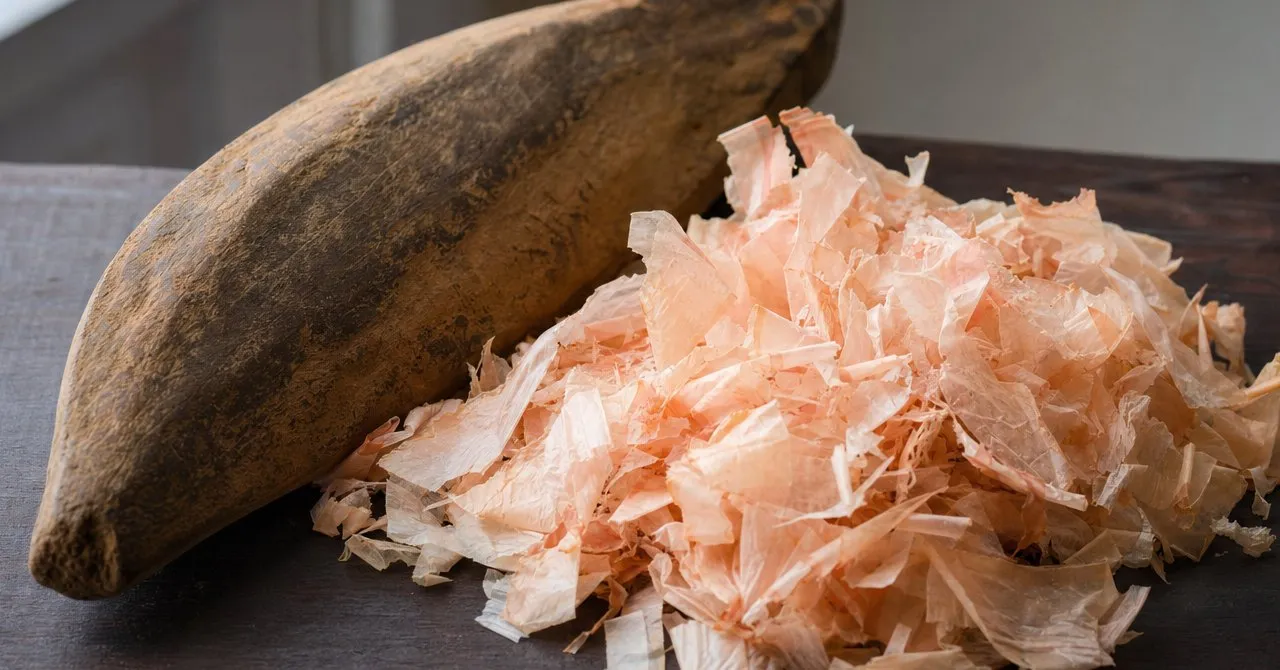
Look up katsuobushi in English and you’ll often read that it is “smoked, fermented, and dried” fish. That’s how MasterClass’s guide to bonito flakes defines them, and it goes on to say a “bacterial mold culture” is applied to the fish. The picture you come away with is that every bag of bonito flakes has been through a long mold-ripening process.
In Japan, that’s only true of one kind. Japan’s national standard for shaved dried fish, JAS 1122, defines two different products: fushi, fish that has been simmered and smoked dry, and karebushi, the same fish taken further with repeated rounds of deliberate mold growth. Japanese food labeling gives them different names. The everyday smoked-only block is called arabushi, and it never sees mold at all.
So the short answer to “is katsuobushi fermented?” is: some of it is mold-ripened, some of it isn’t, and the mold involved is a fungus, not bacteria. Here’s how each kind is made, what the mold actually does, and what a Japanese label can tell you about which one is in your bag.
The short answer
- Katsuobushi is skipjack (katsuo) that has been filleted, simmered, deboned and smoked dry until it’s rock-hard. Bonito flakes are that block, shaved.
- Arabushi stops there: simmered and smoked, no mold.
- Karebushi is the smoked block with its surface shaved, then put through at least two rounds of mold growth and sun-drying. Honkarebushi has had more of those rounds. How many isn’t fixed by the JAS standard, and sources disagree (Ninben, for one, sets its own rule).
- The mold is Aspergillus, a genus of fungi. It isn’t a bacterial culture.
- Labels tell you which is which, up to a point. On a Japanese label, shaved fish made only from karebushi must say karebushi in its name (katsuo karebushi kezuribushi). Hana-katsuo means katsuo fushi only, with no karebushi. Plain katsuo kezuribushi is usually fushi, but it can also be a blend of fushi and karebushi.
What English-language guides say
MasterClass’s article describes all bonito flakes as fermented, calls Aspergillus glaucus “a bacterial mold culture,” and lists four types (karebushi, honkarebushi, hanakatsuo and kezurikatsuo) without mentioning arabushi at all. Its karebushi entry goes further. To be classified as katsuobushi, it says, fillets must be simmered, smoked, dried and “fermented with a bacteria culture for at least two weeks.”
Not every English source gets this wrong. Just One Cookbook’s katsuobushi page lists arabushi separately, as katsuobushi “that is not covered with mold and does not undergo fermentation,” and notes that hanakatsuo is shaved from mold-free arabushi. That matches the Japanese sources below.
The two points worth correcting are narrow ones. Mold-ripening is a step only some katsuobushi goes through, and the organism is a mold, not a bacterium. Everything else about smoked, dried, rock-hard fish is accurate.
How katsuobushi is made
Japan’s Ministry of Agriculture, Forestry and Fisheries (MAFF) and a katsuobushi feature published by Mitsubishi Electric describe the same basic sequence: cut the fish, simmer it, smoke it dry, and then, for some products only, grow mold on it and sun-dry it.
- Cutting. MAFF describes removing the head, guts and belly skin, then cutting the fish into three pieces: two fillets and the backbone. Each fillet is then split into back and belly pieces, giving four pieces.
- Simmering (shajuku). The fish is cooked in hot water below boiling, around 185–199°F (85–93°C) depending on the source. This sets the protein, which is what JAS means by “coagulating the protein through simmering.”
- Deboning. After cooling, the remaining bones and some skin come out. At this stage, Mitsubishi Electric’s feature notes, the fish is called namari.
- Smoking (baikan). The fillets are smoked and cooled, again and again, over days. The heavy-smoked block that comes out is arabushi, also called onibushi.
- Shaving and molding (karebushi only). The surface is shaved off, leaving a reddish-brown block that MAFF and Heibonsha’s World Encyclopedia call hadakabushi, “naked fushi.” It then goes into a curing room or box until mold covers it, gets sun-dried and brushed off, and the cycle repeats.
The numbers vary by source and by maker, so treat these as ranges, not a recipe:
| Step | Kobe University (Takenaka) | Ninben partner factory, Yaizu (Mitsubishi Electric) | Heibonsha World Encyclopedia |
|---|---|---|---|
| Simmering | 185°F (85°C) for 70–90 minutes | about 198–199°F (92–93°C) for 1½–2 hours | not given |
| Smoking | 176–194°F (80–90°C), 5–6 hours per round, 8–10 rounds over 10 days | repeated; oak firewood | 8–12 rounds |
| Each mold round | not given | 2–3 weeks | 15–17 days |
| Mold rounds | about 4, over about 6 months | 4 or more; about 6 months for the whole process | fourth mold = honkarebushi |
MAFF gives one more data point: honkarebushi is ripened with mold for about four to six months. The JAS standard puts one hard number on the smoked fish: a fushi is smoked until its moisture is 26% or less.
A short history
MAFF’s traditional-foods page says the modern method is said to have begun in Kishū (roughly today’s Wakayama Prefecture) in 1674 and to have been carried to Makurazaki, in Kagoshima, in 1707. MAFF presents both dates as tradition (“it is said”), not documented fact. Heibonsha’s encyclopedia says older texts describe only simmering and drying, and calls the theory that today’s molding method was discovered in the Enpō era (1673–81) believable. MAFF’s page, citing its 2022 seafood-processing statistics, says Kagoshima Prefecture is Japan’s top katsuobushi producer.
Arabushi, karebushi and honkarebushi
Here’s how Japan’s standard draws the line. JAS 1122 defines fushi as fish that has had its head and guts removed, been simmered to set the protein, cooled, and smoked dry to 26% moisture or less. Then it defines karebushi on top of that:
「ふし(3.1)(かつおにあっては,表面を削ったもの)に 2 番かび以上のかび付けをしたもの。」 “Fushi (3.1) (in the case of katsuo, with the surface shaved) that has been given a second mold or more.” — JAS 1122:2019, Kezuribushi (Japanese Agricultural Standard for shavings of dried fish)
“Second mold” (niban kabi) means the second round of mold growth. So under JAS, a block becomes karebushi after at least two rounds. One round isn’t enough: anything short of that stays in the fushi category. In practice, the fushi you’ll meet is mostly arabushi.
| Arabushi (荒節) | Karebushi (枯節) | Honkarebushi (本枯節) | |
|---|---|---|---|
| Simmered and smoked | Yes | Yes | Yes |
| Surface shaved | No | Yes | Yes |
| Mold rounds | None | 2 or more (JAS) | More than karebushi; count varies by source |
| JAS name | fushi | karebushi | not a separate JAS category |
| Flavor and use (per Ninben) | strong smoky aroma; suits simmered dishes and noodle sauce | refined aroma and umami | concentrated, no harshness |
Honkarebushi isn’t defined in JAS. Ninben’s researcher says the company defines it in-house as four or more rounds of mold and sun-drying. MAFF describes it as “several” rounds of mold, or a block that has finished its fourth mold. Shogakukan’s Digital Daijisen dictionary places honkarebushi beyond karebushi’s two or three rounds. English sources, MasterClass and Just One Cookbook among them, say three or more. If a count matters to you, look at what the specific maker says.
What the mold does, and is it “fermentation”?
The mold is the reason karebushi exists. Ninben’s researcher explains that growing a good mold on the surface was a way to keep bad molds from taking hold. In the interview, Ninben says it now grows its mold as a pure culture and applies it on purpose. On the factory floor Mitsubishi Electric visited, that meant spraying spores onto the blocks and leaving them in a curing room for two to three weeks per round.
The mold changes both the texture and the flavor:
「カビは、節の乾燥を穏やかに促します。」 “The mold gently encourages the block to dry.” — Ninben R&D department, interviewed by Mitsubishi Electric
Ninben adds that mold growth reduces fishy odor and turns part of the smoky smell into a sweeter aroma. Heibonsha’s encyclopedia says molding lowers the fat content and improves flavor, aroma and color. Shinji Takenaka of Kobe University’s Graduate School of Agricultural Science lists the same kinds of changes: fat breakdown, added flavor and a shift in color.
Which mold? Japanese sources say Aspergillus. Heibonsha’s encyclopedia says the mold is mainly of that genus. Takenaka writes that katsuobushi mold has long been said to be Aspergillus glaucus and related species, but that it wasn’t clear which Aspergillus species actually do the work in the molding stage. His group isolated five species from karebushi: A. amstelodami, A. chevalieri, A. pseudoglaucus, A. ruber and A. sydowii. In samples from one maker, A. pseudoglaucus and A. chevalieri were dominant. So naming Aspergillus glaucus alone, as English guides do, simplifies the picture. Either way, these are filamentous fungi. Calling them a “bacterial” culture is a plain error.
Is that fermentation? It depends on who’s talking. Takenaka describes karebushi as mold-”fermented and ripened” (kabizuke hakkō, jukusei). None of the Kotobank dictionary entries describes katsuobushi-making as fermentation (hakkō), and MAFF’s own page doesn’t use the word either. They say “molding” and “ripening.” In the Ninben interview, the word appears only in the editors’ heading and question, not in Ninben’s answers. So “mold-ripened” is the safest English description of karebushi, and “fermented” is a fair word for it if you’re using the term broadly. What no Japanese source here supports is calling arabushi fermented. It never sees mold.
What a Japanese label tells you
We found no reliable figures for how much of the katsuobushi sold in Japan, or the bonito flakes sold in the US, is arabushi versus karebushi. A Japanese label can still narrow it down.
Appendix 5 of the Food Labeling Standards (Shokuhin Hyōji Kijun), which sets product names for certain foods, says shaved fish made only from one species’ karebushi is named karebushi kezuribushi. Shaved fish made from fushi, or from fushi blended with karebushi, is plain kezuribushi. The industry’s Fair Competition Code for shaved dried fish, administered by the National Kezuribushi Fair Trade Council (Zenkoku Kezuribushi Kōsei Torihiki Kyōgikai), adds the fish name in front and one more allowance:
「(ただし、)かつおのふしのみを削ったものにあっては、「花かつお」と表示することができる。」 “(However,) product made by shaving only katsuo fushi may be labeled ‘hana-katsuo.’” — Fair Competition Code on Labeling of Kezuribushi, Enforcement Rules, Article 3(1)
The Code binds the producers who have joined it. The karebushi naming rule itself is also in the national Food Labeling Standards. Since fushi in these rules means anything short of karebushi, which in practice is mostly arabushi, hana-katsuo on a Japanese label tells you there’s no karebushi in the bag.
| Name on a Japanese label (名称) | What it is |
|---|---|
| かつおかれぶし削りぶし (katsuo karebushi kezuribushi) | shaved katsuo karebushi only: mold-ripened |
| 花かつお (hana-katsuo) | shaved katsuo fushi only: no karebushi; typically arabushi |
| かつお削りぶし (katsuo kezuribushi) | shaved katsuo fushi, or fushi blended with karebushi; not karebushi-only |
| 混合削りぶし (kongō kezuribushi) | shaved fish from two or more species |
The Code also says thick-cut flakes must say atsukezuri (厚削り) and thread-cut must say itokezuri (糸削り).
If your package has only an English label, the Japanese name line may not be there. In that case, look for the words arabushi, karebushi or honkarebushi in the product name or description. If none of them appears, the label alone may not tell you which kind it is.
Which kind to use
Ninben’s researcher matches them to dishes. Arabushi, with its strong smoky aroma, suits rich-tasting dishes such as simmered dishes and noodle dipping sauce (mentsuyu). Karebushi and honkarebushi, with their more refined aroma, are favored for clear soups and delicate Japanese dishes. For dashi ratios and timing, see Dashi isn’t fish stock.
One more note from the JAS standard: it sets a lower moisture range for shaved flakes than for the block, 9 to 17%, or up to 21% for flakes sealed in an airtight container filled with inert gas.
FAQ
Is katsuobushi fermented?
Not all of it. Arabushi is simmered and smoked but never molded. Karebushi and honkarebushi are mold-ripened with Aspergillus, which a Kobe University researcher describes as fermentation. Japan’s JAS standard treats fushi and karebushi as separate products.
What’s the difference between katsuobushi and bonito flakes?
Katsuobushi is the whole dried, smoked block. Bonito flakes are katsuobushi shaved thin; the Japanese category name is kezuribushi. Shaved karebushi alone is sold as katsuo karebushi kezuribushi; hana-katsuo is fushi only; katsuo kezuribushi can be fushi or a blend of fushi and karebushi.
What’s the difference between arabushi and karebushi?
Arabushi is simmered and smoked dry. Karebushi has its surface shaved, then gets at least two rounds of mold growth (the JAS definition) and sun-drying. Ninben describes arabushi as strongly smoky and karebushi as more refined.
Is the mold on katsuobushi bacteria?
No. Japanese sources identify it as Aspergillus, a genus of molds. English guides often name Aspergillus glaucus. A Kobe University researcher isolated five Aspergillus species from karebushi, with A. pseudoglaucus and A. chevalieri dominant, so the single traditional name is a simplification.
Are all bonito flakes made from bonito?
Not necessarily. Japan’s JAS standard covers shaved fish made from katsuo, mackerel (saba), tuna (maguro) and sardine (iwashi), and Japanese labels name the fish. A blend of two or more species is labeled kongō kezuribushi.
What is honkarebushi?
A karebushi that has been through more rounds of mold and sun-drying. JAS doesn’t define it. Ninben defines it as four or more rounds; MAFF describes “several” rounds, or a block finished with its fourth mold, ripened for about four to six months.
How this article was researched
This article is based mainly on Japanese-language primary sources: the Japanese Agricultural Standard for shavings of dried fish (JAS 1122:2019), Appendix 5 of Japan’s Food Labeling Standards, the industry Fair Competition Code on kezuribushi labeling, MAFF’s traditional-foods page, and a grant research report by a Kobe University researcher, published by the Institute for Fermentation, Osaka. Ninben’s comments come from an interview, and the factory details from a visit report, both on Mitsubishi Electric’s CLUB ME site, an appliance maker’s content site; we treat it as a secondary source. Licensed Japanese encyclopedias on Kotobank were used for production details and history. Two English-language pages are cited as examples of what US readers see. Japanese quotations were translated by us, and the label table is our own summary of the cited rules. This site did not make, taste or compare katsuobushi.
Sources
- 日本農林規格 削りぶし JAS 1122:2019 — Ministry of Agriculture, Forestry and Fisheries, Japanese Agricultural Standard for shavings of dried fish (PDF)
- 食品表示基準 別表第五 — Food Labeling Standards, Appendix 5 (product names), as posted by Osaka Prefecture (PDF)
- 削りぶしの表示に関する公正競争規約及び施行規則 — Fair Competition Code and Enforcement Rules on Labeling of Kezuribushi, posted on jfftc.org (PDF)
- かつお節|にっぽん伝統食図鑑 — MAFF, katsuobushi in its traditional Japanese foods guide
- かつお節かび付け工程で働く好乾性糸状菌の分類と菌叢解析に関する研究 — Shinji Takenaka, Kobe University, grant research report on the molds of katsuobushi, Institute for Fermentation, Osaka (PDF)
- 第4回かつお節 — Mitsubishi Electric CLUB ME, katsuobushi feature
- かつお節 インタビュー — Mitsubishi Electric CLUB ME, interview with Ninben’s R&D department
- かつお節 コラム — Mitsubishi Electric CLUB ME, visit to a Ninben partner factory in Yaizu, Shizuoka
- 鰹節 — Kotobank: Kaitei Shinpan Sekai Daihyakka Jiten, Digital Daijisen and other entries on katsuobushi
- How to Cook With Bonito Flakes: 4 Types of Katsuobushi — MasterClass
- Katsuobushi (Dried Bonito Flakes) — Just One Cookbook