Shokupan Isn't "Milk Bread": What Japanese Sandwich Bread Actually Is
Japan's bread labeling code defines shokupan by its pan, not by milk or tangzhong. What the rules say, plus Nippn's basic loaf, adapted.
Search for “shokupan” in English and you’ll often find the same three ideas: it’s “Japanese milk bread,” it’s also “Hokkaido milk bread,” and it owes its soft texture to tangzhong, a cooked flour paste. MasterClass, for example, describes shokupan as bread that “gets its tender texture from a technique called tangzhong.”
Japan’s own definition is about something else entirely. Japan’s industry labeling code for packaged bread defines packaged shokupan by the pan it is baked in. Milk isn’t part of that definition, and neither is any particular method. Nippn, one of Japan’s large flour millers, publishes a basic shokupan recipe that uses no tangzhong at all and only a small amount of milk powder.
Nothing here means milk-bread recipes are wrong. A tangzhong milk loaf is a legitimate bread, and it is one kind of shokupan. It just isn’t the definition of the whole category.
The short answer
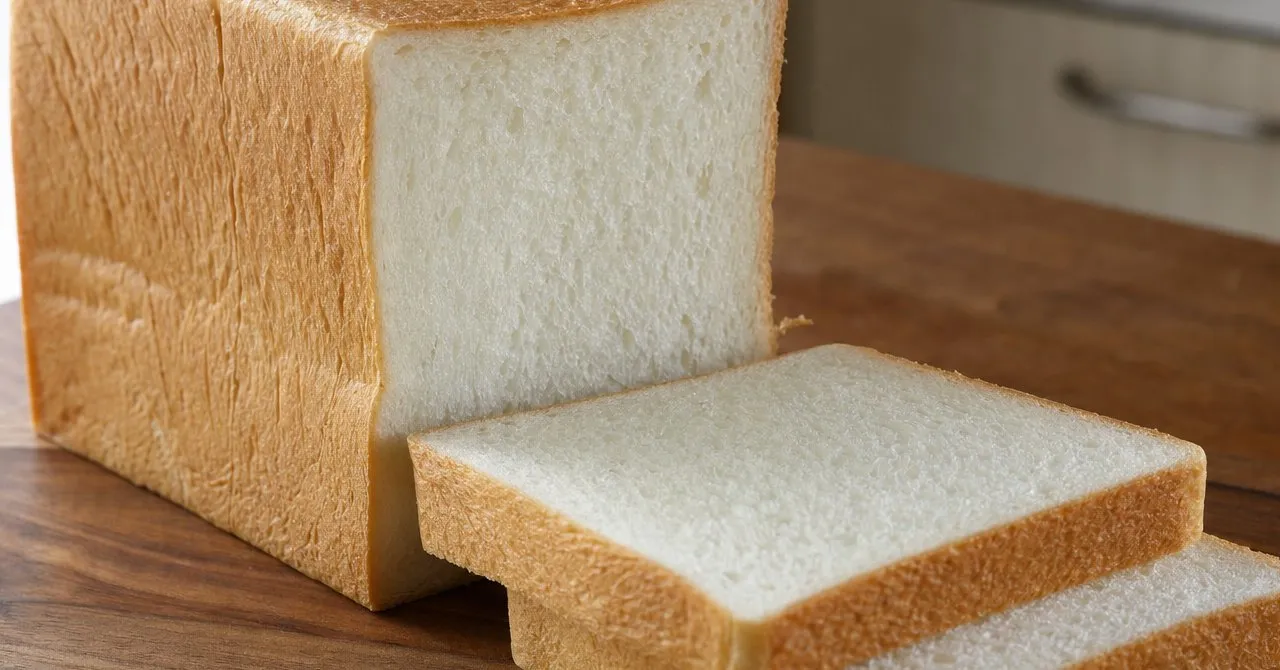
- Shokupan (食パン) is Japan’s everyday loaf: yeast bread baked in a loaf pan, either square (lidded) or domed (open).
- Milk is optional. Many Japanese recipes include a little skim milk powder, and some use milk, but the definition doesn’t require it.
- Yudane (湯種), the Japanese scalded-flour method that tangzhong traces back to, is one of several methods. It is not what makes a loaf shokupan.
- Milk claims are regulated in both countries. Japan’s code sets a minimum milk content before packaged bread can emphasize “milk” on the label, and the US has a federal standard for anything sold as “milk bread.”
What Japan’s bread rules actually say
Packaged bread in Japan is labeled under a fair competition code (公正競争規約): industry labeling rules drawn up by an industry council and certified by the Japan Fair Trade Commission and the Consumer Affairs Agency. It is not a law covering every loaf; it applies to packaged shokupan and the businesses that make and sell it. The one for packaged sliced bread is the Hōsō Shokupan no Hyōji ni Kansuru Kōsei Kyōsō Kiyaku (Fair Competition Code for the Labeling of Packaged Shokupan), administered by the Japan Bread Fair Trade Council (日本パン公正取引協議会).
Article 2 defines packaged shokupan, and the only physical criterion is how it is baked:
パン生地を食パン型(直方体又は円柱状の焼き型をいう。)に入れて焼いたもの — Bread dough placed in a shokupan pan (meaning a rectangular or cylindrical baking pan) and baked. — Japan Bread Fair Trade Council, Fair Competition Code, Article 2
The rest of the definition covers moisture (at least 10%) and how the bread is packaged and shipped: cooled at the factory, wrapped, then sent to stores. It names no ingredient beyond “bread dough” and no method. Strictly, it narrows “shokupan” to the packaged kind rather than defining the word from scratch, but the pan is the only thing it says about the bread itself.
A prefectural standard says nearly the same thing. Saitama Prefecture’s certification standard for bread products defines shokupan as dough baked in a shokupan pan, “rectangular or cylindrical,” and lists milk and dairy only as optional additions, alongside fruit and vegetables.
So, at least in Japan’s labeling rules, “shokupan” works more like “pan loaf” or “sandwich loaf” than “milk bread.” Nothing in either definition rules out a lean loaf of flour, water, yeast, and salt baked in a rectangular pan.
Where milk actually matters: labeling
Milk does have a role in the code, just not in the definition. The code’s implementing rules say a packaged loaf can emphasize milk on the label (words like ミルク, “milk,” or 牛乳, “cow’s milk”) only if the dough meets a minimum:
乳固形分を5パーセント以上(うち乳脂肪を1.35パーセント以上) — Milk solids of 5 percent or more (of which milk fat is 1.35 percent or more). — Japan Bread Fair Trade Council, implementing rules, Article 3
That figure is measured against the flour weight (flour = 100). The rule applies to loaves with the milk kneaded into the dough. The code sets similar thresholds for cheese, honey, and raisins.
The US draws a sharper line. Federal standards of identity have a separate entry for milk bread, 21 CFR 136.130. To be sold as “milk bread,” the dough has to be moistened with milk, or with a combination of dairy ingredients (with or without water) that matches milk’s ratio of nonfat solids to fat. Either way, it must supply at least 8.2 parts milk solids per 100 parts flour by weight. Buttermilk, whey, and milk protein aren’t allowed. Ordinary bread (21 CFR 136.110) may contain some dairy, as long as it stays below the milk-bread threshold.
Here’s how a basic Japanese miller’s loaf compares:
| Milk solids per 100 parts flour | Liquid | |
|---|---|---|
| Nippn’s basic shokupan (oven method, below) | About 2 (6 g skim milk powder per 300 g flour) | Water |
| Japan’s code, to emphasize “milk” on packaged bread | 5 or more (milk fat 1.35 or more) | Not specified |
| US standard for “milk bread” | 8.2 or more | Milk, or dairy ingredients matching milk (water allowed with them) |
Nippn’s basic recipe wouldn’t meet either bar. It’s ordinary shokupan.
These are labeling rules for packaged bread. They don’t govern what a recipe writer calls a homemade loaf. They do show that both countries set a bar before milk can be the selling point.
Yudane and tangzhong: a method, not the definition
Popular English pages present tangzhong as the key to shokupan’s texture. The history King Arthur Baking gives is broadly right: tangzhong has “origins in Japan’s yukone (or yudane) technique” and was popularized across Asia by Taiwanese cookbook author Yvonne Chen.
In Japanese, yudane (湯種, roughly “hot-water starter”) is one of several standard bread methods. A 2010 report from Aichi Prefecture’s agricultural extension staff, comparing methods for rice-flour bread, opens with the standard list:
製パンの基本製法に直捏法、中種法、湯種法がある。 — The basic bread-making methods include the straight-dough method, the sponge-dough method, and the yudane method. — Aichi Prefecture, Ama Agriculture, Forestry and Fisheries Office (2010)
The idea behind yudane is to mix part of the flour with boiling water so its starch gelatinizes, then combine it with the rest of the dough. A 2024 conference abstract by Yamagata University researchers and a food company notes that bread made this way is popular “mainly in Japan” because it is softer and sweeter than ordinary bread. It also names a drawback: in the conventional method, preparing the yudane takes about 24 hours, which makes the bread slow to produce.
That’s the key point. Yudane is a choice Japanese bakers make for some loaves. Nippn’s basic shokupan recipes, for example, use a straight dough. Tangzhong, as MasterClass describes it, is a related technique: “a water roux that involves heating flour and milk and/or water to make a slurry.” Both are ways to get a softer crumb. Neither is required for a loaf to be shokupan.
What about “Hokkaido milk bread”?
King Arthur describes Hokkaido as a prefecture “known for its dairy” and notes that milk bread “is often referred to as Japanese milk bread or Hokkaido milk bread.” The name doesn’t appear in either Japanese definition above. We could not find a Japanese primary source showing where the English name came from or how widely it is used in Japan, so treat it as a descriptive name, not a Japanese category.
Square loaf or domed loaf
Both shapes count as shokupan, since the code only requires a rectangular or cylindrical pan.
| Kaku-gata (角型), “square” | Yama-gata (山型), “mountain” | |
|---|---|---|
| Pan | Baked with a lid | Baked without a lid (rises freely) |
| Shape | Flat top, square slices | Domed top |
| Also called | — | Igirisu pan (“English bread”) |
Haruna Toyama, a JPCA-certified bread coordinator interviewed by the travel site LIVE JAPAN, explains that the square loaf is baked with a lid, unlike the domed loaf, which is also called “English bread.” The square loaf is what US bakers would make in a lidded Pullman pan. Kewpie’s basic egg-salad sandwich recipe recommends a square loaf, sliced 10 to a loaf (more in our tamago sando article).
Slice counts: 4, 5, 6, 8
Japanese loaves are sold by the number of slices per loaf: 4-slice (yon-mai-giri), 5-slice, 6-slice, 8-slice, and so on. Fewer slices mean thicker bread. Kewpie, for example, specifies a 10-slice loaf for egg sandwiches and puts each slice at about 12 mm (about ½ inch).
The “loaf” is a kin (斤). Under Japan’s packaged-bread rules, a loaf may be labeled “1 kin” only if it weighs at least 340 g (12 oz), and the package must also state that “1 kin is 340 g or more.” Lighter loaves are labeled in fractions of a kin.
Preferences differ by region. In a 2019 release, the bakery company Daiichiya Baking reported how its existing brands’ 2018 sales (by value) split among 5-, 6- and 8-slice loaves. Its “western Japan” covers the Kinki, Chūbu, Chūgoku, and Shikoku regions:
| Region | 5-slice | 6-slice | 8-slice |
|---|---|---|---|
| Western Japan | 41.3% | 52.9% | 5.8% |
| Eastern Japan | 4.4% | 55.4% | 40.2% |
The company concluded that thicker bread is preferred in western Japan. These are one company’s sales figures, not a national survey, but the gap is large: 6-slice is the middle ground everywhere, while the west leans thick and the east leans thin.
Panko: bread baked to become crumbs
Panko (パン粉) is literally “bread powder”: pan, the Japanese word for bread, plus ko, “flour” or “powder.” Merriam-Webster traces pan to Portuguese pão and gives 1970 as the earliest known use of “panko” in English.
Japan has a national standard for it: the Japanese Agricultural Standard for bread crumbs (JAS 1491:2024, first set in 2007 and revised in August 2024). Like other JAS standards it is voluntary, since makers choose whether to be graded and carry the JAS mark, but it is the government’s written definition. It defines panko as yeast-leavened dough, mainly wheat flour, that is fermented, heated by baking or a similar method, and then crushed:
発酵させたものをばい焼等の加熱をした後、粉砕したもの — What has been fermented, heated by baking or the like, and then crushed. — MAFF, JAS 1491 Bread crumbs
So in Japan’s definition, panko is bread first: a fermented yeast dough that is cooked, then crushed, rather than crumbs made some other way. The standard then splits it by moisture:
| JAS type | Definition |
|---|---|
| Dried panko (乾燥パン粉) | Dried to 14% moisture or less |
| Fresh panko (生パン粉) | Not dried |
| Semi-dry panko (セミドライパン粉) | Neither of the above; may also be labeled 半生パン粉 (“half-fresh”) |
The electrode-baked loaf
Some panko starts as a loaf that never sees an oven in the usual sense. In a 2019 paper in the Science Journal of Kanagawa University, Takashi Aoki traces electrode bread (電極式), where dough is placed between two metal plates and heated by an electric current passed through it, to a method and apparatus devised in 1935 by Shozo Akutsu of the Japanese Army. (Aoki notes earlier Japanese patents for electrode rice cooking, and that the idea of baking bread with current had already appeared in the US.) Through inquiries to Japan’s national federation of panko manufacturers’ cooperatives (全国パン粉工業協同組合連合会), Aoki learned that electrode bread is still made today and processed into panko. He writes that electrode panko comes out white and slightly harder than panko from oven-baked bread, because the loaf is not actually baked. He also writes, citing no specific source, that the first panko sold as a business was Torakichi Maruyama’s, in Tokyo’s Kyōbashi Hatchōbori district in 1907.
The JAS definition doesn’t require either method. It says only “baking or the like.”
Panko on US shelves
Kikkoman’s US page describes its panko as “made fresh from specially baked, crustless bread.” It says the crumbs are “larger, flakier and lighter than regular bread crumbs” and “coat without ‘packing’ like other bread crumbs do.” The listed ingredients are wheat flour, cane sugar, yeast, and salt. Progresso’s plain panko, from an American brand, lists bleached wheat flour, canola oil, and yeast, with less than 2% dextrose, sugar, and salt. Its page describes the crumbs as “medium ground.”
Both ingredient lists include wheat flour and yeast, which fits the JAS idea of panko as crumbs from a yeast bread, though neither page describes how its crumbs are made beyond Kikkoman’s “specially baked, crustless bread.”
In Japanese frying, panko is the coating for furai and katsu. Karaage is different: it uses a dry coat of flour or starch and no panko (see karaage, tatsuta-age, and zangi). For what goes on a breaded cutlet once it’s fried, see Japanese sauce types.
A basic shokupan, adapted from Nippn
Adapted from Nippn’s published “How to Make Shokupan” (食パンの作り方). Nippn is one of Japan’s major flour millers. This is a straight dough: no yudane, no tangzhong, and no liquid milk. Not tested by this site.
Makes one loaf. For US units and why to weigh, see Japanese recipes in an American kitchen.
| Ingredient | Amount | Baker’s % |
|---|---|---|
| Bread flour | 300 g (10.6 oz) | 100 |
| Dry yeast | 6 g (2 tsp) | 2 |
| Salt | 6 g (1 tsp) | 2 |
| Sugar | 12 g (about 1 tbsp) | 4 |
| Skim milk powder (nonfat dry milk) | 6 g | 2 |
| Shortening | 12 g (about 1 tbsp) | 4 |
| Lukewarm water, about 86°F (30°C) | 216 g / 216 mL (about ¾ cup + 2½ tbsp) | 72 |
Choosing the pan. Nippn doesn’t name a pan size. It sizes the pan by volume instead: fill the pan with water and weigh the water, then use dough equal to 30–40% of that weight (closer to 30% for a deep pan). These ingredients make about 560 g of dough, so by Nippn’s rule they suit a pan that holds roughly 1,400–1,860 mL (about 6 to 8 US cups). That’s our arithmetic, so measure your own pan. Note that Nippn’s page also gives 450–500 g as the dough weight for one loaf, which is less than its ingredient list makes. If your pan is on the small side, scale down.
Method
- Mix. Put half the flour in a bowl and stir in the yeast. (Nippn mixes the dry yeast straight into the flour without proofing it first.) Dissolve the salt, sugar, and milk powder in the water, add it all, and mix until sticky. Add the remaining flour and mix again.
- Knead. Turn the dough out and knead. Work the shortening in, then keep kneading until the dough feels about as soft as an earlobe and stretches into a thin film. Nippn aims for a dough temperature of about 82°F (28°C), adjusted with the water: roughly 77°F (25°C) in summer up to 113°F (45°C) in winter.
- First rise. Cover and leave at 82–86°F (28–30°C) for 40–60 minutes, until 2 to 2½ times its size. Check with a floured finger: if the hole springs back at once, it needs longer; if the hole stays, it’s ready; if the whole dough sinks, it has gone too far.
- Degas. Press out the gas, fold the dough, return it to the bowl, and let it rise 20–30 minutes more. (Nippn says you can skip this if you’re short on time.)
- Divide and rest. Divide in two, round each piece, cover, and rest 15–20 minutes.
- Shape. Roll each piece flat with a rolling pin, fold it in four, pinch the edges into a ball, and set both pieces seam-side down in a pan greased with shortening.
- Final proof. Leave in a warm, humid spot around 97°F (36°C) for 30–40 minutes, until the dough rises about 2 cm (¾ inch) above the rim.
- Bake. Preheat to 375°F (190°C). Bake on the lower rack at 375–390°F (190–200°C) for about 30 minutes, until well browned.
Nippn’s page doesn’t mention a lid, and the dough proofs above the rim, so the instructions read as an open bake, which gives the domed yama-gata shape. It doesn’t give lidded instructions for a square loaf.
Bread-machine version
Nippn’s bread-machine recipe for one loaf uses 250 g (8.8 oz) bread flour, 3 g dry yeast, 190 mL (about ¾ cup + 1 tbsp) water, 1 tbsp skim milk powder, 4 g salt, 2 tbsp sugar (Japanese jōhakutō, about 18 g; about 1½ tbsp US granulated), and 10 g unsalted butter, run on the machine’s basic bread course. Nippn uses skim milk powder so the dough can sit on a timer. If you’d rather use fresh milk, it says 80 mL (⅓ cup) milk plus 110 mL (a little under ½ cup) water can stand in for the milk powder and water. That gives a Japanese manufacturer’s own powdered-milk and fresh-milk versions of the same loaf.
Shokupan vs. milk bread at a glance
| Shokupan (Japanese definition) | “Japanese milk bread” (typical English recipe) | |
|---|---|---|
| Defined by | Baking in a loaf pan | Milk-enriched, soft crumb |
| Milk | Optional; often a little milk powder | Central |
| Tangzhong / yudane | One possible method | Often presented as the defining technique |
| Shape | Square (lidded) or domed (open) | Often domed, sometimes Pullman |
| Example | Nippn’s straight-dough loaf | MasterClass’s tangzhong loaf with whole milk |
FAQ
Is shokupan the same as Japanese milk bread? Not exactly. Shokupan is the broad category: bread baked in a loaf pan. A milk-enriched tangzhong loaf is one kind of shokupan. Japan’s packaged-bread code doesn’t require milk, and Nippn’s basic recipe uses only about 2% milk powder by flour weight.
Do I need tangzhong or yudane to make shokupan? No. Yudane is one of several Japanese bread methods. Nippn’s basic shokupan recipe uses a straight dough. Yudane-style bread is described by Japanese food scientists as softer and sweeter than ordinary bread, but neither method is part of the definition.
What is Hokkaido milk bread? It’s an English name that points to Hokkaido’s dairy reputation. It isn’t a category in Japan’s bread rules, and we couldn’t confirm where the name started.
What does “6-slice” shokupan mean? It’s the number of slices cut from one loaf (one kin). Fewer slices mean thicker bread. Japanese packaged-bread rules require a loaf labeled “1 kin” to weigh at least 340 g.
Can I use a Pullman pan? Yes. A lidded pan gives the square kaku-gata loaf. Nippn’s page doesn’t mention a lid and the instructions read as an open bake, so size the pan by Nippn’s 30–40% rule. If you bake it lidded, you’ll be working beyond Nippn’s instructions.
Is it wrong to call shokupan “milk bread”? For a milk-rich loaf, it’s a fair description. As a definition of shokupan in general, it doesn’t match Japanese usage, and in the US “milk bread” is a regulated name that requires milk (or equivalent dairy ingredients) as the moistening ingredient and a minimum of milk solids.
How this article was researched
The definitions come from Japanese-language primary sources: the Japan Bread Fair Trade Council’s packaged-bread code, Saitama Prefecture’s certification standard, an Aichi Prefecture report on rice-flour bread methods, a Japanese food-science conference abstract, Japan’s agriculture ministry’s JAS standard for bread crumbs, and a Kanagawa University paper on electrode-baked bread. US panko descriptions come only from the manufacturers’ own product pages. The US rules come from the Code of Federal Regulations (21 CFR 136.110 and 136.130). The slice-count data is a single bakery company’s sales figures. Quotations from Japanese sources are kept short and translated by us. The recipes are adapted from Nippn’s published methods and have not been tested by this site. The pan-volume range is our own calculation from Nippn’s rule. English-language descriptions were checked against MasterClass and King Arthur Baking as published at the time of writing.
Sources
Japanese rules and official sources:
- 日本パン公正取引協議会 — 包装食パンの表示に関する公正競争規約 (Japan Bread Fair Trade Council: packaged shokupan labeling code)
- 消費者庁 — 公正競争規約(業種別) (Consumer Affairs Agency: list of fair competition codes)
- 埼玉県 — パン類の認証基準 (Saitama Prefecture: certification standard for bread)
- 農林水産省 — 日本農林規格 パン粉(JAS 1491:2024) (MAFF: Japanese Agricultural Standard for bread crumbs)
- 沖縄県 — JAS制度について (Okinawa Prefecture: JAS grading is voluntary)
- 愛知県 — 製法別の違いによる米粉パンの比較 (Aichi Prefecture: rice-flour bread methods compared)
Japanese research:
- 青木孝 — 電極式調理の発明からパン粉へ続く歴史および再現実験(神奈川大学 理学誌 30巻, 2019) (Kanagawa University: electrode baking and panko)
- 矢野ほか — 独自製法より得たアルファ化小麦粉と湯ごねパンから発想した新しい製パン法の提案(日本食品科学工学会 第71回大会講演要旨) (Yamagata University and Alphatec: yudane-style bread)
Japanese manufacturers:
- ニップン — 食パンの作り方 (Nippn: how to make shokupan, oven method)
- ニップン — 食パン(ホームベーカリー) (Nippn: shokupan, bread machine)
- 第一屋製パン — ニュースリリース(2019年8月30日) (Daiichiya Baking: slice-count sales by region)
- キユーピー — たまごサラダサンドの基本 (Kewpie: basic egg-salad sandwich)
Japanese media:
- LIVE JAPAN — 山型と角型食パンの違いって? (domed vs. square shokupan)
US regulations:
US manufacturers:
English-language references and examples:
Part of our series on what English-language Japanese recipes get wrong, and why.