Tamago Sando: The Japanese Convenience-Store Egg Sandwich at Home
How Kewpie, the Japanese mayonnaise maker, builds a tamago sando: thin square bread, eggs boiled 13 minutes, yolks mashed, whites chopped.
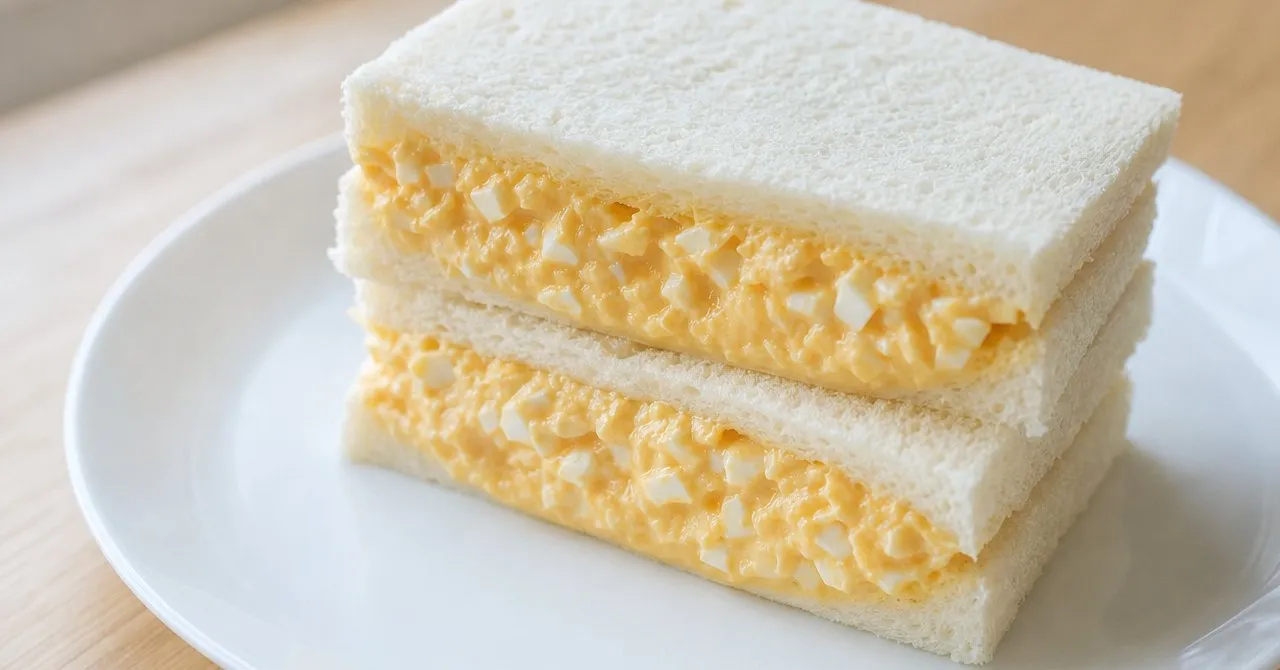
Allrecipes reports that some people claim to have flown 6,700 miles for a Japanese convenience-store egg sandwich. In December 2025, the same outlet reported that 7-Eleven was bringing its Japanese egg sandwich to the US. In early 2026, 7-Eleven Canada launched a version “inspired by 7-Eleven Japan’s best-selling sandwich.”
Plenty of good English-language recipes already exist. This one follows the published method of Kewpie, the Japanese mayonnaise company. Allrecipes and 7-Eleven Canada both say Kewpie mayo goes into the North American store versions. It also explains the ingredients an American kitchen handles differently: the bread, the egg sizes, and the mayonnaise.
The short answer
- The bread is thin. Kewpie calls for 10-slice bread, meaning a loaf cut into ten slices, which it puts at about 12 mm (½ inch). It recommends a loaf with a square cross-section.
- Yolks and whites are handled separately. The yolks are mashed smooth with the seasonings. The whites are chopped and folded in at the end.
- The eggs are Japanese size M or smaller. Kewpie says larger eggs carry more white, which makes the filling watery.
- Butter goes on first. In Kewpie’s explanation, the butter forms a film that keeps moisture from the filling from soaking into the bread.
- Keep it cold. The USDA says hard-cooked eggs should be refrigerated within 2 hours of cooking. The boiled eggs are fully cooked, so the raw-egg concerns behind tamago kake gohan don’t apply to them.
How it reached North American stores
Allrecipes wrote that “for the first time ever, 7-Eleven is bringing one of its most popular and beloved Japanese products to the U.S.” The rollout covered participating 7-Eleven stores, plus the Speedway and Stripes chains. The same piece noted that “some claim they’ve flown 6,700 miles just to get a taste” of it, linking to a TikTok post.
Anthony Bourdain was a fan of the genre, too. As Foodie reported, he posted on X about “the Unnatural, Inexplicable Deliciousness of the Lawson’s egg salad sandwich.” Lawson is a different Japanese chain, so the sandwich isn’t one company’s signature.
7-Eleven Canada tied its launch to travel, noting that “a record-breaking 580,000 Canadians visited Japan in 2024.” (We found no official 7-Eleven Japan sales figures; “best-selling” is 7-Eleven Canada’s word.)
Kewpie’s tamago sando, adapted
Adapted from Kewpie’s published recipe, たまごサラダサンドの基本レシピ (Basic Egg Salad Sandwich). Egg boiling follows Kewpie’s companion page, ゆで卵の基本レシピ (Basic Boiled Eggs). This site has not kitchen-tested the adaptation.
Makes 2 sandwiches (serves 2)
| Ingredient | Amount | Note |
|---|---|---|
| Soft white sandwich bread | 4 slices, about 12 mm (½ inch) thick | Kewpie specifies “10-slice” bread |
| Eggs | 3 | Japanese size M or smaller (see egg sizes below) |
| Kewpie mayonnaise | about 45 g (3 tbsp) | Kewpie gives about 15 g per tablespoon |
| Sugar | 1 pinch | |
| Salt | a little | |
| Pepper | a little | |
| Butter | 1 tbsp (15 mL), softened | |
| To serve (optional) | 4 lettuce leaves, 4 cherry tomatoes | Kewpie lists these as sides |
1. Soften the butter
Take the butter out of the refrigerator first so it spreads without tearing the bread.
2. Boil the eggs for 13 minutes
Kewpie’s sandwich recipe says simply:
卵は13分くらいの固ゆでにする — Hard-boil the eggs for about 13 minutes. — Kewpie, Basic Egg Salad Sandwich
The sandwich page says to adjust for egg size and preference, but not whether to start in cold or boiling water. Kewpie’s boiled-egg page, which uses Japanese M eggs and the same 13 minutes for hard-boiled, fills that in:
- Bring enough water to a boil to cover the eggs well. Just before the eggs go in, Kewpie adds 1 tbsp vinegar and ⅓ tsp salt to the water.
- Use eggs straight from the refrigerator. Kewpie says their consistent starting temperature makes results more predictable.
- Make a small hole in the rounded end (where the air pocket is) with a pushpin, or crack it gently with the back of a spoon.
- Lower the eggs in with a ladle. For the first 2 minutes, roll them gently with chopsticks to help center the yolks.
- Keep the water from boiling hard. Cook 13 minutes for hard-boiled (Kewpie gives 8 for soft, 11 for medium).
- Chill in cold water. Once cool, peel under water, letting it run between the membrane and the white.
3. Mash the yolks, chop the whites
Separate the yolks from the whites. Mash the yolks until smooth, then mix in the mayonnaise, sugar, salt, and pepper until you have a paste. Kewpie says both the pasty yolk and the pinch of sugar add richness (koku).
Kewpie’s page says two things about the whites. The numbered step says to mince them (みじん切り), and the tip below it says:
白身は粗く刻みます — Chop the whites coarsely. — Kewpie, Basic Egg Salad Sandwich
Either way, the whites stay in visible pieces and are not mashed with the yolks. Fold the chopped whites into the yolk paste.
4. Butter, fill, and leave a border
Spread butter on one side of each slice. Spoon the filling onto two of the slices. Use the back of the spoon to keep it mounded in the center, and leave a margin of about 1 cm (⅜ inch) from the crust so it doesn’t squeeze out. Top with the other slices so the butter faces the filling.
5. Press, trim, and cut
Press gently to settle the filling. Trim off the crusts and cut into pieces.
包丁を前後に動かしながら切りましょう — Cut while moving the knife back and forth. — Kewpie, Basic Egg Salad Sandwich
Kewpie recommends a long, sharp knife rather than a bread knife. It explains that a bread knife’s wavy edge lets the filling slip. Wipe the blade between cuts for clean edges.
Useful but not in Kewpie’s method: a ruler to check slice thickness. RecipeTin Japan pushes its yolks through a fine sieve; Kewpie mashes.
The bread: thickness is in the name
In Japan, sliced bread is sold by how many slices a loaf has been cut into: 4-slice, 5-slice, 6-slice, 8-slice, and so on. The higher the number, the thinner the slice. The count is the thickness.
| Japanese cut | Approximate thickness | Source |
|---|---|---|
| 4-slice (4枚切り) | about 3 cm (1¼ inches) | All About editorial guide |
| 5-slice (5枚切り) | about 2.5 cm (1 inch) | All About editorial guide |
| 6-slice (6枚切り) | about 2 cm (¾ inch) | All About editorial guide |
| 8-slice (8枚切り) | about 15 mm (⅝ inch) | Kewpie |
| 10-slice (10枚切り) | about 12 mm (½ inch) | Kewpie |
| 12-slice (12枚切り) | about 10 mm (⅜ inch) | Kewpie |
The All About figures are a rule of thumb that assumes a loaf about 12.5 cm (5 inches) square. Kewpie lists both 10-slice and 12-slice as sandwich cuts.
What this means for a US loaf. Your bread bag doesn’t tell you thickness this way, so measure a slice. You’re looking for about ½ inch. If yours is thicker, slice an unsliced loaf yourself, or accept a breadier sandwich. RecipeTin Japan, for example, uses 1.5 cm (⅝ inch) slices.
Why a square loaf
たまごサンドイッチには、切った断面が四角形の「角食パン」がおすすめです — For egg sandwiches, we recommend kaku-shokupan, a loaf whose cut face is square. — Kewpie, Basic Egg Salad Sandwich
Kaku-shokupan is shokupan baked into a square block, much like an American Pullman loaf. Kewpie recommends it for its soft, fine crumb.
Is shokupan “milk bread”?
Many English-language pages say so. 7-Eleven Canada describes its bread as “fresh shokupan (milk bread).” Allrecipes calls the US sandwich’s bread “soft and fluffy milk bread.” RecipeTin Japan writes “Shokupan is Japanese milk bread.”
One Japanese official definition frames it differently. Saitama Prefecture’s certification standard for bread defines 食パン (shokupan) by how it’s baked: dough put into a loaf pan, rectangular or cylindrical, and baked. Milk and dairy appear in its list of permitted ingredients, but they aren’t what makes a loaf shokupan. (That standard covers the prefecture’s own certification program, not national law.) Plenty of shokupan contains milk, so the shorthand is understandable; it just isn’t the definition. We cover this in detail in Shokupan Isn’t “Milk Bread”: What Japanese Sandwich Bread Actually Is.
Egg sizes: Japan’s M is not America’s medium
Kewpie’s egg advice is specific:
卵はMサイズ以下がおすすめです — We recommend eggs of size M or smaller. — Kewpie, Basic Egg Salad Sandwich
The reason it gives is that with L eggs, there’s more white, and the filling tastes watery. The two countries define egg sizes differently, though. Japan sets a weight range for each individual egg. The US sets a minimum weight for a dozen.
| Japan (MAFF standard, per egg) | Weight | US (USDA, minimum per dozen) | Per-egg average at that minimum |
|---|---|---|---|
| L | 64 g to under 70 g | Extra Large: 27 oz | about 64 g (2¼ oz) |
| M | 58 g to under 64 g | Large: 24 oz | about 57 g (2 oz) |
| MS | 52 g to under 58 g | Medium: 21 oz | about 50 g (1¾ oz) |
| S | 46 g to under 52 g | Small: 18 oz | about 43 g (1½ oz) |
Rows are lined up for rough comparison only; the two systems don’t map exactly. Per-egg figures are our arithmetic: the USDA dozen minimum divided by 12. The USDA notes that size refers to the dozen’s weight, so individual eggs vary.
So Kewpie’s “M or smaller” means eggs under 64 g (about 2¼ oz). In US terms, that’s roughly a large or medium egg, not extra large or jumbo. If you only have extra-large or jumbo eggs, Kewpie’s reasoning predicts a wetter filling, since bigger eggs carry more white. Kewpie doesn’t publish a boiling time for US sizes, so treat the 13 minutes as written for Japanese M eggs.
The mayonnaise question
Kewpie’s recipe calls for Kewpie mayonnaise, as you’d expect. But there are two products under that name in the US. The Japanese Kewpie (the 450 g bottle Kewpie sells in Japan) uses egg yolks and Kewpie’s own vinegar. The US-made Kewpie, labeled “Product of USA,” lists rice vinegar and sugar, which the Japanese label doesn’t. Both labels list an amino-acid seasoning (MSG on the US label, 調味料(アミノ酸) on the Japanese one). Both are legitimate products with different recipes. Kewpie’s sandwich recipe was written for the Japanese one. The full comparison is in The Vinegar in Japanese Kewpie Mayo Isn’t Rice Vinegar.
RecipeTin Japan makes the case for Japanese mayo plainly: “If you use Western-style mayonnaise, it will completely change the flavour of the egg sandwich.” That’s a flavor judgment, not a rule. American mayonnaise makes a perfectly good egg salad sandwich; it just isn’t this one.
Kewpie’s other egg sandwich: the thick omelet version
Not every Japanese egg sandwich is egg salad. Kewpie publishes a second basic recipe, 厚焼きたまごサンド (atsuyaki tamago sando), a thick-omelet sandwich. It uses a slab of soft, dashi-seasoned omelet instead of a mash.
For two servings, Kewpie uses two slices of 8-slice bread (about 15 mm, or ⅝ inch) and 3 eggs. The eggs are seasoned with ½ tsp granulated Japanese dashi, 50 mL (about 3 tbsp + 1 tsp) water, 1 tsp (about 3 g) sugar, and a little salt, and cooked in 1 tsp vegetable oil. The bread is spread with 1 tbsp mayonnaise mixed with ½ tsp Japanese mustard (karashi). The eggs are stirred in a tamagoyaki pan until half set, then covered and cooked on low for about a minute. Off the heat, the omelet is folded to the size of the bread and left covered for about 2 minutes, then flipped and left for about 1 more. The omelet is sandwiched once slightly cooled, wrapped for about 5 minutes, then trimmed and cut.
Kewpie’s page doesn’t tie this style to any region of Japan. For more on the stock that seasons it, see Dashi Isn’t Fish Stock.
How other English-language recipes differ
There’s no single correct tamago sando. RecipeTin Japan’s version, for example, differs from Kewpie’s in several ways:
| Kewpie (published recipe) | RecipeTin Japan | |
|---|---|---|
| Eggs | 3, boiled 13 minutes | 4, steamed 12–13 minutes (boiling also offered) |
| Yolks | Mashed smooth | Pushed through a fine sieve |
| Whites | Chopped (step says minced, tip says coarse) | Finely diced |
| Seasoning | Mayo, a pinch of sugar, salt, pepper | Mayo, sugar, salt, rice wine vinegar, optional Ajinomoto (MSG) |
| Bread | 10-slice, about 12 mm | Shokupan about 1.5 cm |
Both separate the yolks and whites, and both rely on Japanese-style mayonnaise. The differences are choices, not errors. Ours is to start from the method the mayonnaise maker publishes.
Food safety: cooked eggs, then keep it cold
This sandwich uses fully cooked eggs. The USDA’s advice is to “always cook eggs until both the white and yolk are firm,” and Kewpie classes 13 minutes as hard-boiled. The raw-egg concerns behind dishes like tamago kake gohan don’t apply to the boiled eggs.
What matters is time and temperature after cooking. US federal guidance says:
- Refrigerate hard-cooked eggs within 2 hours of cooking and use them within a week (USDA FSIS).
- Egg salad keeps 3 to 4 days in a refrigerator at 40°F (4°C) or below, and it doesn’t freeze well (FoodSafety.gov’s cold storage chart).
- Don’t leave perishable food between 40°F and 140°F (4°C–60°C) for more than 2 hours. Above 90°F (32°C), the limit is 1 hour (USDA FSIS).
- Packing it for later? The USDA says to keep cold food at or below 40°F (4°C) in the refrigerator, in coolers, or in containers on ice.
In short: make it, chill it, and eat it within the limits above.
FAQ
What is tamago sando? Tamago means egg and sando is the Japanese shortening of “sandwich.” In English it usually refers to the egg salad version sold in Japanese convenience stores; Kewpie also publishes a thick-omelet version.
How do you make the 7-Eleven egg sandwich at home? We found no recipe published by 7-Eleven. A manufacturer’s method you can follow is Kewpie’s: thin square bread about 12 mm (½ inch) thick, eggs boiled about 13 minutes, yolks mashed with Kewpie mayo, a pinch of sugar, salt, and pepper, then whites chopped and folded in. Butter the bread, trim the crusts, and cut with a long, sharp knife.
Why is Japanese egg salad so creamy? In Kewpie’s method, the yolks are mashed into a smooth paste with the mayonnaise before the whites go in. Kewpie also recommends eggs no larger than Japanese M, because larger eggs have more white and make the filling watery.
What bread should I use for tamago sando? Soft, fine-crumbed white bread, ideally from a square (Pullman-style) loaf, sliced about 12 mm (½ inch) thick. Kewpie specifies Japanese “10-slice” bread. Measure a US slice to compare.
Can I use American mayonnaise? Yes, and you’ll get a good egg salad sandwich. But Kewpie’s recipe is built on Kewpie mayonnaise, and RecipeTin Japan says Western-style mayo will “completely change the flavour.” Japanese and US-made Kewpie also have different ingredient lists. See our Kewpie article.
How this article was researched
The recipe is adapted from Kewpie’s Japanese-language published recipes: the basic egg salad sandwich, the basic boiled egg, and the basic thick-omelet sandwich. It has not been kitchen-tested by this site. Egg size classes come from Japan’s Ministry of Agriculture, Forestry and Fisheries and from the USDA. Food-safety guidance comes from USDA FSIS and FoodSafety.gov. Bread-thickness figures come from Kewpie and an All About editorial guide, and the shokupan definition from Saitama Prefecture’s certification standard. Popularity details come from Allrecipes and 7-Eleven Canada. Japanese quotations are kept short and translated by us. Per-egg weights for US sizes are our own arithmetic from USDA dozen minimums.
Sources
Japanese sources:
- キユーピー — たまごサラダサンドの基本レシピ (Kewpie: Basic Egg Salad Sandwich)
- キユーピー — ゆで卵の基本レシピ (Kewpie: Basic Boiled Eggs)
- キユーピー — 厚焼きたまごサンドの基本レシピ (Kewpie: Basic Thick-Omelet Sandwich)
- キユーピー — マヨネーズの原料 (Kewpie: Mayonnaise ingredients)
- キユーピー — キユーピー マヨネーズ 450g 商品情報 (Kewpie: product page, 450 g)
- 農林水産省 — 鶏卵の規格 (MAFF: egg size standards)
- 埼玉県 — パン類の認証基準 (Saitama Prefecture: certification standard for bread)
- All About — 「よく買う食パンの厚さ」はどれ? (All About: bread slice thickness)
US government sources:
- USDA FSIS — Shell Eggs from Farm to Table
- FoodSafety.gov — Cold Food Storage Charts
- USDA FSIS — USDA Urges Consumers to Keep Clear of the Danger Zone This Summer
Companies and press:
- 7-Eleven Canada — Japanese-Style Egg Salad Sandwich Launches in 7-Eleven Canada
- Allrecipes (republished on AOL) — 7-Eleven Is Finally Bringing the International Product Fans Begged for to the U.S.
- Foodie (republished on AOL) — Anthony Bourdain Was Mystified By This Japanese Sandwich’s ‘Inexplicable Deliciousness’
- Kewpie USA product page — KEWPIE Mayonnaise, 12 fl oz
English-language recipe example:
See also: The Vinegar in Japanese Kewpie Mayo Isn’t Rice Vinegar, Shokupan Isn’t “Milk Bread”: What Japanese Sandwich Bread Actually Is, and Cooking Japanese Recipes in an American Kitchen.