Tempura and Tentsuyu: How Japan Does It
Japanese flour makers explain tempura batter: cold water, soft flour, barely mixed. Plus frying temperatures by ingredient and a 5:1:1 tentsuyu.
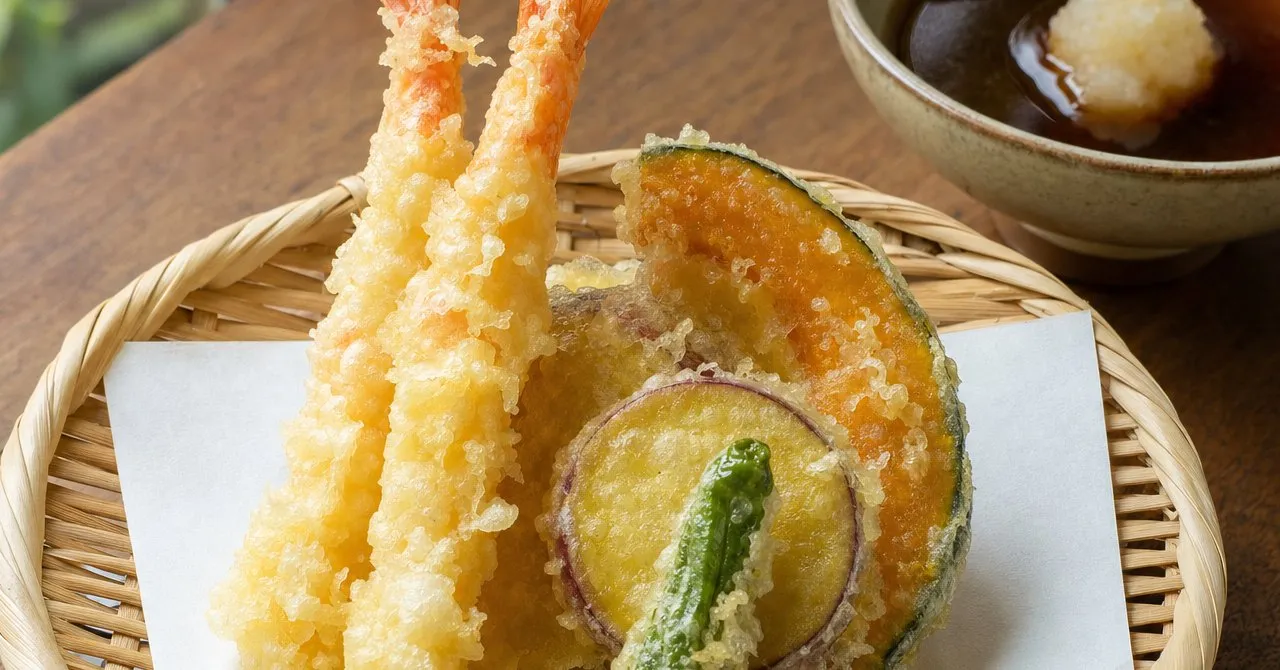
Tempura batter breaks most of the rules people learn for batters. You don’t whisk it smooth, you don’t let it rest, and you don’t make it ahead. Japan’s big flour millers explain why, and it comes down to one thing: gluten.
The short answer: use cold water and a soft, low-protein flour. Mix only until the flour is barely combined, and make the batter right before it goes into the oil. Then fry vegetables a little cooler than seafood, and serve with a thin dipping sauce of dashi, soy sauce and mirin.
Some well-known English-language sources already say much of this. Just One Cookbook’s tempura page, for example, says the batter should be ice-cold and contain some lumps. This page adds the Japanese sources behind those rules: the numbers from flour makers and Japan’s agriculture ministry, and a tentsuyu ratio you can scale.
Why tempura batter is different: gluten
Wheat flour contains proteins that form gluten when they meet water. In bread, you want that. In tempura, you don’t.
Two Nisshin sources appear throughout this article. Nisshin Seifun Group, one of Japan’s largest flour millers, publishes a tempura guide (“Nisshin’s guide” below). Its recipe arm, Nisshin Seifun Welna, publishes a basic tempura recipe (“Nisshin’s recipe”). The guide puts the problem plainly:
小麦粉(薄力粉)に水を混ぜて時間が経つと、グルテン(粘り)が発生します。 — When you mix flour (soft flour) with water and time passes, gluten (stickiness) develops. — Nisshin Seifun Group
Nisshin’s guide says that when too much gluten develops, the tempura doesn’t fry up crisp and loses both looks and texture. Showa Sangyo, another Japanese flour and oil maker, describes the result of overmixing as a heavy, thick finish (ぼってり, botteri).
A 2019 paper in the Journal of Cookery Science of Japan frames tempura the same way. It calls suppressing gluten formation the key point of making tempura. That’s why the authors tested barley, buckwheat and Job’s-tears flours, which don’t form gluten in a batter the way wheat does. (Barley still counts as a gluten-containing grain under FDA labeling rules, so it is not an option for a gluten-free diet.)
Everything in a Japanese tempura batter method follows from keeping gluten low.
Four rules, and the reason for each
| Rule | What Japanese sources say | Why |
|---|---|---|
| Cold water | Showa Sangyo: cold water is used so that gluten doesn’t develop. Nisshin’s guide suggests adding ice. | Nisshin’s guide says lukewarm water makes gluten form readily, and notes that 77–86°F (25–30°C) is said to be the range where gluten forms most easily. |
| Soft flour (薄力粉, hakurikiko) | Nisshin’s recipe specifies soft flour. Showa Sangyo explains that more gluten makes a stickier batter. | Less protein means less gluten. |
| Barely mix | Nisshin’s guide: mix lightly with chopsticks or a whisk; not mixing too much is “the iron rule,” and small lumps are fine. | Every stir develops more gluten. |
| Make it last | Nisshin and Showa Sangyo both say to make the batter just before frying. | Showa Sangyo says batter that sits won’t fry up crisp. Nisshin’s guide explains why: gluten keeps developing over time. |
Two smaller steps also come from these sources. Sift the flour first. Nisshin’s guide says it prevents large lumps, and Showa Sangyo says it adds air for a lighter coating. Nisshin’s recipe suggests sifting two or three times. And dust wet ingredients with flour before battering. Nisshin’s guide recommends this for lotus root and other watery vegetables, mushrooms and seafood, so the flavor stays in. Its recipe dusts seafood so the batter coats evenly.
For shrimp, Nisshin’s guide adds a caution: wipe off only the surface moisture. Dry them too thoroughly and you take flavor with the water.
About “hakurikiko” in the US
Hakurikiko is Japan’s soft, low-protein wheat flour, the type Japanese flour makers specify for tempura. We have not compared US flour brands’ protein levels, so we can’t name an exact equivalent. The principle from the Japanese sources is simple: the lower the protein, the less gluten. If you have a choice, use the softest, lowest-protein wheat flour you can find, and check the protein figure on the label.
Tempura flour (天ぷら粉)
Japanese stores also sell premixed tempura-ko. According to Showa Sangyo, it is blended with starch and other ingredients to lower the protein, so less gluten forms. It already contains egg powder, so you add only water, and the coating stays crisp longer. Nisshin’s guide notes that tempura flour contains baking powder, so its batter floats faster in the oil than plain-flour batter.
Frying temperature: vegetables cooler, seafood hotter
Nisshin’s tempura guide and Japan’s agriculture ministry give the same pattern: vegetables a little cooler, seafood a little hotter and faster. Single recipes often use one temperature, such as Nisshin Seifun Welna’s 338–356°F (170–180°C) for everything.
| Source | Vegetables | Seafood / meat |
|---|---|---|
| Nisshin Seifun Group (guide) | 320–338°F (160–170°C) | 338–356°F (170–180°C), fried briefly |
| Japan’s agriculture ministry (MAFF) | About 338°F (170°C) | Meat and fish about 347–356°F (175–180°C) |
| Nisshin Seifun Welna (recipe) | Any ingredient: 338–356°F (170–180°C) | |
| Oita city kakiage recipe | Mixed kakiage with shrimp: 356°F (180°C) |
Nisshin’s guide gives the reasons. Vegetables burn easily, so a slightly lower temperature protects their color and flavor. Seafood goes in hotter for a short fry. For kakiage (mixed fritters), the guide suggests about 320°F (160°C) when the batter is thin, and about 338°F (170°C) when seafood is in the mix.
Japan’s agriculture ministry gives the same pattern in its consumer Q&A on home frying:
揚げ油は野菜が170℃くらい、肉や魚は175~180℃くらいが基本になります。 — As a baseline, frying oil should be about 170°C for vegetables and about 175–180°C for meat and fish. — Ministry of Agriculture, Forestry and Fisheries
No source we cite gives a frying order. Our own reasoning: because the vegetable range is lower, frying vegetables first means you only raise the heat, never lower it.
Reading the oil without a thermometer
Nisshin’s guide describes a way to judge the oil by dropping in a little batter, in three stages:
| What the batter does | Temperature |
|---|---|
| Sinks to the bottom, then slowly floats up | Low: 302–320°F (150–160°C) |
| Sinks partway, then rises | Medium: 338–356°F (170–180°C) |
| Floats almost immediately | High: 356–374°F (180–190°C) |
This is a useful check, but a deep-fry thermometer gives you an actual number. Remember that tempura-flour batter floats faster because of its baking powder, so the test reads differently with a mix.
Don’t crowd the pot. Nisshin’s guide says to fill about half the oil’s surface at a time.
The basic batter
Adapted from Nisshin Seifun Welna’s recipe “Tempura (using soft wheat flour).” Serves 4.
Batter
- 100 g (3.5 oz) soft wheat flour (hakurikiko)
- 1 egg (about 50 g)
- 150 mL (about ½ cup + 2 tbsp) water
To fry
- Shrimp, sweet potato, or other ingredients of your choice
- A little extra flour, for dusting seafood
- Frying oil
Method
- Sift the flour two or three times.
- Pat seafood lightly dry and dust it with flour, so the batter coats evenly.
- Heat the oil to 338–356°F (170–180°C).
- Make the batter just before frying. Mix the egg and water in a bowl. Add the flour and stir lightly with thick chopsticks, stopping while a little flour still shows.
- Dip the ingredients in the batter and fry them in the hot oil.
Nisshin’s recipe gives no frying times.
Notes from Nisshin Seifun Group’s tempura guide (a separate page from the recipe above):
- Use cold water; the guide suggests adding ice.
- Dust watery vegetables such as lotus root, and mushrooms, with flour too. Potatoes and similar starchy vegetables don’t necessarily need it.
- Wipe only the surface moisture from shrimp.
- If you want to split temperatures, the guide fries vegetables at 320–338°F (160–170°C) and seafood at 338–356°F (170–180°C).
- Fill no more than about half the oil’s surface at a time.
How other Japanese batters compare
Nisshin’s batter has about twice as much liquid (egg plus water) as flour by weight. Yamasa’s large batch is close, at 1 L water to 500 g flour plus one yolk. Not every Japanese recipe uses egg, though. A kakiage recipe on the Oita city website, from the culinary course at Yōshikan High School, tosses the ingredients in 36 g of flour. It then makes the batter from 50 g of flour and 150 mL of water, with no egg.
Tentsuyu: the dipping sauce
Tentsuyu (天つゆ) is a thin dipping sauce of dashi, soy sauce and mirin. Most of it is dashi, so it is far thinner than a teriyaki glaze. In the Japanese recipes we cite for teriyaki, the glaze is soy sauce and mirin (sometimes sake) with no dashi (see Teriyaki Is Not a Sauce).
Two Japanese recipes we found give exact amounts:
| Source | Dashi | Soy sauce | Mirin | Ratio |
|---|---|---|---|---|
| Oita city website (recipe from Yōshikan High School’s culinary course) | 200 mL ichiban dashi | 40 mL light-colored (usukuchi) soy sauce | 40 mL | 5 : 1 : 1 |
| Yamasa (soy sauce maker), 4 servings. The liquid before it is gelled. | 300 mL dashi of Rishiri kombu and shaved dried tuna (kezuribushi) | 25 mL regular + 25 mL usukuchi | 50 mL hon-mirin, cooked to drive off the alcohol | 6 : 1 : 1 |
The Yamasa recipe is a creative one. It boils the tentsuyu, chills it, and sets it with a gelling agent, then batters and fries the cubes. Its liquid works out to 6:1:1. Because the recipe sets that liquid, treat it as a data point, not as a dipping-sauce recipe.
Both recipes use usukuchi, at least in part. Despite its pale color, usukuchi is actually about 10% saltier than regular soy sauce. See our guide to Japanese soy sauce types for the difference. If you use only regular (koikuchi) soy sauce, the sauce will be darker and a little less salty.
Tentsuyu recipe
Adapted from the Oita city recipe (5:1:1).
- 200 mL (about ¾ cup + 1½ tbsp) ichiban dashi
- 40 mL (about 2 tbsp + 2 tsp) usukuchi soy sauce
- 40 mL (about 2 tbsp + 2 tsp) mirin
- Put the mirin in a small saucepan over heat and let it bubble until the alcohol cooks off.
- Add the dashi and soy sauce and bring it to a boil once. Then take it off the heat.
Serve with the tempura for dipping.
The dashi, from the same Oita recipe: Wipe 20 g (about 0.7 oz) of kombu with a tightly wrung cloth and make a few cuts in it. Put 1 L (about 4¼ cups) of water in a pot, add the kombu, and heat. Take the kombu out when it starts to float. Add 30 g (about 1 oz) of katsuobushi, turn off the heat once it comes to a boil, and strain when the flakes begin to sink. This makes more dashi than the tentsuyu needs. For more on dashi, see Dashi Is Not Fish Stock.
Grated daikon and ginger
Yamasa’s recipe plates the tempura with small mounds of grated daikon topped with grated ginger, both squeezed of excess water (8 g and 4 g for four servings).
Salt and matcha salt
Tempura isn’t always dipped in tentsuyu. A recipe sheet posted on the Saitama Prefecture website (it doesn’t name the issuing office) about tempura made from fresh tea leaves suggests eating it with salt or matcha salt to taste:
好みで、塩や抹茶塩をつけていただく。 — Eat with salt or matcha salt, as you like. — Recipe sheet on the Saitama Prefecture website
The sheet doesn’t give a ratio for matcha salt, and we didn’t find one in a manufacturer source, so we won’t suggest one here.
Oil safety: what Japan’s stoves do, and what US guidance says
Japan: an automatic cutoff
Since October 2008, Japanese law has required household gas cooktops to have an oil-overheating prevention device, according to Japan’s product-safety agency, NITE. It shuts off the flame before the oil reaches 572°F (300°C). Single-burner tabletop units and commercial cooktops are exempt.
So a cook in Japan frying on a post-2008 gas cooktop has an automatic cutoff as a last-resort backstop. It only trips near 572°F (300°C), well above frying temperatures. We have not verified whether US ranges are required to have anything comparable. A thermometer clipped to the pot is the reliable way to hold the temperatures above. Our guide to cooking Japanese recipes in an American kitchen covers this and other stove differences.
US: what USDA and NFPA say
The USDA Food Safety and Inspection Service notes that deep-frying oil can reach temperatures of over 400°F (about 204°C). On grease fires, it is direct:
“In the event of a grease fire, never use water to put out the fire.”
USDA says a kitchen fire extinguisher, or covering the fryer with a metal lid, is the best way to put out a grease fire. It also says to call 911 immediately if one occurs.
The National Fire Protection Association (NFPA) says cooking fires are the number-one cause of home fires and home injuries. Its Cooking Safety tip sheet (©2016, as reprinted by the Village of Penn Yan) says to stay in the kitchen while you are frying. For a small grease fire in a pan, it advises sliding a lid over the pan and turning off the burner, then leaving the pan covered until it has completely cooled.
Reusing oil: USDA says to strain used oil through cheesecloth or a sieve and store it in a sealed, light-proof container for up to 3 months. Discard it if it turns cloudy, foams, or smells or tastes off.
One note on USDA’s numbers: its “Approximate Cooking Times” chart lists shrimp at 320°F (160°C) for 4–6 minutes and fish fillets at 320°F (160°C) for 3–5 minutes. It is general frying guidance, not a tempura method. Nisshin’s guide fries battered seafood hotter, at 338–356°F (170–180°C), and for a short time.
FAQ
Why does tempura batter use ice water? To slow gluten. Japanese flour makers Nisshin and Showa Sangyo both say cold water is used to keep gluten from developing. Nisshin’s guide notes that gluten is said to form most readily at 77–86°F (25–30°C).
Should tempura batter be lumpy? A little, yes. Nisshin’s guide says small lumps are fine, and Nisshin’s recipe stops mixing while a little flour still shows. Overmixing develops gluten and makes the coating heavy, according to Showa Sangyo.
What temperature should oil be for tempura? Nisshin’s guide fries vegetables at about 320–338°F (160–170°C) and seafood at about 338–356°F (170–180°C). Japan’s agriculture ministry gives about 338°F (170°C) for vegetables and 347–356°F (175–180°C) for meat and fish. Nisshin’s basic recipe uses 338–356°F (170–180°C) for everything.
What is the ratio for tentsuyu? A dipping-sauce recipe from Oita city uses dashi, soy sauce and mirin at 5:1:1: for 200 mL of dashi, 40 mL each of soy sauce and mirin. Yamasa’s (gelled) tentsuyu works out to 6:1:1.
Can tempura batter be made gluten-free? Japanese researchers have tested rice flour. A small 2019 study in a Japanese university bulletin measured less oil absorption for rice-flour batter than for wheat (about 20–23% vs. 25.5%). Its 38-person taste panel found no significant difference in crispness. The same paper notes that rice flour holds together less well because it lacks gluten. If you need to avoid gluten, also check the soy sauce in your tentsuyu; see Is Tamari Gluten-Free?.
Can I make the batter ahead? Japanese flour makers say no. Both say to make it just before frying. Showa Sangyo says batter that sits won’t fry up crisp, and Nisshin’s guide explains why: gluten keeps developing over time.
How this article was researched
This article draws on Japanese-language primary sources: technical and recipe pages from the flour makers Nisshin Seifun Group, Nisshin Seifun Welna and Showa Sangyo, and a recipe from the soy sauce maker Yamasa. It also uses Japan’s agriculture ministry, a recipe on the Oita city website, a recipe sheet on the Saitama Prefecture website, two Japanese academic papers, and NITE’s product-safety release. US guidance comes from USDA FSIS, the FDA and NFPA. Japanese quotations are kept short and translated by us. The batter recipe is adapted from Nisshin Seifun Welna, with tips from Nisshin Seifun Group’s guide listed separately. The tentsuyu follows the Oita city recipe’s amounts and method. Neither recipe has been kitchen-tested by this site.
Sources
Japanese manufacturers:
- 天ぷら|こむぎ粉料理の基礎とコツ — Nisshin Seifun Group, tempura guide
- 天ぷら(薄力小麦粉使用) — Nisshin Seifun Welna, tempura recipe
- 天ぷら粉と小麦粉の違いとは? — Showa Sangyo, tempura flour vs. wheat flour
- 食べる”天つゆ”天ぷら — Yamasa, tempura of gelled tentsuyu
Japanese government:
- 家庭で揚げ物をする際に、どうすれば上手に揚げることができますか。 — MAFF, home frying Q&A
- かき揚げ(楊志館高校 調理科 提供) — Oita City, kakiage, ichiban dashi and tentsuyu recipe (PDF)
- 「お茶の葉の天ぷら」作り方 — tea-leaf tempura recipe sheet on the Saitama Prefecture website (PDF)
- ガスこんろから目を離さずに! — NITE, gas cooktop safety release, 2018 (PDF)
Japanese academic sources:
- 雑穀粉の天ぷら衣への利用適性 — Taniguchi et al., J. Cook. Sci. Jpn. 52(6), 2019
- 米粉の粒度の違いによる揚げ物の調理性と嗜好について — Tamura et al., rice-flour batter study, Chugoku Gakuen repository, 2019 (PDF)
US guidance:
- Deep Fat Frying and Food Safety — USDA Food Safety and Inspection Service
- Gluten and Food Labeling — FDA
- Cooking — NFPA
- Cooking Safety tip sheet — NFPA (©2016, PDF reprinted by the Village of Penn Yan)
English-language example: