"No MSG" and "No Chemical Seasonings": Why MSG Is Still Argued Over in Japan
MSG was patented in Japan in 1908. How the US and Japan label it, what “No MSG” may and may not mean, and what FDA, JECFA and Japan's regulators say.
In the US, the argument over MSG is tied to the phrase “Chinese Restaurant Syndrome,” and “No MSG” is a claim you can find on packages. Japan, where the product was invented, has its own version of the argument, and it centers on a word. For decades MSG was called kagaku chōmiryō, “chemical seasoning.” Makers began calling it umami chōmiryō, “umami seasoning,” in the late 1980s, yet “no chemical seasonings” was still a common phrase online in 2022, according to J-CAST News.
The short answer: regulators in both countries treat MSG as a permitted food additive. Both have also taken aim at the same kind of label: a product that says it has no MSG, or no seasoning additives, while getting glutamate or other amino acids from another ingredient. The FDA says flatly that such foods “cannot claim ‘No MSG’ or ‘No added MSG.’” Japan’s 2022 guideline flags the practice as potentially misleading and also questions the word “chemical” itself.
The short answer
- MSG began in Japan. Kikunae Ikeda, working from dried kombu, obtained a patent in July 1908, and Ajinomoto went on sale in May 1909.
- Safety positions: The FDA considers added MSG “generally recognized as safe” (GRAS). The FAO/WHO expert committee JECFA set its acceptable daily intake as “not specified” in 1987.
- “No MSG” in the US: Foods with ingredients that naturally contain free glutamate, such as hydrolyzed vegetable protein or yeast extract, can’t say “No MSG” or “No added MSG,” according to the FDA.
- “No chemical seasonings” in Japan: A 2022 Consumer Affairs Agency guideline says additive labeling that uses words like “chemical” and “natural” can’t be considered appropriate, and flags claims of no seasoning additives on foods made with extracts that contain amino acids.
- On Japanese labels, MSG can appear under the group name 調味料(アミノ酸), “seasoning (amino acids).”
Where MSG came from: Ikeda, kombu and Ajinomoto
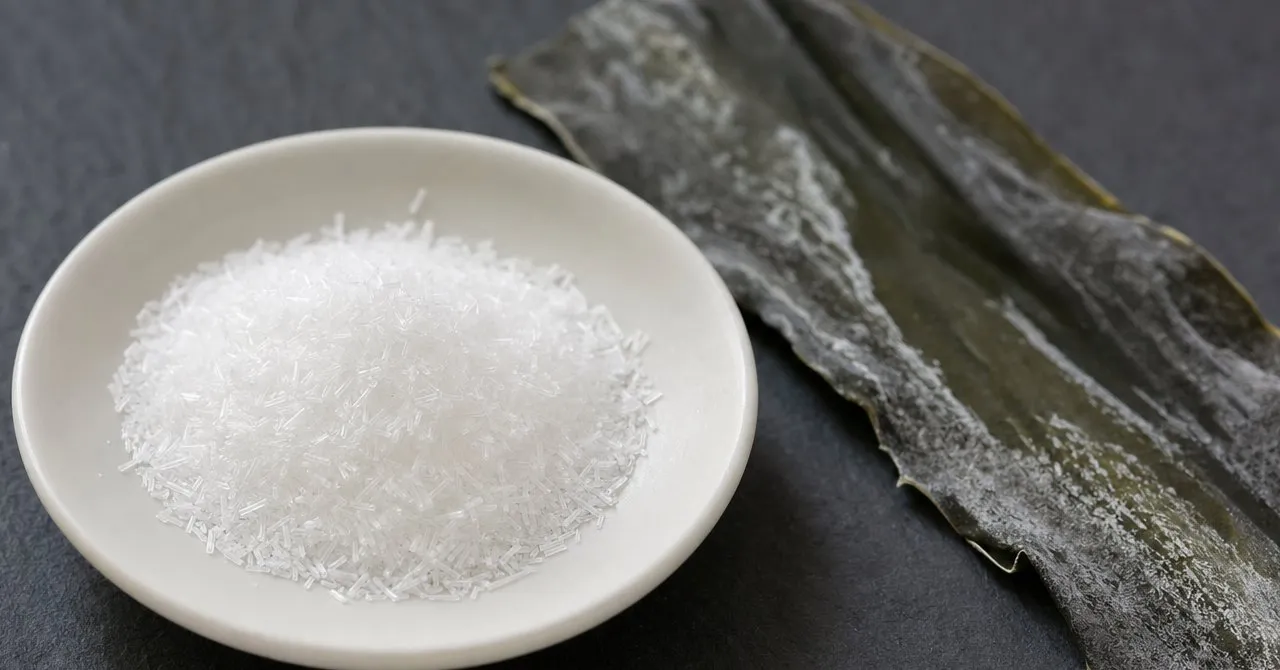
Kombu, the kelp at the base of Japanese dashi, is rich in glutamate. The Umami Information Center, a Japanese nonprofit, describes how the chemist Kikunae Ikeda began:
池田は乾燥したコンブを出発材料としました。 — Ikeda used dried kombu as his starting material. — Umami Information Center
The center dates the discovery to 1908. It says Ikeda’s idea began with a bundle of dashi kombu in the spring of 1907, and that he applied for a patent in April 1908, which was registered on July 25, 1908. Ajinomoto’s company history picks up from there:
| Date | Event (per Ajinomoto’s company history) |
|---|---|
| July 1908 | Ikeda obtains a patent for a seasoning manufacturing method |
| September 1908 | Saburosuke Suzuki II signs a patent-sharing agreement with Ikeda and decides to commercialize the product |
| December 1908 | The first prototype of monosodium glutamate is made |
| March 1909 | Production is completed at the Zushi factory |
| May 1909 | General sale begins |
The early process broke down the raw material with hydrochloric acid, the history notes. The FDA describes a different method: MSG “is produced by the fermentation of starch, sugar beets, sugar cane or molasses.”
Glutamate is one umami compound among several; katsuobushi supplies inosinate and dried shiitake guanylate. See our guide to the types of umami.
“Chinese Restaurant Syndrome”: the 1968 letter and what came after
In April 1968, a doctor named Robert Ho Man Kwok wrote a letter to the New England Journal of Medicine under the title “Chinese-restaurant syndrome.” According to the Science History Institute’s magazine, Distillations, he described his heart racing and feeling weak and numb afterward. Newspapers then ran what the magazine calls “breathless stories about so-called Chinese Restaurant Syndrome.” The same piece argues that Americans panicked “only when MSG was linked to Chinese cuisine.”
Since then:
- The FDA says it has received reports of symptoms such as headache and nausea after eating foods containing MSG, but “we were never able to confirm that the MSG caused the reported effects.” A 1990s review the FDA requested from the Federation of American Societies for Experimental Biology (FASEB) concluded that MSG is safe, while noting mild, short-lived symptoms in some sensitive people who consumed 3 grams or more without food. The FDA adds that a typical serving of a food with added MSG contains less than 0.5 grams.
- A 2016 systematic review in The Journal of Headache and Pain (Obayashi and Nagamura) looked at human studies on MSG and headache. The first author, Yoko Obayashi, is affiliated with the International Glutamate Technical Committee (IGTC) in Brussels and works for an MSG manufacturer that belongs to it. According to the paper’s competing-interests statement, the IGTC paid the publication fee; the second author declared no competing interests. Among studies where MSG was given with food, none found a significant difference in headache incidence, with one exception in a single study’s female group. The authors said studies using concentrated MSG solutions may not have been properly blinded, and they concluded that further studies are needed to determine whether a causal relationship exists.
- Merriam-Webster labels “Chinese restaurant syndrome” as “dated, sometimes offensive.” Its usage note says later research has failed to establish a clear link, and that medical literature uses “MSG symptom complex” instead.
None of this makes people who avoid MSG wrong to do so. The FDA itself describes short-term symptoms in some sensitive people, and accurate labels matter most to those who read them closely.
The United States: GRAS, named on the label, and “No MSG”
The FDA’s question-and-answer page on MSG sets out the US rules:
- Status. “FDA considers the addition of MSG to foods to be ‘generally recognized as safe’ (GRAS).”
- Labeling added MSG. Foods with added MSG must list it in the ingredient panel as “monosodium glutamate.” It “cannot be listed as ‘spices and flavoring.’”
- Ingredients with natural free glutamate. The FDA’s examples are hydrolyzed vegetable protein, autolyzed yeast, hydrolyzed yeast, yeast extract, soy extracts and protein isolate, “as well as … tomatoes and cheeses.” These appear on labels under their own names, and the label doesn’t have to say they contain glutamate.
- The “No MSG” claim. Foods with any ingredient that naturally contains it “cannot claim ‘No MSG’ or ‘No added MSG’ on their packaging.”
So under the FDA’s wording, “No MSG” isn’t allowed just because no MSG was added: foods with ingredients that naturally contain free glutamate can’t make the claim either.
Japan: from “chemical seasoning” to “umami seasoning”
The name
Digital Daijisen defines 化学調味料 (kagaku chōmiryō) as the former name of umami seasoning. Heibonsha’s Encyclopedia Mypaedia, as collected on Kotobank, dates the switch and gives the reason:
消費者の天然志向に対応して1980年代後半から,メーカー側は〈うま味調味料〉という名称を採用しはじめた。 — Responding to consumers’ preference for natural products, manufacturers began adopting the name “umami seasoning” in the late 1980s. — 百科事典マイペディア (Heibonsha), via Kotobank
The term also left Japan’s official standards. The Consumer Affairs Agency notes that “chemical seasoning” was once used in JAS (Japanese Agricultural Standards), was removed in 1989, and has never been used in the Food Labeling Standards.
As for the old name’s origin, a 2022 J-CAST News article, citing Japan’s umami seasoning industry association and Ajinomoto, says it began in the mid-1950s on an NHK cooking program, because the public broadcaster couldn’t name brands. We couldn’t open the association’s own page, so treat this as secondhand.
The word still carries weight. J-CAST reported that on a live TBS morning show in February 2022, a comedian joked that a bakery’s bread owed its flavor to “chemical seasoning,” and about ten minutes later the announcer corrected it on air to umami chōmiryō.
The 2022 guideline on “no-additive” labels
On March 30, 2022, Japan’s Consumer Affairs Agency issued the Guideline on Labeling Food Additives as Not Used (食品添加物の不使用表示に関するガイドライン), as an annex to its food labeling Q&A. It is a yardstick for judging whether a “no additives” claim misleads consumers in ways the Food Labeling Standards prohibit, and it says it does not ban such labels across the board. It sorts problem claims into ten types and asked businesses to review labels by the end of March 2024.
Three of the ten types matter for MSG:
| Type | What the guideline describes | Relevance to MSG |
|---|---|---|
| 1 | A bare “no additives” (無添加) claim that doesn’t say what’s absent | A vague “additive-free” label tells you nothing about glutamate |
| 2 | Terms not defined in the Food Labeling Standards, such as “artificial,” “synthetic,” “chemical” or “natural,” used with “no” or “not used” | The guideline’s example is “no artificial sweeteners.” It doesn’t give “no chemical seasonings” as an example, but it discusses the term 化学調味料 in this same section |
| 5 | Saying an additive isn’t used when an ingredient with the same or a similar function is | The guideline’s example: a food made with an extract containing amino acids that says it uses no seasoning as an additive |
Type 5 is Japan’s closest match to the FDA rule: both target claims that a seasoning compound is absent when another ingredient supplies amino acids such as glutamate. The difference is strength. The FDA states a prohibition; the Japanese guideline gives criteria for judging whether a claim misleads.
Reading 調味料(アミノ酸等) on a Japanese label
Japanese labels generally list additives by substance name, in descending order by weight. For some categories, a group name may be used instead. “Seasoning” (調味料) is one of them, according to Osaka Prefecture’s labeling guide. Sapporo’s guidance explains that seasonings fall into four groups: amino acids, nucleotides, organic acids and inorganic salts. When two or more groups are used, the label names the main one and adds 等 (“etc.”), as in 調味料(アミノ酸等). The annex on group names in the national notice on the Food Labeling Standards lists monosodium L-glutamate in the amino-acid seasoning group.
The group name doesn’t say which compound is used. An older health ministry Q&A (1991, partly revised in 2007) says single-component amino acids used as seasonings, such as monosodium L-glutamate, must be labeled as additives. The same Q&A says amino-acid liquid made by breaking down plant or animal protein, without isolating individual amino acids, is treated as a food, like meat extract, so it needs no additive labeling. That is roughly Japan’s counterpart of hydrolyzed vegetable protein.
You can see the difference on real products. Japanese Kewpie mayonnaise lists 調味料(アミノ酸). The 12 fl oz “Product of USA” bottle on Kewpie USA’s official store lists monosodium glutamate (more in our Kewpie article). Ajinomoto’s Japanese Hondashi lists yeast extract among its ingredients and 調味料(アミノ酸等) among its additives.
Safety evaluations: what each agency has said
| Body | Position | Year |
|---|---|---|
| FDA (US) | Added MSG is “generally recognized as safe” (GRAS) | The FDA page doesn’t give the year |
| JECFA (FAO/WHO) | Acceptable daily intake “not specified,” a group ADI covering glutamic acid and its ammonium, calcium, sodium, magnesium and potassium salts | 1987 (31st meeting) |
| Food Safety Commission of Japan | No evaluation of its own as of a 2011 planning document; later reviews found cover MSG from specific GM production strains | 2011; 2014 onward |
JECFA’s 1973 evaluation had set a numerical figure. In Japan, MSG is a designated additive under the Food Sanitation Act. The 2011 Food Safety Commission document, a list of candidate topics for the commission’s own risk assessments, put it this way:
食品安全委員会による評価状況:なし。 — Evaluation status by the Food Safety Commission: none. — Food Safety Commission of Japan, 2011 planning-committee document
The commission has since assessed MSG made with specific genetically modified microbial strains, such as a 2014 draft assessment of a strain used by Ajinomoto. That review compared the product against conventionally produced MSG and didn’t set an intake figure; the commission has published similar drafts for other strains. We did not find a general commission evaluation of MSG itself.
Japan vs. US: the labeling rules side by side
| United States | Japan | |
|---|---|---|
| Who sets the rule | FDA | Consumer Affairs Agency (Food Labeling Standards and its 2022 guideline) |
| How added MSG appears | By name: “monosodium glutamate” | By substance name, or under a group name such as 調味料(アミノ酸) |
| Ingredients with natural glutamate (protein hydrolysates, yeast extract) | Listed under their own names | Amino-acid liquid from hydrolyzed protein is treated as a food, not an additive (per the 1991 ministry Q&A); yeast extract appears among the ingredients, before the additives, on products such as Hondashi |
| “No MSG”-type claim when those ingredients are used | Not allowed: “cannot claim ‘No MSG’ or ‘No added MSG’” | Flagged as potentially misleading (guideline type 5); a yardstick, not a blanket ban |
| Words like “chemical” or “natural” | Not addressed on the FDA’s MSG Q&A page | Called not appropriate for additive labeling (guideline type 2) |
FAQ
Is MSG safe?
The FDA considers added MSG “generally recognized as safe,” and JECFA set its acceptable daily intake as “not specified” in 1987. The FDA also says some sensitive people may have mild, short-term symptoms after 3 grams or more taken without food. This site reports agency positions and doesn’t give medical advice.
What does “No MSG” mean on a US label?
The FDA says foods with ingredients that naturally contain free glutamate, such as hydrolyzed vegetable protein or yeast extract, “cannot claim ‘No MSG’ or ‘No added MSG.’” So the claim is meant to mean more than “no MSG was added.” The label itself is the maker’s statement.
What is “chemical seasoning” in Japan?
Kagaku chōmiryō is the old Japanese name for umami seasonings such as MSG. Makers began using “umami seasoning” in the late 1980s, and the term was dropped from JAS standards in 1989. A 2022 Consumer Affairs Agency guideline says words like “chemical” aren’t appropriate in additive labeling.
Does 調味料(アミノ酸等) mean MSG?
Not necessarily. It’s a group name: a seasoning from the amino-acid group, plus at least one other group. MSG is an amino-acid seasoning, but the label doesn’t name the exact compound. If you want to know, check the maker’s information for that product.
Is “Chinese Restaurant Syndrome” real?
The term comes from a 1968 letter to the New England Journal of Medicine. The FDA says it couldn’t confirm that MSG caused the reported effects, and a 2016 systematic review found no significant difference in headaches when MSG was taken with food, apart from the female group in one study (the first author works for an MSG maker). Merriam-Webster labels the term “dated, sometimes offensive.”
How this article was researched
This article is built mainly on Japanese-language primary sources: the Consumer Affairs Agency’s guideline and labeling notices, Osaka and Sapporo guidance, a health ministry Q&A, Food Safety Commission documents, Ajinomoto, Kewpie, the Umami Information Center and Kotobank. US rules come from the FDA, and the international evaluation from the WHO’s JECFA database. The “Chinese Restaurant Syndrome” history draws on a peer-reviewed, industry-linked systematic review (its conflict of interest is noted in the text), the Science History Institute and Merriam-Webster; the origin of the term “chemical seasoning” is secondhand, via J-CAST News. Japanese quotations are kept short and translated by us. This article reports agency positions and is not medical advice.
Sources
Japanese government and local government:
- 食品添加物の不使用表示に関するガイドライン — Consumer Affairs Agency, guideline on “no additive” labeling, March 30, 2022 (copy hosted by Akita Prefecture, PDF)
- 食品添加物の不使用表示に関するガイドラインが策定されました! — Akita Prefecture, notice of the guideline (PDF)
- 食品添加物の不使用表示に関するガイドライン(案)に関する意見募集 — Consumer Affairs Agency, call for comments on the draft guideline, December 2021
- 食品表示基準について(新旧対照表) 別添 添加物1-4 — national notice on the Food Labeling Standards, annex on group names, comparison table (hosted by Osaka Prefecture, PDF)
- 加工食品の表示:添加物 — Osaka Prefecture, additive labeling on processed foods
- 添加物(一般用加工食品) — City of Sapporo, additive labeling guidance
- 食品添加物表示 Q&A — Japan’s health ministry, food additive labeling Q&A, 1991, partly revised 2007 (hosted by the Japan Food Chemical Research Foundation, PDF)
- 食品安全委員会が自ら行う食品健康影響評価の案件候補について(案) — Food Safety Commission of Japan, planning committee document, 2011 (PDF)
- GLU-No.6株を利用して生産されたL-グルタミン酸ナトリウム 評価書(案) — Food Safety Commission of Japan, draft assessment of MSG made with a GM strain, 2014 (PDF)
International and US government:
- Monosodium L-glutamate — WHO, JECFA evaluation database
- Questions and Answers on Monosodium Glutamate (MSG) — US Food and Drug Administration
Manufacturer and industry:
- 麻布十番の工場で、うま味調味料「味の素®」を試作 — Ajinomoto Group history: the first prototype and launch
- 核酸系うま味物質と相乗作用の発見 — Umami Information Center, the discovery of umami compounds
- 池田菊苗 — Umami Information Center, profile of Kikunae Ikeda
- キユーピー マヨネーズ 450g(商品情報) — Kewpie: product page and ingredient list
- Kewpie USA — official online store, KEWPIE Mayonnaise 12 fl oz (Product of USA)
- 味の素「ほんだし®」 — Ajinomoto: Hondashi product page
Dictionaries:
- 化学調味料 — Kotobank, dictionary entries for “chemical seasoning”
- Chinese restaurant syndrome — Merriam-Webster
Research and reporting:
- Does monosodium glutamate really cause headache? A systematic review of human studies — Obayashi and Nagamura, The Journal of Headache and Pain, 2016
- The Rotten Science Behind the MSG Scare — Science History Institute, Distillations, 2023
- 「化学調味料」は放送禁止用語? TBS生放送で訂正「うま味調味料でした」 — J-CAST News, on a TBS on-air correction, 2022