Why Japan Doesn't Eat Freshwater Fish Raw (and the Exceptions)
Japan's health agencies warn against eating raw fish and crabs from rivers and lakes. The parasites they name, the exceptions, and what the FDA says.
Japan is famous for raw fish, so it’s natural to assume that anything with fins can become sashimi there. If you fish for trout, bass or walleye, you may have wondered whether your catch could go the same way. Japan’s own health agencies give a clear answer for fish and crabs from rivers and lakes: don’t eat them raw.
That isn’t a quirk of taste. Japanese public-health sources name a different set of parasites in freshwater species than the one most people know from ocean fish, and two of them were behind food-poisoning cases in Japan in 2022 and 2023. A few raw freshwater dishes do survive as regional traditions, and the same agencies attach warnings to the fish they’re made from.
What follows is official guidance from both countries, not medical advice.
The short answer
- Japanese health agencies warn against eating raw fish and shellfish from rivers and lakes. A Tokyo health center’s 2025 newsletter puts it in one line: raw freshwater seafood is dangerous.
- The parasites are different from ocean fish. Japanese sources name Gnathostoma roundworms, Metagonimus yokogawai and liver flukes in freshwater fish, and lung flukes in freshwater crabs.
- Japan’s raw freshwater dishes come with warnings. Carp and ayu are named as parasite hosts in official sources, and Japan has a recorded set of infections from eating loach alive.
- Sea-run salmon and trout can carry the Japanese broad tapeworm. Japan’s Food Safety Commission says to cook or freeze them.
- The FDA says even farmed fish raised in freshwater may carry flukes, which enter through the skin rather than the feed, and that flukes appear to resist freezing better than roundworms. Its general advice is that the safest route is to cook seafood.
What Japan’s health agencies say
“Raw freshwater seafood is dangerous”
In March 2025, the Tama-Kodaira Public Health Center, part of the Tokyo Metropolitan Government, devoted its food-safety newsletter to parasites in fish and crabs from rivers and lakes. Its headline is blunt:
淡水(川や湖)でとれた魚介類の生食は危険です! — Eating raw seafood caught in fresh water (rivers and lakes) is dangerous! — Tokyo Metropolitan Tama-Kodaira Public Health Center, March 2025
The newsletter says Anisakis, the roundworm in ocean fish, is the parasite people know. Freshwater crabs and fish such as shirauo (a small, translucent fish) carry parasites too. It describes a lung fluke food-poisoning case in Tokyo in January 2023, in which the patient had eaten raw mitten crab, among other things. Its advice is to cook freshwater seafood through to the center and sanitize knives and cutting boards afterward. It gives no freezing advice.
Japan’s national infectious-disease surveillance report (IASR), published by the National Institute of Infectious Diseases with the health ministry (MHLW), ran a feature in January 2025 on parasites carried by seafood. It recommends freezing fish meant to be eaten raw at −4°F (−20°C) for at least 24 hours, and says cooking at 158°F (70°C) or higher, or freezing, is recommended at home.
The parasites Japanese sources name
| Parasite | What it is | Hosts named in Japanese official sources |
|---|---|---|
| Gnathostoma (顎口虫, gakkōchū) | Roundworm; four species are a concern in Japan | Snakehead, loach, catfish, carp, kokanee, crucian carp, shirauo, ayu, yamame trout; the 2011 Gnathostoma sheet also notes infection from black bass |
| Metagonimus yokogawai (横川吸虫, Yokogawa kyūchū) | Intestinal fluke | Ayu, Japanese dace (ugui), shirauo |
| Liver fluke (肝吸虫, kan-kyūchū) | Fluke | “Freshwater fish,” with no species named in the sources we read |
| Lung flukes (肺吸虫, hai-kyūchū) | Two species reported in Japan | Freshwater crabs: mitten crab (mokuzugani) and Japanese freshwater crab (sawagani) |
The table draws on the Food Safety Commission of Japan’s 2011 hazard sheets, the Tokyo newsletter, the IASR feature and the Aichi Prefectural Institute of Public Health. Some details:
- Gnathostoma. The Food Safety Commission’s sheet says human infection is mainly linked to eating freshwater fish raw. It counts 3,227 human cases reported in Japan through 2004. It also says larvae in fish can be killed by freezing at −4°F (−20°C) for 3 to 5 days, as well as by cooking.
- Black bass. The same sheet, from 2011, notes that infection from black bass had been reported. The Japanese sources don’t say whether bass in US waters carry the same risk, and we found no US source on it.
- Liver fluke. The IASR feature says liver flukes and Metagonimus infect people through freshwater fish, without naming species for the liver fluke. We didn’t find an official Japanese source naming carp, or any other specific fish, as a host of Japan’s liver fluke, so we don’t claim one here.
- Lung flukes are a crab problem. The IASR feature says eating freshwater crabs raw or undercooked is the main route of human infection. It cites a finding that 17% of sawagani sold as food in Tokyo carried one of the two lung fluke species.
Why outbreaks still happen
These aren’t historical curiosities. Between late September and late November 2022, clinics in eastern Aomori Prefecture saw patients with creeping skin eruptions, and Gnathostoma was found in some of the lesions. By May 12, 2023, the local health centers knew of 306 patients. According to Aomori Prefecture, most of them had eaten shirauo without cooking it.
The prefecture’s prevention page tells people to cook freshwater fish, shirauo included. It adds that freezing at −4°F (−20°C) for 3 to 5 days is said to kill the parasites, so fish that seafood businesses have kept under proper temperature control can be eaten safely.
The exceptions Japan does eat raw
Japanese food culture does include raw freshwater dishes. The Food Safety Commission’s Metagonimus sheet says so directly:
日本では淡水魚を生食する習慣があり、各地に横川吸虫が分布する。 — Japan has a custom of eating freshwater fish raw, and Metagonimus yokogawai is found in many regions. — Food Safety Commission of Japan, hazard sheet
Koi no arai (carp “washed” sashimi)
Japan’s agriculture ministry (MAFF) lists koi no arai as one of Fukushima Prefecture’s representative carp dishes, “in which fresh carp is eaten like Sashimi.” Its method: slice the carp thinly, rinse it quickly in hot water at about 108°F (42°C), then plunge it into ice water. The MAFF page doesn’t mention parasites.
Carp, though, is on the official lists. The Food Safety Commission names carp among the fish that transmit Gnathostoma nipponicum, and the Aichi institute lists carp with snakehead, loach and catfish as freshwater fish that carry Gnathostoma larvae. We found no source saying the brief warm rinse in arai is a parasite control. For comparison, the cooking figure in the IASR feature is 158°F (70°C) or higher.
English-language explanations of arai can treat it purely as a texture technique. Sushi Walker’s glossary, for example, explains that the water bath tightens the muscle fibers and gives the flesh a springy bite. That’s accurate, but it isn’t the whole story for carp.
Ayu
Ayu, a small river fish, shows up on two lists. The Food Safety Commission names it as a source of Metagonimus yokogawai when eaten raw or undercooked, and the Tokyo newsletter names it as a host of Gnathostoma nipponicum larvae.
The Metagonimus sheet also mentions a report that slow-freezing ayu at about 27°F (−3°C) for 3 days prevented infection. That’s a reported finding, not an official recommendation, and we haven’t seen it adopted as guidance.
Odorigui: eating small fish alive
Odorigui (踊り食い, “dancing eating”) means swallowing small fish while they’re still alive. Two fish with nearly identical names get mixed up here. The IASR feature points out that the fish famous for odorigui is shirouo (素魚), a goby, while shirauo (白魚) is an entirely different fish in another family.
The official parasite warnings we found name shirauo, including the Aomori outbreak. We didn’t find an official Japanese source on parasites in shirouo, so we can’t say what its risk is either way.
Japan does have an official record of odorigui going wrong, with a different fish. The Aichi institute reports that since the 1980s about 100 cases of Gnathostoma hispidum infection from eating imported loach alive as odorigui have been reported.
Sea-run salmon and trout: the Japanese broad tapeworm
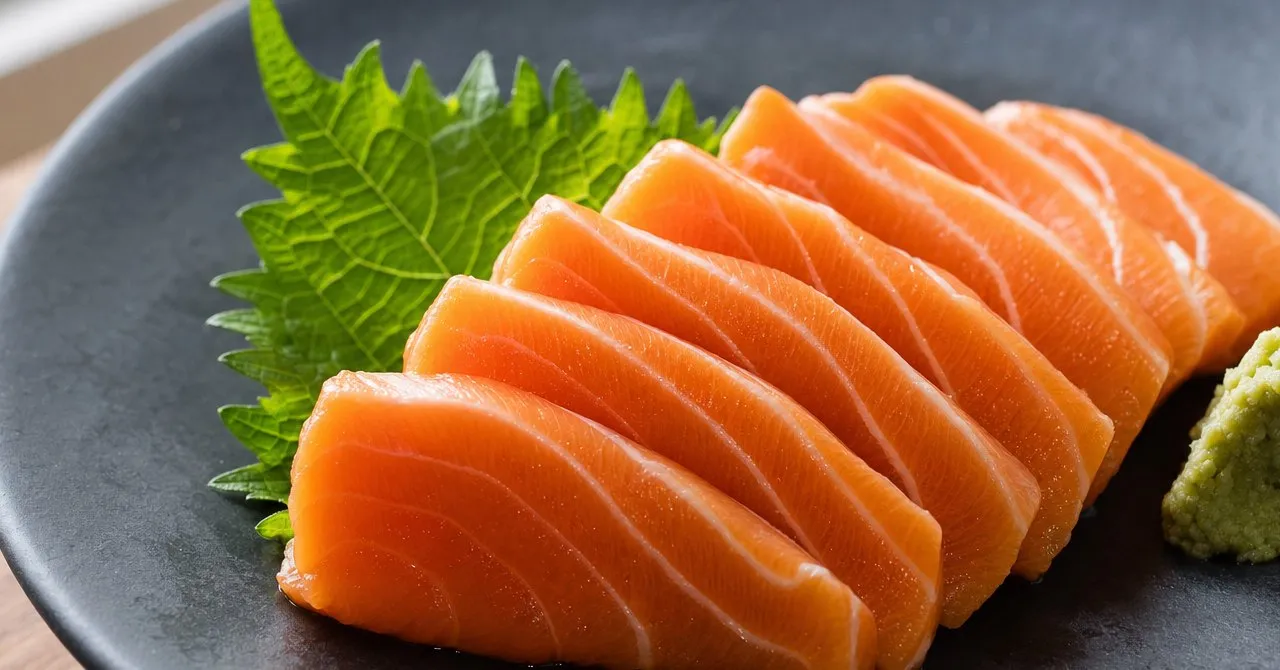
Salmon and trout are a separate case, with a separate parasite. The Food Safety Commission’s tapeworm sheet names the Japanese broad tapeworm (日本海裂頭条虫, Nihonkai rettō jōchū; Diphyllobothrium nihonkaiense in the 2011 sheet, written as Dib. nihonkaiensis in the 2025 IASR feature) and gives masu salmon (sakuramasu) and pink salmon (karafutomasu) as its second intermediate hosts. Sashimi, sushi and masu-zushi (pressed trout sushi) made from Pacific salmon (genus Oncorhynchus) are the foods it lists. The sheet also notes that two of three cases reported in France and Switzerland since 2006 were traced to raw chum salmon imported from Canada.
Its prevention figures: cook to 133°F (56°C) or above, or freeze at −4°F (−20°C) or below for at least 24 hours. The IASR feature estimates 300 to 500 broad tapeworm cases a year in Japan, based on health-insurance data. Of 127 cases sent to NIID for genetic testing between 2015 and 2023, 120 were the Japanese broad tapeworm.
Farmed salmon is a different case: Japan’s agriculture ministry says salmon and trout farmed on parasite-free feed can be produced safe to eat as sashimi, as our sushi-grade article explains. MAFF’s statement comes from its Anisakis risk profile; the FDA notes that flukes can still reach fish farmed in freshwater through the skin. For how Japan’s raw-fish safety numbers look overall, see is sashimi safe in Japan?.
What the FDA says about freshwater fish
The FDA’s Fish and Fishery Products Hazards and Controls Guidance, written for seafood processors, covers parasites in Chapter 5. On freshwater fish specifically, it says:
- “fish raised in freshwater may have a parasite hazard from trematodes.” Trematodes are flukes. In its discussion of farmed fish, the guidance explains that these parasites “enter the fish through the skin rather than in the food,” so a fish’s feed doesn’t account for them.
- “Flukes appear to be more resistant to freezing than roundworms.” Tapeworms, by contrast, “are more susceptible to freezing than are roundworms.”
- “The process of heating raw fish sufficiently to kill bacterial pathogens is also sufficient to kill parasites.”
The chapter’s freezing options for fish eaten raw, such as −4°F (−20°C) or below for 7 days in total, are covered in our sushi-grade article. They are written for commercial processors, not home freezers.
The FDA’s consumer seafood page (content current as of March 5, 2024) doesn’t single out freshwater fish. Its general advice:
- “Most seafood should be cooked to an internal temperature of 145°F” (63°C).
- If you eat raw fish anyway, “one rule of thumb is to eat fish that has been previously frozen,” but “freezing doesn’t kill all harmful germs.”
- In the FDA’s words, “the safest route is to cook your seafood.”
- Pregnant people, children, older adults and people with weakened immune systems are among those it says should avoid raw or undercooked fish and shellfish.
Its tip to “check for fish advisories” when eating fish caught by family or friends appears in its mercury advice, not its parasite advice.
How English-language pages handle this
Some anglers’ sites get the basics right. On The Water’s guide to sushi says it in capitals: “DO NOT EAT RAW FRESHWATER FISH.”
Others are more permissive. Fish’n Canada’s “Freshwater Sushi” article answers its own question with “The quick answer is yes.. with a caveat,” the caveat being freezing. It suggests freezing at 0°F (−18°C) “for at least two days.” That’s warmer than any of the FDA’s freezing options, and much shorter than the FDA’s 7-day option at −4°F (−20°C). To be fair to the article, it also says home freezers usually can’t reach the temperatures needed, and it doesn’t claim to speak for any agency.
Japan’s official view is closer to On The Water’s.
What this means for US cooks and anglers
This isn’t personal advice. Put together, the agencies say:
- Japan (the Tokyo health center, Aomori Prefecture, the Aichi institute): cook freshwater fish and crabs through to the center. Aomori Prefecture and the Aichi institute add that freezing at −4°F (−20°C) for 3 to 5 days is said to kill the parasites, and Aomori says fish kept under proper temperature control by seafood businesses can be eaten safely.
- The FDA: cooking is the safest route. If you eat fish raw, previously frozen fish is its rule of thumb, but flukes appear to resist freezing better than roundworms.
- Crabs count too. Japan’s IASR feature calls freshwater crabs the main route for lung flukes.
For a wider look at how Japan regulates foods that are served raw, see Japan’s raw food rules. For another raw food that Japan treats differently from the US, see raw eggs and tamago kake gohan.
FAQ
Can you eat freshwater fish raw? Japanese health agencies advise against it. A Tokyo health center calls raw seafood from rivers and lakes dangerous. The FDA says fish farmed in freshwater may carry flukes even on pellet feed, and that cooking is the safest route.
Is koi (carp) sashimi safe? Japan does have a raw carp dish, koi no arai, but carp is named in Japanese official sources as a carrier of Gnathostoma larvae. We found no source saying the dish’s brief warm-water rinse kills parasites.
Does freezing make freshwater fish safe to eat raw? Japanese sources say freezing at −4°F (−20°C) for 3 to 5 days can kill Gnathostoma larvae in fish. The FDA notes flukes seem harder to kill by freezing than roundworms, and that freezing doesn’t kill all germs. Japanese agencies tell people to cook freshwater fish, and the FDA calls cooking the safest route.
Is wild salmon safe to eat raw? Japan’s Food Safety Commission lists sashimi and sushi made from Pacific salmon (genus Oncorhynchus), such as masu and pink salmon, as sources of the Japanese broad tapeworm. It says cooking to 133°F (56°C) or freezing at −4°F (−20°C) for 24 hours kills it.
What is the difference between shirouo and shirauo? They’re different fish. Shirouo is a goby, the one famous for being eaten alive as odorigui. Shirauo belongs to a separate family and is the one Japanese sources name as a parasite carrier, including in a 2022 outbreak in Aomori.
How this article was researched
The Japanese side comes from Japanese-language official sources: the Tokyo Metropolitan Tama-Kodaira Public Health Center’s March 2025 newsletter, the January 2025 IASR feature from the National Institute of Infectious Diseases and MHLW, the Food Safety Commission of Japan’s 2011 hazard sheets on Gnathostoma, Metagonimus and broad tapeworms, Aomori Prefecture’s Gnathostoma prevention page, the Aichi Prefectural Institute of Public Health, and MAFF’s regional-cuisine page on koi no arai. The US side comes from the FDA’s seafood hazards guidance and its consumer seafood page. Japanese quotations are short and translated by us. Where we couldn’t confirm something, such as an official Japanese source tying liver fluke to carp or any source on parasites in shirouo, we say so. This article contains no recipe and is not medical advice.
Sources
Japanese official sources:
- 食品衛生情報 2025年3月発行号「知っていますか?川や湖でとれる魚介類の寄生虫」 — Tokyo Metropolitan Tama-Kodaira Public Health Center: parasites in fish and crabs from rivers and lakes (PDF)
- 病原微生物検出情報 Vol.46 No.1「魚介類を介する寄生虫症 2024年現在」 — IASR (NIID/MHLW): seafood-borne parasitic diseases as of 2024 (PDF)
- ハザード概要シート(顎口虫) — Food Safety Commission of Japan: Gnathostoma hazard sheet (PDF)
- ハザード概要シート(横川吸虫) — Food Safety Commission of Japan: Metagonimus yokogawai hazard sheet (PDF)
- ハザード概要シート(裂頭条虫) — Food Safety Commission of Japan: broad tapeworm hazard sheet (PDF)
- 顎口虫症の予防について — Aomori Prefecture: preventing gnathostomiasis
- 顎口虫症 — Aichi Prefectural Institute of Public Health: gnathostomiasis
- Koi-no-Arai — MAFF, Our Regional Cuisines
- 食品安全に関するリスクプロファイルシート(寄生虫)アニサキス — MAFF: risk profile sheet, Anisakis (PDF)
US official sources:
- FDA — Fish and Fishery Products Hazards and Controls Guidance, Chapter 5: Parasites (PDF)
- FDA — Selecting and Serving Fresh and Frozen Seafood Safely
English-language examples: