What Japan Allows to Be Served Raw: Fish, Beef, Horse, Liver, Pork, Oysters and Fugu
Japan has no single raw-food rule. Freezing for fish and horse, a heat step for raw beef, bans on beef liver and pork, oyster waters, certified fugu processors.
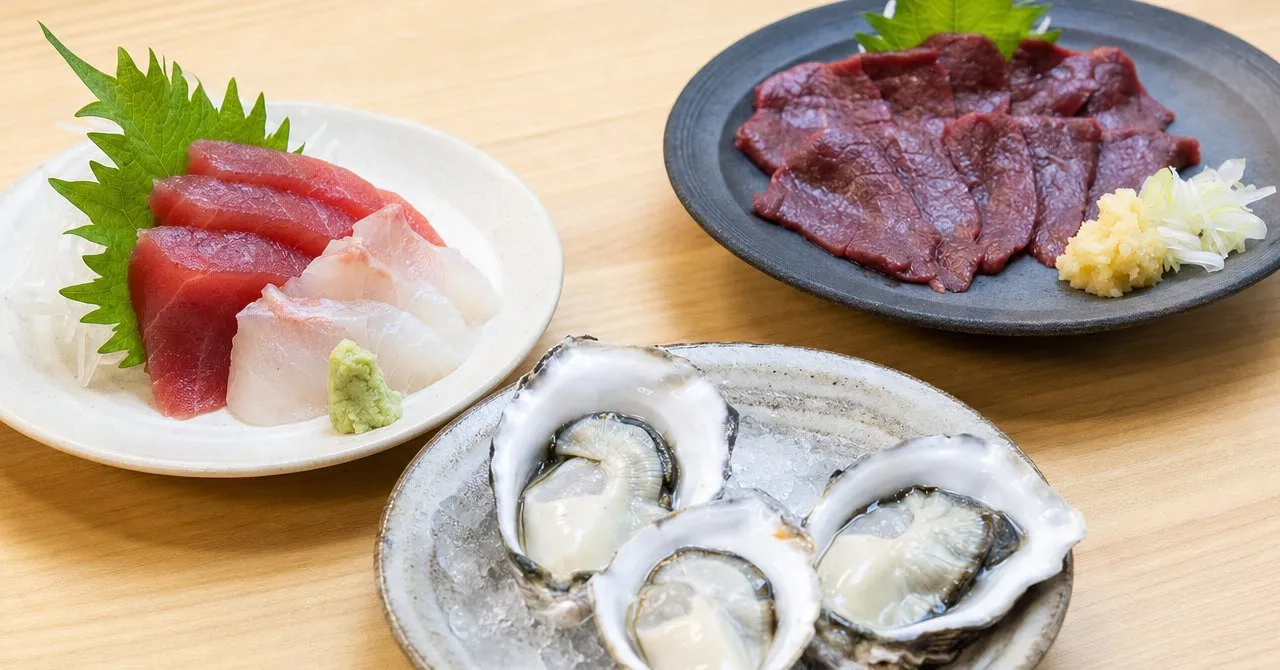
Japan serves foods raw that most American menus don’t: horse sashimi, beef sashimi, chicken sashimi and fugu. Raw oysters are familiar in both countries, but Japan sorts them differently. It can look as if Japan simply trusts raw food more, or as if anything fresh enough is fine to eat raw there.
That isn’t what Japan’s own rules say. There is no single “raw food law.” Each food has its own rule, and the rules work in completely different ways, from freezing conditions to outright bans. This page puts them side by side, with the agency and year behind each, and then sets them next to what US agencies say.
The rules side by side
| Food | Main concern | Japan’s rule | Source, year |
|---|---|---|---|
| Fish (Anisakis) | Parasite | Advice to businesses: freeze at −4°F (−20°C) for 24 hours or more, or cook to 158°F (70°C), or 140°F (60°C) for 1 minute | MHLW Anisakis page |
| Flounder (Kudoa) | Parasite | Inactivated by storage at 5°F to −4°F (−15°C to −20°C) for 4 hours or more, or 167°F (75°C) at the center for 5 minutes | MHLW notice, 2011 |
| Horse meat (Sarcocystis fayeri) | Parasite | Freezing at −4°F (−20°C) at the center for 48 hours or more, or colder for less time | MHLW notices, 1998 (hygiene standard) and 2011 (freezing) |
| Raw beef (not organs) | Bacteria | Legal standard: heat the meat block to a depth of 1 cm (about ⅜ inch) at 140°F (60°C) for 2 minutes or more, plus testing and warnings | Food Sanitation Act standard (MHLW), in force October 1, 2011 |
| Beef liver | Bacteria inside the liver | Sale and service for raw eating banned | Food Sanitation Act ban, July 1, 2012 |
| Pork, including organs | Hepatitis E virus, parasites, bacteria | Sale and service for raw eating banned | Food Sanitation Act ban, June 12, 2015 |
| Raw oysters | Bacteria | Bacterial standards; harvest area must be labeled | Food Sanitation Act standard (national); Food Labeling Act |
| Fugu | Natural toxin | Processors certified by prefectures, by exam | MHLW standard, 2019 |
| Chicken | Campylobacter | No national raw standard; MHLW says cook it | MHLW Q&A |
MHLW is Japan’s Ministry of Health, Labour and Welfare.
Fish and flounder: freezing advice, not a freezing law
For raw fish, the parasite in MHLW’s guidance is Anisakis. MHLW advises businesses to freeze fish at −4°F (−20°C) for at least 24 hours, or to cook it. It doesn’t say whether that’s the freezer’s temperature or the fish’s center. We found no Japanese law requiring fish for raw eating to be frozen. How this compares with FDA freezing guidance is in what “sushi grade” actually means.
MHLW’s 2025 figures, as published by Kyoto Prefecture, count 1,172 food-poisoning incidents nationwide; Anisakis accounted for 280 of them, with 283 patients. For more, see is sashimi safe in Japan? and, for river fish, raw freshwater fish.
Flounder (hirame) has a separate parasite, Kudoa septempunctata, which MHLW addressed in a June 17, 2011 notice. It reports that storage at 5°F to −4°F (−15°C to −20°C) for 4 hours or more, or heating to 167°F (75°C) at the center for 5 minutes or more, inactivated the spores.
Horse meat: freezing at the center
The same 2011 notice covered Sarcocystis fayeri, a parasite in horse muscle and the concern behind raw horse meat (basashi). It gives freezing conditions measured at the center of the meat:
| Center temperature | Time |
|---|---|
| −4°F (−20°C) | 48 hours or more |
| −22°F (−30°C) | 36 hours or more |
| −40°F (−40°C) | 18 hours or more |
| −22°F (−30°C), in a rapid freezer | 18 hours or more |
| Immersion in liquid nitrogen | 1 hour or more |
These are conditions found to inactivate the parasite, passed to prefectures as guidance, not a legal standard of the kind raw beef has.
Kumamoto Prefecture notes that the parasite doesn’t settle in people:
ウマでは筋肉に寄生し、人には寄生しません。 — In horses it lives in the muscle; it doesn’t live as a parasite in people. — Kumamoto Prefecture
For both parasites, flounder’s Kudoa and horse meat’s Sarcocystis, Kumamoto says symptoms are temporary vomiting or diarrhea a few hours (4–8 hours) after eating, generally not severe. Hiroshima Prefecture notes that raw horse meat and horse liver remain under a 1998 ministry notice, the “hygiene standard for meat for raw consumption.” We didn’t read that 1998 document, so we don’t describe its contents.
Raw beef: legal, with a heat step
Raw beef dishes such as yukhoe, beef tartare, gyū-sashi and gyū-tataki fall under a legal standard in force since October 1, 2011. According to Chiba City and Osaka Prefecture, it covers beef sold for raw eating, not organs, and requires that:
- the product test negative for Enterobacteriaceae, the bacterial family that includes E. coli;
- the meat block be heated from the surface to a depth of at least 1 cm (about ⅜ inch) at 140°F (60°C) for at least 2 minutes;
- processing be done by someone knowledgeable about the risks of enterohemorrhagic E. coli;
- packages, or restaurant menus and counters, warn that eating raw meat generally carries a risk of food poisoning, and that children, older people and others with weaker resistance should avoid it.
Beef that doesn’t meet the standard can’t be sold or served for raw eating. This is a rule for businesses selling or serving beef for raw eating. It doesn’t govern home cooking, and a quick sear on a steak isn’t the specified process of heating the block to 1 cm deep at 140°F (60°C) for 2 minutes. For the beef itself, see what A5 wagyu and Kobe beef actually mean.
Beef liver and pork: banned for raw eating
Japan banned the sale and service of beef liver for raw eating from July 1, 2012. Hiroshima Prefecture explains that enterohemorrhagic E. coli such as O157 may be present inside the liver regardless of freshness or hygiene.
牛レバーを安全に生食するための方法は、今のところありません。 — So far, there is no way to eat beef liver raw safely. — Hiroshima Prefecture
For restaurants, Hiroshima says liver must be cooked through, for example 145°F (63°C) at the center for 30 minutes or 167°F (75°C) for 1 minute.
Pork followed. From June 12, 2015, pork, including liver and other organs, can’t be sold or served for raw eating. Miyagi Prefecture gives the reasons: raw pork, wild boar or venison carries a risk of hepatitis E virus infection, which can become severe; human parasitic infections have been reported worldwide; and there are risks from Salmonella and Campylobacter.
Raw oysters: it’s the water, not the freshness
Japanese stores sell oysters as seishoku-yō (生食用, “for raw eating”) or kanetsu chōri-yō (加熱調理用, “for cooking”). Hiroshima Prefecture says the difference isn’t freshness:
どちらの生かきも鮮度は同じですが、採取された海域が違います。 — Both kinds of raw oysters are equally fresh, but they were harvested in different waters. — Hiroshima Prefecture
Raw-use oysters must be labeled with the harvest area under the Food Labeling Act. Under the national Food Sanitation Act standard, as listed by Hyogo Prefecture, they must have a bacterial count of 50,000 per gram or less, E. coli (most probable number) of 230 per 100 g or less, and, for shucked oysters, Vibrio parahaemolyticus of 100 per gram or less. The harvest water has its own coliform limit, and raw-use oysters are kept at 50°F (10°C) or below, or frozen at 5°F (−15°C) or below.
Hiroshima adds its own system. Oysters from its designated waters can be shipped for raw eating as harvested; those from conditionally designated waters qualify only after about 20 hours of purification. Hiroshima also describes voluntary norovirus testing: a positive result switches oysters to “for cooking” until a later test is negative. Norovirus isn’t among the national standard’s criteria. In 2025, norovirus caused 462 incidents and 18,566 patients nationwide, the most incidents and patients of any cause, though those figures cover all foods, not only oysters.
Fugu: certified hands
Fugu’s danger is tetrodotoxin, a natural toxin. MHLW’s risk profile says ordinary cooking heat doesn’t break it down, and that the organs, especially the liver and ovaries, concentrate it.
Japan’s answer is to control who handles the fish. An MHLW notice issued October 31, 2019 (last amended March 10, 2025) sets national standards for certifying fugu processors: people whom the prefectural governor or an equivalent official recognizes as able to process fugu reliably.
認定の際に必要な知識及び技術は試験により確認すること。 — The knowledge and skills required for certification are to be confirmed by examination. — MHLW, fugu processor certification standards
In the practical test, candidates identify at least five real fugu species and separate a fish into edible and inedible parts. The notice says poisonings often come from amateur cooking at home. MHLW’s undated risk profile says that in recent years there have been about 10 poisonings and about 10 patients a year, with deaths in some years, and its 2025 summary notes a run of poisonings from fugu liver in July 2025.
Chicken: no national raw standard
Torisashi (chicken sashimi) and lightly seared chicken tataki are served in Japan, but there’s no national raw-chicken standard like the one for beef. Osaka Prefecture asks wholesalers to tell restaurants that chicken needs cooking, and Hiroshima Prefecture tells businesses not to serve it raw. Kagoshima Prefecture has its own hygiene standard for chicken served raw (we didn’t read its contents) and says chicken sold for cooking must not be served as torisashi.
MHLW’s Campylobacter Q&A counts 220 incidents and 1,226 patients in 2025. It lists chicken tataki and sashimi of chicken liver or tenderloin among suspected causes, advises heating the center to 167°F (75°C) or above for at least 1 minute, and notes that Guillain-Barré syndrome can develop weeks after infection. Its key line:
「新鮮だから安全」ではありません。 — “It’s fresh, so it’s safe” is not true. — MHLW, Campylobacter Q&A
Raw eggs have their own Japanese rule, covered in raw eggs and tamago kake gohan.
What US agencies say for comparable foods
US guidance mostly takes a simpler line: cook it.
| Food | US guidance | Agency |
|---|---|---|
| Beef and pork steaks, roasts, chops | 145°F (63°C), then rest 3 minutes | FoodSafety.gov |
| Ground beef and pork | 160°F (71°C) | FoodSafety.gov |
| Chicken | 165°F (74°C); “If you eat undercooked chicken, you can get food poisoning.” | FoodSafety.gov, CDC |
| Fish | 145°F (63°C), or until the flesh is no longer translucent and separates easily with a fork; freezing guidance for raw fish (see sushi grade) | FoodSafety.gov, FDA |
| Oysters | Cook until shells open; “Hot sauce and lemon juice don’t kill Vibrio.” | FoodSafety.gov, CDC |
| Fugu | Puffer fish can be detained at import, with one exception for Japan | FDA Import Alert 16-20 |
The CDC adds that a contaminated oyster “doesn’t look, smell, or even taste different from any other oyster.”
On fugu, FDA Import Alert 16-20 says the toxin “cannot be destroyed by cooking or freezing.” It describes an agreement with Japan for “a single species of puffer fish, Takifugu rubripes, also known as ‘Tora Fugu’ for ‘special occasions’ only,” with each shipment inspected and certified as safe by a Japanese government official. According to FDA’s page on the 1988 exchange of letters, exports are limited to the muscle, skin and testicles of tiger puffer, processed by a certified person (a “puffer fish processing specialist”). Domestic puffer fish is a separate matter: FDA’s puffer fish advisory says not to serve or sell it “unless it has been harvested in the mid-Atlantic.”
What some English-language pages say
Torisashi and freshness. A 2015 Modern Farmer piece quotes the chef-owner of an izakaya-style restaurant in Berkeley, California, on chicken sashimi: “It has to be very fresh. They kill and chill it very quickly.” He also stresses clean knives and cutting boards. Those steps matter for handling, but MHLW’s position is that freshness doesn’t make raw chicken safe. The same article correctly reports Japan’s 2012 ban on raw beef liver.
Fugu “banned” in the US. A 2026 Chowhound article says fugu is banned in the US unless you have a specific license, and that “restaurants are only allowed to import three times per year, and it must be used for special occasions.” The “special occasions” part matches the FDA import alert. We couldn’t find a three-times-a-year limit in the FDA documents we read. What FDA describes isn’t a license but a buyers’ association whose member restaurants buy only from FDA-approved importers and serve the fish on site. “Allowed only under narrow conditions” is closer to what the FDA describes.
Horse meat as “one of the safest.” A 2025 Japan Food Guide page calls basashi “one of the safest raw meat dishes” and cites a 2011 MHLW “Hygiene Standards for Raw Horse Meat,” without mentioning freezing. The page cites no source for its comparison with beef and pork. Kumamoto says illness from this parasite is generally mild. But MHLW issued freezing conditions in 2011 because raw horse meat was linked to illness, the 2011 MHLW document we found is that freezing notice, Hiroshima cites a 1998 standard for raw horse meat, and we couldn’t find a 2011 standard under the name the page uses.
FAQ
Is raw beef legal in Japan? Yes, under conditions. Since October 1, 2011, beef sold for raw eating must meet a standard that includes heating the meat block to a depth of 1 cm (about ⅜ inch) at 140°F (60°C) for at least 2 minutes. Raw beef liver has been banned since July 1, 2012.
Is torisashi safe? Japan’s health ministry doesn’t call it safe. There’s no national raw-chicken standard, and MHLW says “fresh” doesn’t mean safe. In the US, the CDC says to cook chicken to 165°F (74°C).
Are Japanese raw oysters fresher than cooking oysters? Not according to Hiroshima Prefecture, which says both are equally fresh. The difference is the water they came from.
Is fugu from Japan legal in the US? Only in a narrow case. FDA Import Alert 16-20 allows a single species, tora fugu, from Japan for “special occasions” under an agreement between the two governments, with each shipment certified by a Japanese official. Domestic puffer fish is a separate matter; FDA’s advisory limits it to fish harvested in the mid-Atlantic.
How this article was researched
The Japanese rules come from Japanese-language official sources: MHLW notices, a Q&A and risk profiles, and food-safety pages from Chiba City and the Osaka, Hiroshima, Hyogo, Miyagi, Kumamoto, Kagoshima and Kyoto prefectural governments. The US side comes from FoodSafety.gov, the CDC and the FDA. Japanese quotations are kept short and translated by us. This article reports what agencies say and is not medical advice.
Sources
Japanese national government:
- 厚生労働省「アニサキスによる食中毒を予防しましょう」 — MHLW: preventing Anisakis food poisoning
- 厚生労働省「生食用生鮮食品による病因物質不明有症事例への対応について」 — MHLW: 2011 notice on Kudoa (flounder) and Sarcocystis (horse meat) (PDF)
- 厚生労働省「ふぐ処理者の認定基準について」 — MHLW: certification standards for fugu processors (PDF)
- 厚生労働省「自然毒のリスクプロファイル:魚類:フグ毒」 — MHLW: risk profile, pufferfish toxin
- 厚生労働省「カンピロバクター食中毒予防について(Q&A)」 — MHLW: Campylobacter Q&A
- 厚生労働省「令和7年食中毒発生状況の概要」 — MHLW: overview of 2025 food poisoning (PDF)
Japanese local governments:
- 千葉市「牛の生食用食肉に係る規格基準及び表示基準」 — Chiba City: standards for raw beef
- 大阪府「食肉の生食にご用心!」 — Osaka Prefecture: raw meat warnings and bans
- 広島県「牛の肝臓(レバー)や豚肉(内臓を含む)を生食用として食べることはできません」 — Hiroshima Prefecture: beef liver and pork bans
- 広島県「生食用食肉(牛肉)には基準が定められています」 — Hiroshima Prefecture: raw beef standard and raw horse meat
- 広島県「広島かきの衛生対策」 — Hiroshima Prefecture: oyster safety measures
- 兵庫県「生食用かきの取扱いについて」 — Hyogo Prefecture: handling raw-use oysters
- 宮城県「豚肉や豚レバー等の生食の禁止について」 — Miyagi Prefecture: ban on raw pork
- 熊本県「生食用生鮮食品(ヒラメ、馬刺し)による食中毒に注意しましょう」 — Kumamoto Prefecture: flounder and horse sashimi
- 鹿児島県「カンピロバクター食中毒にご注意を(営業者向け)」 — Kagoshima Prefecture: Campylobacter, for businesses
- 京都府「食の安全」 — Kyoto Prefecture: 2025 national food-poisoning figures
US government:
- FoodSafety.gov — Cook to a Safe Minimum Internal Temperature
- CDC — Chicken and Food Poisoning
- CDC — Vibrio and Oysters
- FDA — Import Alert 16-20 (puffer fish)
- FDA — FDA-Japan Exchange of Letters Regarding Puffer Fish
- FDA — Advisory on Puffer Fish
English-language examples:
- Modern Farmer — 7 Kinds of Sashimi Not Made With Fish
- Chowhound — The Japanese Delicacy That’s Banned In The US Unless You Have A Specific License
- Japan Food Guide — Horse meat cuisine
Part of our look at what English-language Japanese recipes get wrong.