In Japan, Miso Soup Isn't Eaten with a Spoon: How It's Served, Drunk and Filled
In Japan, miso soup is sipped from the lifted bowl, with chopsticks for the solids. Which bowls you can lift, what goes in it, and where tonjiru begins.
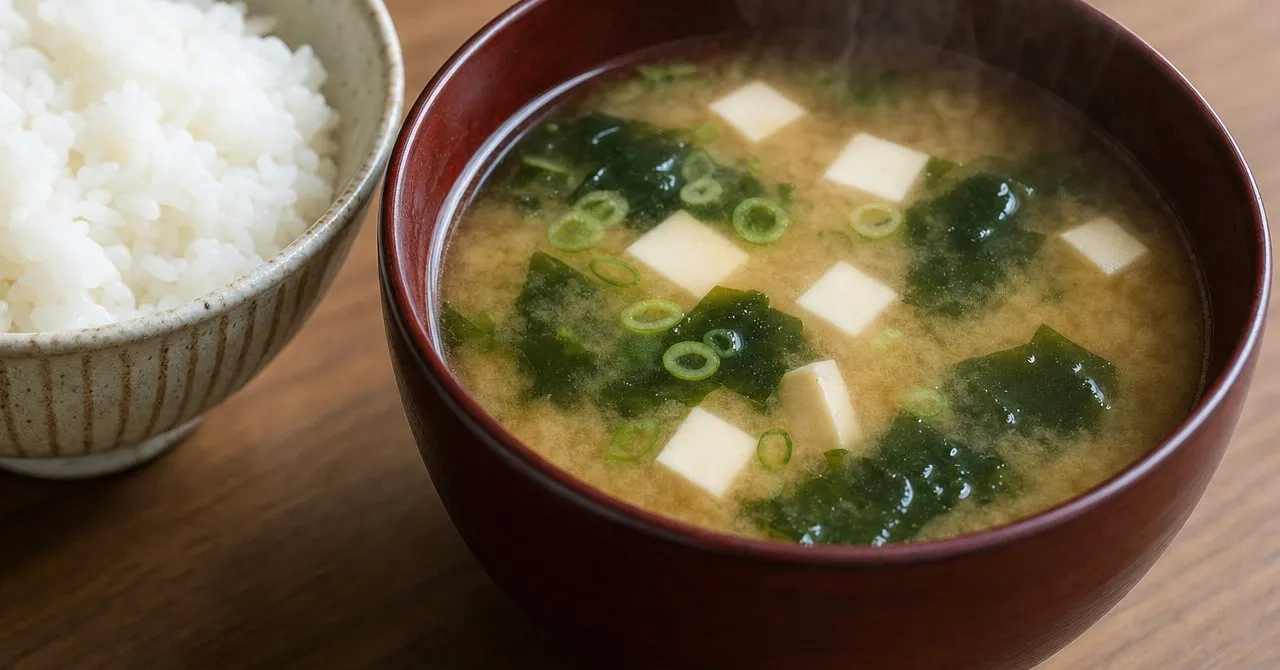
At many Japanese restaurants in the US, miso soup arrives in a small bowl with an Asian-style soup spoon. That’s a perfectly good way to serve it. But if you’ve wondered how it’s eaten in Japan, the answer is simpler: there’s no spoon. You lift the bowl, drink from it, and pick up the tofu and seaweed with your chopsticks.
That habit grew up around light wooden bowls, and it shapes where the soup sits on the table. Below: how Japanese etiquette guides describe it, which bowls you can lift, what Japanese home cooks put in miso soup, and where it ends and its heartier relatives, tonjiru and kenchinjiru, begin.
The short answer
- In Japan, you drink miso soup from the bowl. Lift it with both hands, sip the broth, and eat the solids with chopsticks. Japanese etiquette guides don’t use a spoon for it.
- Rice and soup bowls may be lifted. So may small, palm-sized dishes. Flat plates of grilled fish or tempura stay on the table.
- The most common ingredient is tofu. In a 10,000-person survey by Ajinomoto, more than 80% of home cooks said they often use it. Wakame, aburaage (fried tofu), negi and daikon round out the top five.
- Tonjiru is pork-and-vegetable soup seasoned with miso. Kenchinjiru is a vegetable soup whose vegetables are sautéed in oil first, and the versions we found are seasoned with soy sauce, not miso. Sautéing alone doesn’t tell them apart.
In Japan, you drink it from the bowl
Nippon.com’s guide to the standard Japanese meal, supervised by Shibazaki Naoto, an associate professor at Gifu University who teaches Ogasawara-school etiquette, puts it plainly: “Soups are consumed by lifting the bowl to the mouth.”
The guide gives the reason: soup bowls were light, lacquered wood, and because they went up to the mouth, the contents “did not require a spoon.” Rice sits front left and soup front right, which the guide says reduces the risk of spills. It suggests stirring the soup with your chopsticks and taking a sip first, then rice, then the solids in the soup, and afterward moving between rice and the other dishes rather than finishing one at a time.
How to lift the bowl
Both etiquette guides stress two hands, not one.
- Pick the bowl up with your right hand and support it with your left. Nippon.com warns that reaching across with only the left hand for a bowl on the right invites accidents.
- Once the bowl is steady in your left hand, pick up your chopsticks with your right.
- Drink from the rim, and use chopsticks for the tofu, wakame and onion.
- Put your chopsticks down, then set the bowl down with both hands.
As a shortcut, the guide says it’s acceptable to lift and lower soup and rice bowls with your chopsticks still in hand.
Precious.jp, a Japanese lifestyle magazine, makes the same point in an article with manners instructor Hirakawa Naoko: don’t pick up a soup bowl in one hand and gulp from it. For lidded bowls, it says to use both hands, and then:
「フタは逆さにして、両手でテーブルに置きましょう。」 “Turn the lid upside down and set it on the table with both hands.” — Precious.jp, with manners instructor Hirakawa Naoko
It also flags tezara (手皿, “hand plate”), cupping your free hand under food to catch drips. It calls this a breach of manners and suggests resting a sheet of kaishi (folding paper) on your palm instead.
Which bowls you can lift
Precious.jp draws the line by size and contents:
「手のひらサイズより大きな器でも、汁物やご飯類の入った器は持ち上げても構いません。」 “Even a dish larger than your palm may be lifted if it holds soup or rice.” — Precious.jp, with manners instructor Hirakawa Naoko
| Dish | Lift it? | Per Precious.jp |
|---|---|---|
| Soup bowl (miso soup, clear soup) | Yes, with both hands | Soup and rice bowls may be lifted even if larger than your palm |
| Rice bowl | Yes | Same |
| Small bowls (kobachi), soy sauce dish for sashimi | Yes | Palm-sized dishes are held while eating |
| Flat plates of grilled fish or tempura | No | Large dishes stay on the table |
So why do US restaurants bring a spoon?
The Takeout describes the American norm: “In the United States, miso soup is typically served in a small bowl with an East Asian-style soup spoon.” Like Chowhound, it then describes the Japanese way: lift the bowl and use chopsticks for the solids.
Neither explains how the spoon became standard in American restaurants, and we found no source that does. The spoon isn’t wrong; it’s a US serving convention. To eat the Japanese way, set it aside and lift the bowl.
What goes in miso soup in Japan
Daijisen calls miso soup a soup of vegetables, tofu, seaweed, shellfish and so on, with miso dissolved into dashi. The Japanese edition of Britannica (Britannica International Encyclopedia) adds seafood, meat and processed foods, and names katsuobushi, niboshi (dried sardines) and kombu as the usual dashi bases.
For what home cooks actually use, the best data we found is an online survey by Ajinomoto, maker of Hondashi granulated dashi: 10,000 people ages 20 to 69 who make miso soup at least monthly (instant excluded), in March 2018. It’s one manufacturer’s survey, so treat it as a snapshot.
「8割以上の人が、豆腐をよく使うと回答。」 “More than 80% said they often use tofu.” — Ajinomoto Hondashi miso soup survey
| Rank | Ingredient | Notes |
|---|---|---|
| 1 | Tofu | More than 80% often use it |
| 2 | Wakame seaweed | Percentage not published |
| 3 | Aburaage (thin fried tofu) | Percentage not published |
| 4 | Negi (long green onion) | Percentage not published |
| 5 | Daikon radish | Percentage not published |
The survey also notes regional favorites, without percentages:
| Region | Popular ingredient |
|---|---|
| Hokkaido, Okinawa, Shikoku | Egg |
| Tottori and Shimane | Shijimi (small clams) |
The shijimi result fits what Japan’s agriculture ministry (MAFF) says about Lake Shinji in Shimane. In registering Shinjiko-san Yamato shijimi (Yamato shijimi clams from Lake Shinji, a brackish lake) as a protected geographical indication, MAFF describes the clam as essential to shijimi-jiru (shijimi soup) and clear soup, standard dishes on home tables and in restaurants. (The registration page doesn’t say whether that soup is miso-based or clear, so we don’t claim either.)
When Ajinomoto asked about unexpected ingredients that work well, tomato came first, followed by kabocha squash, sweet potato, natto and lettuce. So respondents’ idea of what suits miso soup goes well beyond the classics.
Corn and mushrooms are not “un-Japanese”
Anything outside the top five isn’t automatically a Western invention. A school-lunch recipe from an elementary school in Shūnan, posted on Yamaguchi Prefecture’s website, is a miso soup of potato and corn, with onion, aburaage, spinach and a dashi of niboshi. Mushrooms belong too. A recipe on Tokyo’s Minato City website makes a miso soup of napa cabbage, nameko mushrooms and aburaage in a kombu-and-katsuobushi dashi. Mushrooms also show up in miso soup’s heartier relatives: shiitake in Ishikawa’s metta-jiru in a MAFF feature, and enoki in a tonjiru on Ichikawa City’s website. For more on negi and the other vegetables, see Japanese vegetables in American stores.
English recipes that go their own way
Some English-language recipes build a different soup around miso and say so. Belly Full’s Chicken Vegetable Miso Soup calls itself “a twist on classic miso soup.” It sautés carrots, onion, shiitake, garlic and ginger in olive oil, adds a little sriracha, and uses 5 cups of low-sodium chicken broth with white miso, chicken breast and napa cabbage. There’s no dashi.
That’s a legitimate soup, honestly labeled. The vegetables aren’t the difference; shiitake, carrots and napa cabbage all appear in Japanese soups. The differences are the base and the seasoning: chicken broth instead of dashi, an olive-oil sauté to start, and garlic, ginger and sriracha. None of the Japanese sources we checked, including dictionaries, the Ajinomoto survey and the MAFF and city recipes, build miso soup that way.
If you want the Japanese version, start with dashi; see Dashi Isn’t Fish Stock. If you love the chicken-broth version, keep making it. It’s simply a different soup.
Where miso soup ends: tonjiru and kenchinjiru
Two heartier soups sit right next to miso soup: tonjiru (豚汁, pork soup, also read butajiru) and kenchinjiru (けんちん汁). It’s tempting to separate them by technique, sautéed versus simmered. The Japanese sources don’t support that as a rule.
Tonjiru. All three Japanese dictionaries on Kotobank define it the same way: pork and vegetables in a miso-seasoned soup. Daijisen’s version:
「ぶた肉のこま切れと野菜とを入れた味噌仕立ての汁。」 “A miso-seasoned soup with small pieces of pork and vegetables.” — Daijisen (Shogakukan), entry for 豚汁
None of the definitions mention sautéing, and the recipes go both ways. MAFF’s feature on regional pork dishes describes Ishikawa’s metta-jiru as a tonjiru loaded with root vegetables, and its method simply simmers everything in boiling dashi. So does a Kyoto school-lunch recipe on the city’s website. A tonjiru recipe on Ichikawa City’s website, on the other hand, sautés the pork, taro, daikon, carrot and burdock in oil before adding dashi.
Root vegetables are typical, and MAFF notes that in metta-jiru “使う根菜に決まりはなく” (there’s no rule about which root vegetables go in). But a long list isn’t required: the Kyoto school-lunch recipe’s only root vegetable is carrot, alongside onion.
Kenchinjiru. MAFF’s regional-cuisine database (Kanagawa entry) defines it by the sauté:
「大根やにんじんなどの野菜を油で炒めてから煮込む料理。」 “A dish in which vegetables such as daikon and carrots are sautéed in oil and then simmered.” — MAFF, Uchi no Kyōdo Ryōri, kenchinjiru (Kanagawa)
MAFF traces one theory of the name to Kenchō-ji, a Zen temple in Kamakura. The temple’s version is shōjin (Buddhist vegetarian) cooking, with no animal foods and a dashi from kombu and shiitake. MAFF’s recipe, credited to the temple and lightly adapted for home kitchens, is seasoned with salt, soy sauce, mirin and a little sake, and the tofu is crumbled in by hand. Home versions vary: a kenchinjiru recipe on Iwate Prefecture’s website also sautés and uses soy sauce, but its dashi includes niboshi and katsuobushi, so it isn’t vegetarian. Both kenchinjiru recipes we checked were seasoned with soy sauce. We didn’t confirm whether miso-seasoned kenchinjiru is a regional norm anywhere, so we leave that open.
| Miso soup | Tonjiru | Kenchinjiru | |
|---|---|---|---|
| Seasoning | Miso | Miso | Soy sauce in the recipes we checked |
| Meat | Not required | Pork is the defining ingredient | None in the temple version; home dashi may use fish |
| Sautéed first? | No, in Hikari Miso’s basic method | Sometimes | Yes, per MAFF’s definition |
| Tofu | Cubed, in Hikari Miso’s method | Not in the definitions; Kyoto’s adds aburaage (fried tofu), MAFF’s and Ichikawa’s have none | Crumbled by hand |
| Typical ingredients | No fixed list; tofu, wakame, aburaage, negi and daikon are common | Pork plus root vegetables, flexibly (Kyoto’s uses just carrot and onion) | Daikon, carrot, burdock, taro, konnyaku, tofu and more |
Is tonjiru a kind of miso soup? Britannica’s Japanese edition includes meat in its miso soup definition, so by that measure it qualifies. But it has its own name and its own dictionary entries.
Make it: tofu and wakame miso soup (one serving)
Adapted from Hikari Miso’s published basic method, scaled from two servings to one. This site has not kitchen-tested it.
This uses three of the survey’s top five: tofu, wakame and negi. For the two-serving version and the research on why miso soup isn’t boiled, see Miso Isn’t One Thing.
Ingredients (1 serving)
- 200 mL (about ¾ US cup + 1½ tbsp) dashi (see Dashi Isn’t Fish Stock)
- 75 g (about 2⅔ oz) tofu
- 10–15 g (about ⅓–½ oz) salted wakame (enzō wakame)
- ⅛ naganegi (Japanese long onion), about 12–13 g by our math, using the City of Zushi’s figure of about 100 g for a medium negi.
- 1 tbsp miso (about 18 g, going by Hikari Miso’s US label). The Miso Health Promotion Committee, a Japanese industry group, puts a typical serving at about 15 g.
The wakame weight is for salted wakame. If you have dried wakame, rehydrate it according to the package instead.
Method
- Rinse the wakame briefly, soak it in water for 2–3 minutes, and cut it about 3 cm (1¼ in) wide. Cut the tofu into 1.5 cm (⅝ in) cubes. Slice the naganegi thinly.
- Heat the dashi in a small pot, add the tofu and wakame, and bring to a boil.
- When they’re heated through, turn off the heat.
- Once the bubbling settles, dissolve in the miso. Return the pot to the heat, but don’t let it boil.
- At niebana, the moment just before it boils, add the negi, stir briefly and turn off the heat.
Hikari’s rule once the miso is in is firm:
「風味が落ちるので決して沸騰させないでください。」 “Never let it boil, because the flavor will suffer.” — Hikari Miso
Serve it in a light bowl, rice to the left, soup to the right. Japanese and US tablespoons are effectively the same size; for cups and other conversions, see Cooking Japanese Recipes in an American Kitchen. For tofu types, see Silken Tofu Isn’t Lightly Pressed Tofu.
FAQ
How do you eat miso soup the Japanese way?
Lift the bowl with both hands, holding it in your left, and drink from the rim. Eat the tofu, seaweed and other solids with chopsticks. Japanese etiquette guides such as nippon.com’s don’t use a spoon.
Is it rude to use a spoon for miso soup?
In a US restaurant that hands you a spoon, no. It’s how the soup is served there. In Japan, the spoon simply isn’t part of the setting; the bowl is meant to be lifted.
Which Japanese bowls can you pick up?
Rice bowls, soup bowls and small palm-sized dishes such as kobachi and sashimi soy dishes, according to manners instructor Hirakawa Naoko in Precious.jp. Flat plates of grilled fish or tempura stay on the table.
What goes in miso soup in Japan?
In Ajinomoto’s survey of 10,000 home cooks, the top five were tofu, wakame, aburaage, negi and daikon, with tofu used often by more than 80%. Egg is popular in Hokkaido, Okinawa and Shikoku, and shijimi clams in Tottori and Shimane. Corn and mushrooms also appear in Japanese miso soup recipes.
What’s the difference between tonjiru and miso soup?
Japanese dictionaries define tonjiru as a miso-seasoned soup of pork and vegetables, so pork is what sets it apart. It can be sautéed first or not; Japanese recipes do both. Kenchinjiru, by contrast, is seasoned with soy sauce in the recipes we checked.
How this article was researched
This article is built on Japanese-language sources: Japan’s agriculture ministry (its regional-cuisine database, its aff magazine and a geographical-indication registration), recipes published on the websites of Yamaguchi and Iwate prefectures and the cities of Kyoto and Ichikawa, Japanese dictionaries on Kotobank, Ajinomoto’s miso soup survey, Hikari Miso’s basic method, and two Japanese etiquette guides (nippon.com, supervised by Shibazaki Naoto, and Precious.jp with Hirakawa Naoko). English-language examples come from The Takeout, Chowhound and Belly Full. Japanese quotations are kept short and translated by us. The recipe is adapted from Hikari Miso’s published method and has not been kitchen-tested by this site; the per-serving amounts and conversions are our own arithmetic. Several of the local-government PDFs don’t name the office that issued them; we identify them by the site that hosts them.
Sources
Japanese government and local government:
- けんちん汁 神奈川県 — MAFF, Uchi no Kyōdo Ryōri: kenchinjiru (Kanagawa)
- 豚肉で作る 日本の郷土料理 — MAFF, aff magazine, regional pork dishes including metta-jiru (Ishikawa)
- 登録番号 第171号 宍道湖産ヤマトシジミ — MAFF, geographical-indication registration for Lake Shinji Yamato shijimi
- じゃがいもとコーンのみそ汁 — School-lunch recipes from a Shūnan elementary school, on Yamaguchi Prefecture’s website (PDF)
- けんちん汁 — Kenchinjiru recipe on Iwate Prefecture’s website (PDF)
- 豚汁 — School-lunch tonjiru recipe on Kyoto City’s website (PDF)
- ゆず香る具だくさん豚汁 — Tonjiru recipe on Ichikawa City’s website (PDF)
- 白菜なめこ汁 米味噌仕立て — Napa cabbage and nameko miso soup, on Minato City’s website (PDF)
- 逗子市 野菜の目安量チラシ — City of Zushi vegetable weight flyer (PDF)
Japanese manufacturers:
- ほんだし みそ汁アンケート — Ajinomoto, Hondashi miso soup survey (n=10,000, March 2018)
- 教えて!だしと味噌汁のキホン — Hikari Miso, basics of dashi and miso soup
- Hikari Miso — Organic Miso White Miso (US nutrition label, 1 tbsp = 18 g)
Japanese industry group:
Japanese dictionaries:
- 味噌汁 — Kotobank: Daijisen, Nihon Kokugo Daijiten, Britannica International Encyclopedia (Japanese edition) and other entries on miso soup
- 豚汁 — Kotobank: Daijisen, Nihon Kokugo Daijiten and Kodansha cooking dictionary entries on tonjiru
Etiquette:
- Ichijū Sansai: The Standard Elements of a Typical Japanese Meal — nippon.com, supervised by Shibazaki Naoto
- 和食を食べるときにやってはいけない「器の扱い方」8選 — Precious.jp, eight bowl-handling mistakes at a Japanese meal, with Hirakawa Naoko
English-language examples: