Flipping Your Chopsticks for Shared Dishes: Polite Abroad, Frowned On in Japan?
English guides say to flip your chopsticks for shared plates. Japanese etiquette guides call that sakasa-bashi and say to use serving chopsticks instead.
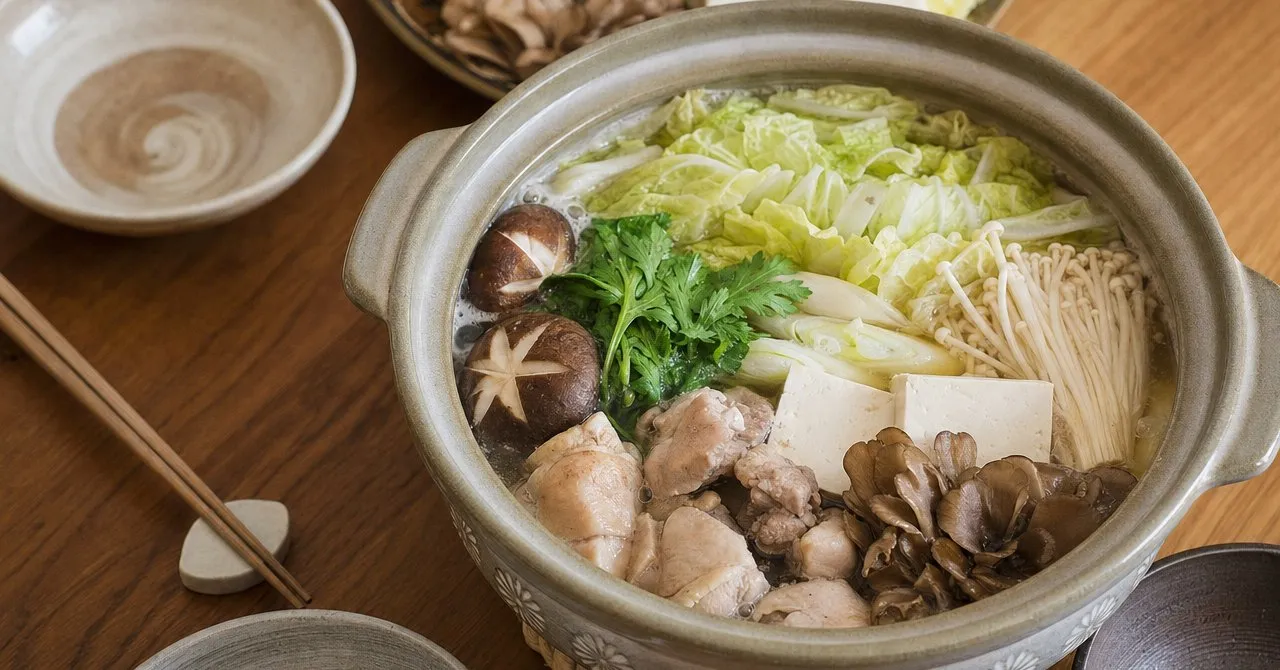
You’re sharing a platter of gyoza or a pot of nabe, and there’s no serving spoon. Several widely read English-language guides have a ready answer: turn your chopsticks around and pick up food with the clean end, the one that hasn’t been in your mouth. It sounds considerate, and it’s offered in good faith.
Japanese etiquette guides see it differently. They have a name for the move, sakasa-bashi (“upside-down chopsticks”) or kaeshi-bashi (“turned-around chopsticks”), and they list it among the kirai-bashi, the chopstick habits that make other people at the table uncomfortable. What they recommend instead is simple: use toribashi, a separate pair of serving chopsticks, and if there isn’t one, ask for one.
Both sides want the same thing: keep your own mouth away from food other people will eat. Here’s what each says, why the Japanese sources object, and how shared hot pots are handled.
The short answer
- Japanese etiquette guides say to use serving chopsticks (toribashi) for shared dishes. Flipping your own pair is called sakasa-bashi or kaeshi-bashi, and it’s on the standard lists of chopstick faux pas.
- If there are no serving chopsticks, ask for a pair. At a restaurant, ask the staff. At home, set one out.
- Japanese guides give two reasons. One points out that the flipped end is the end your fingers were on, so it isn’t actually clean. Another explains the rule through the double-tipped chopsticks used at New Year and other celebrations.
- Casual settings differ. A Japanese etiquette instructor quoted on hot-pot manners says that among close friends who are fine with it, people can even use their own chopsticks directly, though that habit is itself on Japanese taboo lists. The key is reading the table.
- The English guides aren’t far off. All three mention a separate pair or serving utensils as an option, and Tasting Table puts them first. The difference is that they treat flipping as an acceptable or even preferred way to serve, while Japanese guides list it as a faux pas.
What English-language guides say
The advice to flip your chopsticks shows up on some widely read English pages about Japanese dining. Three examples:
| Source | What it says |
|---|---|
| Wikipedia, “Customs and etiquette in Japanese dining” | When taking food from a communal dish, “unless with family or very close friends, one should turn the chopsticks around,” which it says is considered more sanitary. As an alternative, it says “one could have a separate set of chopsticks for communal dishes.” |
| Time Out Tokyo, “How to use chopsticks like a Tokyoite” (2018) | “just turn your chopsticks upside down and use the back to pick up whatever you’re having.” As the alternative, it says “an extra pair will be provided or can always be asked for.” |
| Tasting Table, chopstick etiquette rules (2025) | Restaurants “will usually provide separate utensils for transferring food from the communal plate to your own.” On “the rare occasion” they don’t, “the most polite practice is to reverse your chopsticks and serve with the ends you haven’t eaten from.” For diners who aren’t keen on handling the business ends of their chopsticks, it says it’s “probably better to just ask for extra utensils first.” |
Read closely, these aren’t careless. Wikipedia carves out an exception for family and close friends and mentions a separate set of chopsticks. Time Out Tokyo says you can always ask for an extra pair. Tasting Table assumes the restaurant will give you serving utensils and suggests asking for them in some cases. Where they part ways with Japanese etiquette guides is the status of flipping itself. Wikipedia and Time Out Tokyo offer it as the first option, and Tasting Table calls it “the most polite practice” when nothing is provided. Japanese guides list it as a faux pas.
What Japanese etiquette guides say
It has a name, and it’s on the list
Japanese chopstick etiquette is often taught as a list of things not to do. Nippon.com’s Japanese-language data page on chopstick manners lists more than 40 of them, introduced as habits known as kirai-bashi, kinji-bashi or imi-bashi. Kaeshi-bashi (also sakasa-bashi) is on it, defined as turning your chopsticks end for end when serving food so that the tips you’ve had in your mouth don’t touch it.
Sanjō City in Niigata Prefecture lists sakasa-bashi in its food-education newsletter as turning your chopsticks upside down to serve shared food, and follows with one line of advice:
「取り分け用の箸を準備しましょう。」 “Have chopsticks ready for serving.” — Sanjō City food-education newsletter, No. 127 (2016)
The same newsletter defines otemoto, a polite word for your own chopsticks, as the chopsticks each person uses, as opposed to toribashi.
Mynavi News’s guide to chopstick taboos also lists sakasa-bashi, defined as flipping your chopsticks to take food from a large shared plate.
A guide supervised by an etiquette scholar
Nippon.com’s Japanese-language guide to chopstick culture was supervised by Shibazaki Naoto, an associate professor at Gifu University’s graduate school and a sōshihan (master instructor) of the Ogasawara school of etiquette. Writing about iwai-bashi, the double-tipped chopsticks used for New Year and other celebrations, it says that switching ends to serve osechi or a shared platter is a problem, and adds:
「さらには「返し箸(逆さ箸)」というマナー違反なので、ちゃんと取り箸を用意しよう。」 “What’s more, it’s the breach of manners called kaeshi-bashi (sakasa-bashi), so set out proper serving chopsticks.” — Nippon.com, supervised by Shibazaki Naoto
Why flipping your chopsticks is frowned on
The Japanese sources we found give two different reasons.
1. The “clean” end is the end you were holding
A hot-pot etiquette quiz on Precious.jp, a Japanese lifestyle magazine site, asks whether you should flip your chopsticks when a restaurant hasn’t set out serving chopsticks. Its answer is no:
「箸を逆に持つ「逆さ箸」は、気を遣っているように見えて、手で触れた部分を鍋の中に入れることになるので、不衛生です。」 “Holding your chopsticks backward, sakasa-bashi, may look considerate, but it means putting the part your hand has touched into the pot, which is unhygienic.” — Precious.jp, hot-pot etiquette quiz (2020)
The quiz adds that it’s also poor manners and that some people may find it unhygienic and unpleasant. It recommends asking the restaurant staff to bring serving chopsticks.
The English guides treat the back end as clean because it hasn’t touched your mouth. The Japanese guide points out that it has spent the whole meal in your fingers. Flipping keeps your mouth off the food, but it puts the handle into the shared dish.
2. On celebration chopsticks, both ends are shared with the gods
Nippon.com gives a different reason, and it’s tied to a specific kind of chopstick. Iwai-bashi (also called yanagi-bashi), the chopsticks used at New Year and on other festive days, are tapered at both ends. The guide explains that they are meant for sharing the meal with the gods (shinjin kyōshoku), and that switching to the end you haven’t put in your mouth gets in the way of the gods’ meal. That’s the point where it adds that the move is kaeshi-bashi and says to set out serving chopsticks.
That explanation is specific to iwai-bashi, but it shows the rule has roots beyond hygiene. The same guide says that Japan’s habit of giving each family member their own chopsticks comes less from a hygiene idea, like not sharing a toothbrush, and more from a sense of spiritual purity.
Shared platters and hot pots: how serving works
Nabe, a pot simmered at the table and shared, is where this question comes up most. It comes up in Japan too. In a hot-pot survey by Recruit Lifestyle reported by Shogakukan’s @DIME (2018; 1,044 people in their 20s and 30s), the top concern people had about eating nabe was whether it’s OK to use their own chopsticks directly (jikabashi). Second was whether they should serve other people. The article gives the ranking only, with no percentages.
The guidance from the Japanese sources comes down to a few points:
- Serving chopsticks come with the dish. Mynavi News calls providing serving chopsticks for shared platters good manners, and Sanjō City tells readers to have them ready. At a restaurant, if none are set out, Precious.jp says to ask the staff.
- Serving chopsticks move food; your own pair eats it. Sanjō City’s newsletter draws exactly that line between toribashi and otemoto, the chopsticks each diner uses.
- Someone may serve the table. In the same @DIME article, Sakai Shinobu, an etiquette instructor with an Ogasawara-school shihan certification, says that in a large group it’s kind for the people sitting closest to the pot to serve those around them. With three or four people, Sakai says there’s no need to serve. Just offer to anyone who hasn’t taken anything yet.
The Japanese sources we used don’t address ladles for the broth. (For one well-known nabe dish and how it varies by region, see Sukiyaki, Kantō vs. Kansai.)
It depends on the table
None of the Japanese sources treat this as a rule enforced the same way everywhere. The clearest statement comes from Sakai Shinobu in @DIME. Sakai notes that some people dislike jikabashi even within their own family, so you should go by other people’s comfort, not your own. But Sakai also says that among close friends who are all fine with it, eating straight from the pot is part of the fun of nabe. The conclusion:
「その場の『和』を崩さないように臨機応変にふるまうのも、またマナーです」 “Being flexible so you don’t disturb the harmony of the moment is also good manners.” — Sakai Shinobu, etiquette instructor, in @DIME (2018)
Using your own chopsticks directly, jikabashi, is itself on the same taboo lists (nippon.com’s data page and Mynavi News both include it), so Sakai’s point is an exception for close company, not a general license. That partly overlaps with Wikipedia’s exception for “family or very close friends,” though Sakai warns that even family members may mind. Outside close company, the other Japanese sources point to serving chopsticks, not flipping.
Do people in Japan flip their chopsticks anyway? Mynavi News suggests some do, asking readers whether they’ve ever used sakasa-bashi to avoid jikabashi. We found no survey on how common it is.
A few other chopstick taboos, from a Japanese source
English lists of chopstick taboos are mostly accurate. Nippon.com’s guide says there are dozens of kirai-bashi. Here are a few that matter at a shared table, with what nippon.com says about each:
| Name | What it is | Why it’s avoided |
|---|---|---|
| Tate-bashi (standing chopsticks) | Sticking chopsticks upright in a bowl of rice | It recalls offerings to the dead. Nippon.com notes that the rice offered to someone who has died, makura-meshi, is served with chopsticks standing in it. |
| Hashi-watashi or awase-bashi (chopstick to chopstick) | Two people passing food from one pair of chopsticks to another | It resembles the funeral rite in which two people pick up a bone from the cremated remains together. |
| Sashi-bashi (stabbing) | Spearing food with your chopsticks | Listed as a taboo in nippon.com’s guide. |
| Watashi-bashi (bridge chopsticks) | Laying chopsticks across the top of a bowl | Nippon.com’s data page notes it signals “I’m finished eating.” |
| Mayoi-bashi (hesitating) | Hovering over dishes while deciding what to take | Listed on nippon.com’s data page of taboos. |
On standing chopsticks, nippon.com puts it in one line:
「同様に、ご飯に箸を突き立てる「立て箸」も、死者へのお供えを連想させる禁忌である。」 “In the same way, sticking chopsticks upright in rice, tate-bashi, is also taboo, because it calls to mind offerings to the dead.” — Nippon.com, supervised by Shibazaki Naoto
Here the English guides and the Japanese ones agree. Wikipedia, Time Out Tokyo and Tasting Table all warn against standing chopsticks in rice and passing food chopstick to chopstick, and all three tie these to funerals or offerings to the dead. If you want to hand someone a piece of food, put it on their plate or let them take it from yours.
What to do at your own table
- Serving a shared dish? Set out serving chopsticks next to it.
- At a restaurant with no serving utensils? Ask for a pair.
- Close friends, casual hot pot? A judgment call. Follow the table.
- If you’ve been flipping your chopsticks: your intention was right. Japanese guides just prefer a separate pair.
Rice bowls and soup bowls have their own conventions too. See how miso soup is eaten in Japan.
FAQ
Is it rude to flip your chopsticks to take food in Japan?
Japanese etiquette guides consider it poor manners. It has a name, sakasa-bashi or kaeshi-bashi, and it’s on lists of chopstick faux pas from nippon.com, Sanjō City and Mynavi News. Using serving chopsticks is the recommended alternative. Among close friends, practice is looser.
What are toribashi?
Toribashi are serving chopsticks, a separate pair set beside a shared dish for moving food onto your own plate or bowl. Your own chopsticks (otemoto) stay at your place.
What should I do if there are no serving chopsticks?
Ask for a pair. A Japanese hot-pot etiquette guide from Precious.jp says to ask the restaurant staff, and Time Out Tokyo notes an extra pair can always be asked for. At home, set serving chopsticks out before the meal.
Why do some Japanese guides call flipping chopsticks unhygienic?
Precious.jp’s hot-pot etiquette quiz says flipping may look considerate, but it puts the part your hand has touched into the pot. Nippon.com gives a different, non-hygiene reason tied to celebration chopsticks.
Can you eat directly from the pot with your own chopsticks at a Japanese hot pot?
Using your own chopsticks in the shared pot, jikabashi, is on Japanese lists of chopstick taboos. But among close friends who are all fine with it, etiquette instructor Sakai Shinobu, quoted by @DIME, says it can be part of the fun. Sakai also notes some people dislike it even within families, so go by others’ comfort. Otherwise, Japanese guides recommend serving chopsticks.
Why shouldn’t you stick chopsticks upright in rice?
Japanese sources say it recalls offerings to the dead. Nippon.com notes that rice offered to someone who has died is served with chopsticks standing in it.
How this article was researched
This article is based mainly on Japanese-language etiquette sources: a nippon.com guide to chopstick culture supervised by Shibazaki Naoto of Gifu University, nippon.com’s list of chopstick taboos, a food-education newsletter from Sanjō City, and Japanese magazine and news guides from Precious.jp, @DIME and Mynavi News. English-language examples come from Wikipedia, Time Out Tokyo and Tasting Table, read in October 2026. Japanese quotations were translated by us. We found no survey of how often people in Japan flip their chopsticks, and no Japanese source that addresses shared ladles directly, so we have not made claims about either.
Sources
- 和食文化の基本「箸遣い」:タブーが多いのは「食事=神事」だから? — Nippon.com, chopstick culture and taboos, supervised by Shibazaki Naoto
- あなたは大丈夫?:意外と知らない箸のマナー — Nippon.com Japan Data, list of chopstick taboos
- 食育だより No.127(平成28年12月19日号) — Sanjō City, Niigata, food-education newsletter on chopsticks (PDF)
- 「お鍋を食べる時のNGマナー」をテストで診断! — Precious.jp, hot-pot etiquette quiz
- 直箸はやっぱりダメ!押さえておきたい鍋マナーと取り分け方のポイント — @DIME, hot-pot manners and serving
- 直箸はやっぱりダメ!押さえておきたい鍋マナーと取り分け方のポイント(2ページ目) — @DIME, page 2, with the instructor’s credentials
- 箸マナーとは? 正しい使い方やタブーを一覧で紹介 — Mynavi News, chopstick manners and taboos
- Customs and etiquette in Japanese dining — Wikipedia
- How to use chopsticks like a Tokyoite — Time Out Tokyo
- The Most Important Chopstick Etiquette Rules To Follow When Eating At A Japanese Restaurant — Tasting Table