Katsu Curry in Britain, Philadelphia Rolls in America: "Japanese" Dishes Born Abroad
Katsu curry, Philadelphia rolls, spicy mayo, sriracha, sushi burritos and Spam musubi: what's known about where each took shape, and what the words mean in Japan.
A lot of the food sold as “Japanese” outside Japan was invented outside Japan. In Britain, “katsu” can mean a curry sauce with no cutlet in it. In the US, the Philadelphia roll, the spicy tuna roll and the sushi burrito are familiar American sushi items. Sriracha often shows up in “Japanese” recipes, and it isn’t Japanese at all.
None of this makes these dishes fake. They’re real foods with their own histories. The only thing worth correcting is the label: when a recipe calls one of them “authentic Japanese,” or uses a Japanese word in a way Japanese speakers wouldn’t recognize, it helps to know what the word means back home.
Here’s what’s known about where each dish took shape, and what Japanese dictionaries and companies say about the words.
The short answer
| Dish or word | Where it took shape | What the word means in Japan |
|---|---|---|
| “Katsu curry” as a sauce or flavor | UK; traced to the first Wagamama restaurant (1992) | Katsu karē: curry rice topped with a fried cutlet |
| Philadelphia roll | US | Not a Japanese dish; the origin of the name is disputed |
| Inside-out roll (uramaki) | US, credited to the California roll | Uramaki, literally “reverse-side roll” |
| Spicy tuna roll, spicy mayo | US | Tsuna usually means processed, oil-packed tuna, like the canned kind |
| Sriracha | A Thai-style sauce, made famous in the US by Huy Fong Foods | Not a Japanese seasoning; a product sold in Japan markets it as Thai in origin |
| Sushi burrito | US; popularized by Sushirrito (San Francisco, 2011) | No traditional Japanese counterpart we could document |
| Spam musubi | Hawaii; origin disputed | Okinawa has a similar canned-meat-and-egg rice ball |
Katsu curry: a cutlet in Japan, a sauce in Britain
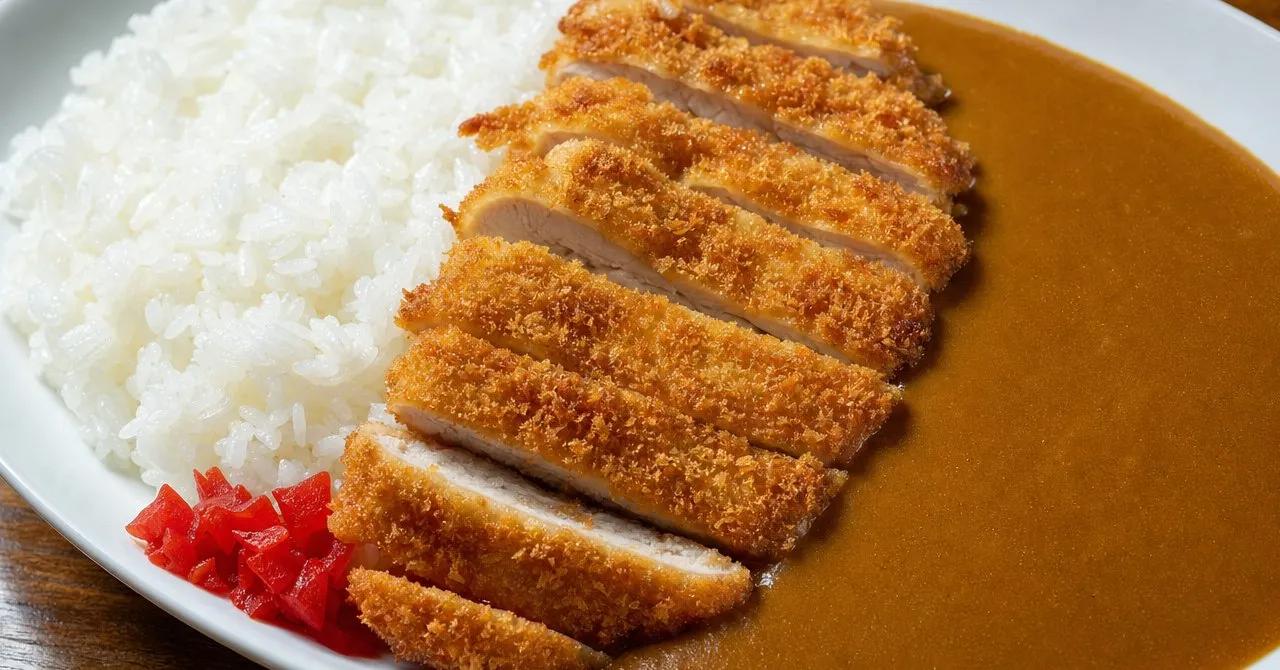
In Japan, katsu karē (カツカレー) is one specific plate. The Japanese dictionary Daijisen defines it this way:
「豚肉などのカツをのせたカレーライス。」 “Curry rice topped with a cutlet, such as pork.” — Digital Daijisen (Shogakukan), via Kotobank
Katsu means a fried cutlet, usually breaded pork, as SoraNews24 explains it for English readers. The dish is that cutlet laid on top of Japanese curry and rice. Who served it first depends on how you count. The Japanese food magazine dancyu calls the “Kawakin-don” rice bowl of Kawakin, which began as a Western-style food stall in Asakusa, Tokyo, and dates its founding to 1918, the true original katsu curry. It credits the Ginza restaurant Ginza Swiss with the plated dish under the name “katsu curry.” By the restaurant’s own account, as dancyu reports it, that plate was born in 1948 when Shigeru Chiba, a Yomiuri Giants player, asked for a pork cutlet on his curry rice because eating them separately was a bother. English Wikipedia adds a third claimant, Ōroji in Shinjuku, Tokyo (1921).
(For the curry itself, a roux-thickened stew that came to Japan by way of Britain, see Japanese Curry Is Not Indian Curry.)
How “katsu” became a flavor in the UK
In Britain, the trail leads to Wagamama, a restaurant chain that started in London. JETRO, Japan’s government trade-promotion agency, cites UK-based chef and food writer Tim Anderson as saying that “the origins of katsu curry in the UK go back to the first Wagamama outlet (a chain of Asian fusion restaurants) in 1992.” The dish was on the opening menu, JETRO says, when most British diners didn’t know much about Japanese food yet. The Japanese news site GIGAZINE dates that first restaurant, in London’s Bloomsbury, to April 22, 1992.
Over the years, the word drifted. JETRO’s article says that in the UK “katsu has been used as a name for sweet curry flavored Japanese sauce,” and that “katsu curry – or increasingly just katsu – has become an on trend Japanese flavor.” The examples it lists include katsu cashew nuts, katsu mayo and mackerel in katsu curry sauce. Products like katsu curry oats, it adds, are “surprising (from a Japanese perspective).”
The products themselves show the shift:
- Wagamama Katsu Curry Sauce, sold through the UK grocer Ocado, is a ready-made sauce with no meat in it. It’s labeled suitable for vegans. Its description calls the sauce “the key ingredient in our most iconic dish,” and the serving suggestion tells you to add your own chicken and rice.
- Tesco Finest Katsu Curry Flavour crisps are potato chips seasoned with spices, onion and garlic powder. There’s no cutlet anywhere near them. “Katsu curry” here names a taste.
SoraNews24 described the same pattern in 2020: people in Britain had started calling Japanese curry roux “katsu curry,” “even if it doesn’t contain the vital ‘katsu’ meat cutlet.”
That’s an ordinary thing for a borrowed word to do. It just isn’t what the word means in Japan, where katsu is the cutlet. The British versions can differ in the pot too. JETRO notes they may contain coconut milk, “which is popular in UK curries but not normally used in traditional Japanese curry.”
Japanese companies take part, too. JETRO reports that S&B Foods, one of Japan’s big curry makers, exports to more than 60 countries and that the UK is its largest market in Europe.
If you’re in the US, “katsu sauce” in English-language recipes often refers to tonkatsu sauce, the thick brown sauce for cutlets. That’s a different thing again. See Japanese Sauce Types.
The Philadelphia roll and the inside-out roll
The Philadelphia roll is an American sushi roll. English Wikipedia describes it as “generally made with smoked (or sometimes raw) salmon, cream cheese, and cucumber,” usually with the rice on the outside, and says that, like many Western-inspired rolls, “its design and name are modified to target an American market.” Japanese Wikipedia describes it as a type of maki sushi that originated in the United States.
The name is where the accounts split. Japanese Wikipedia says the name comes from the Philadelphia brand of cream cheese and has no direct connection to the city. Tasting Table tells a different story: it credits a Philadelphia restaurant owner it calls “Madame Saito,” who it says was riffing on lox and bagels and was asked by the city’s mayor to create a sushi recipe honoring Philadelphia. Neither cites a primary source, so we treat both the inventor and the origin of the name as unsettled. The sources agree on the essentials: it was made for American diners, and it isn’t a traditional Japanese roll.
Why the rice is on the outside
The Philadelphia roll’s shape, rice outside and nori inside, is also an American development. In Japanese it’s called uramaki (裏巻き), literally a “reverse-side roll.” Japanese Wikipedia’s article on the California roll says the technique is credited to a sushi chef who saw American customers peeling the seaweed off and eating the roll without it. Kahei Yamamoto, head of the nori and tea company Yamamotoyama, summed up the logic in an interview with Forbes JAPAN:
「表が黒いから食べないのであれば表を白くすればよい。」 “If people won’t eat it because the outside is black, make the outside white.” — Kahei Yamamoto, Yamamotoyama, interviewed by Forbes JAPAN
In the same interview, he says the inside-out California roll then became hugely popular in the US. He credits several sushi chefs, not one named person. Who invented the California roll is told in more than one version, so we won’t pick one.
Spicy tuna, spicy mayo, and what “tuna” means in Japanese
The spicy tuna roll is another American classic. English Wikipedia says it was invented in Los Angeles in the 1980s, made by mixing tuna scraps with chili sauce, and that it usually contains raw tuna and “spicy mayo or sriracha.” Wikipedia also names an inventor and a restaurant, but we couldn’t confirm those details against a primary source, so we’re leaving them out.
Spicy mayo is treated as American by at least one Japanese-run recipe site. Namiko Chen, who runs the English-language Japanese recipe site Just One Cookbook, put it plainly in a reply to a reader:
“We don’t have spicy mayo in Japan, and it’s totally an American thing.” — Namiko Chen, Just One Cookbook (“Spicy Mayo,” reader comments)
In the same reply, she adds that this kind of sauce doesn’t go on traditional-style sushi in Japan. The site’s recipe is Japanese mayonnaise mixed with sriracha and a splash of lime juice. We haven’t checked Japanese conveyor-belt chains’ menus, so we won’t claim that no mayo-topped sushi exists in Japan. For the mayonnaise itself, see Kewpie Mayonnaise.
“Tuna” (tsuna) versus maguro
There’s a language wrinkle here. Japanese has borrowed the English word “tuna” as tsuna (ツナ), but it doesn’t mean what it means on an American sushi menu. The Daijisen dictionary defines tsuna as tuna-family fish, and adds:
「一般に、ビンナガの油漬けをいう。」 “Generally refers to oil-packed albacore.” — Digital Daijisen (Shogakukan), via Kotobank
The Seisenban Nihon Kokugo Daijiten (the abridged edition of Japan’s largest dictionary) defines tsuna as processed tuna meat. Hagoromo Foods, the company behind the Sea Chicken canned-tuna brand, explained the terms to the newspaper Nikkan Gendai: the processed product is called tsuna, and when it’s packed in oil or otherwise canned, it’s tsuna-kan, canned tuna. Hagoromo also notes that tsuna can be made from bonito as well as tuna.
So in Japanese, “tsuna” points to the processed, canned kind. The dictionary defines it by the fish’s Japanese name, maguro (マグロ), and Japanese encyclopedias on Kotobank describe maguro, bluefin above all, as prized for sashimi and sushi. Given those definitions, a literal Japanese rendering, supaishī tsuna, would point toward the canned product rather than raw fish.
For raw fish at home, see “Sushi Grade” Has No Legal Meaning.
Sriracha: Thai-style, made famous in California
Smithsonian Magazine describes Huy Fong Foods’ sriracha as “a version of a hot sauce originating in Si Racha, Thailand.” The company’s founder, David Tran, was “a southern Vietnamese refugee,” according to the same article, and he founded the company in Los Angeles’s Chinatown. Huy Fong’s address is in Irwindale, California, and the company describes its sauce as “created from sun ripened chilies pureed into a smooth paste.”
At least one sriracha sold in Japan is marketed as Thai in origin. When Meidi-ya brought a Tabasco-brand sriracha to Japan, the food-industry trade paper Nihon Shokuryo Shimbun quoted its description this way:
「タイのレシピをルイジアナ風にアレンジしたオリジナルのシラチャーソース」 “An original sriracha sauce that adapts a Thai recipe in Louisiana style.” — Nihon Shokuryo Shimbun, on Meidi-ya’s Tabasco Sriracha
Sriracha has a real story of its own, through Thailand, a Vietnamese refugee and Los Angeles. It just isn’t a Japanese seasoning.
Sushi burritos and Spam musubi, briefly
The sushi burrito is an American fast-casual idea. The best-documented early example is the Sushirrito chain, which English Wikipedia says “started in San Francisco in January 2011,” selling “a blend of traditional sushi with the form of a burrito.” We couldn’t find a Japanese source that treats it as a traditional Japanese dish.
Spam musubi is a Hawaiian snack. Japanese Wikipedia calls it a snack commonly eaten across the state and says it’s described as Hawaiian local food. Its origin is disputed; English Wikipedia says so in as many words. Japanese Wikipedia traces Spam’s popularity in Hawaii to Japanese American soldiers who came home after World War II, and credits Barbara Funamura, a restaurant owner on Kauai, with creating Spam musubi in 1983. English Wikipedia adds other claims, including one from survivors of the Japanese American internment camps on the mainland, who say they made a precursor. What the sources agree on is that it became a Hawaiian staple, wrapped in nori “in the tradition of Japanese onigiri.”
Japan has a close cousin. Japanese Wikipedia notes that in Okinawa, where Spam took hold after the war through US military supplies, a similar rice ball, pōku tamago omusubi (“pork-egg rice ball”), is sometimes eaten. English Wikipedia notes that Spam musubi with egg is sometimes called “Potama,” so the “pork” here is the canned meat, not fresh pork. For how onigiri differs from sushi, see Onigiri Isn’t Made with Sushi Rice.
Why this happens, and what to do with it
A Japanese idea travels, and cooks change it to suit local tastes: coconut milk in British curry, cream cheese and inside-out rolls in America, Spam in Hawaii. Sometimes, as with “katsu” in Britain, the name itself changes meaning.
- Cook the dish you want. British-style katsu curry and the spicy tuna roll are legitimate dishes.
- Read the label as a regional term. “Katsu curry sauce” in a British recipe is a sauce. A Japanese recipe for katsu karē expects a cutlet.
- Don’t assume a Japanese-sounding ingredient is Japanese. Sriracha is Thai-style. Just One Cookbook describes spicy mayo as American.
- If you’re looking for the Japanese version, search by the Japanese name: katsu karē for the cutlet plate, maguro for raw tuna.
FAQ
Is katsu curry Japanese?
Yes, as a dish. In Japan, katsu karē is curry rice topped with a fried cutlet, and the origin stories, all from Tokyo restaurants, date to 1918, 1921 and 1948. What’s British is the use of “katsu” or “katsu curry” for the curry sauce or flavor on its own, which JETRO, citing chef Tim Anderson, traces to Wagamama’s first restaurant in 1992.
Why do people in the UK call curry sauce “katsu”?
JETRO, citing chef Tim Anderson, traces UK katsu curry to Wagamama’s first restaurant in 1992, and over time “katsu” came to be used in the UK as a name for the sweet curry-flavored sauce. Products like Wagamama’s own Katsu Curry Sauce and katsu curry-flavored crisps contain no cutlet.
Where did the Philadelphia roll come from?
It’s an American roll of salmon, cream cheese and cucumber, usually made inside out. Japanese Wikipedia says the name comes from Philadelphia cream cheese, not the city; Tasting Table credits a Philadelphia restaurant owner. Neither cites a primary source, so the inventor and the name’s origin are unsettled.
Is spicy mayo Japanese?
Just One Cookbook’s Namiko Chen calls it “totally an American thing.” It’s usually Japanese-style mayonnaise plus sriracha.
Is sriracha a Japanese sauce?
No. Smithsonian Magazine describes Huy Fong’s sriracha, made in California, as a version of a hot sauce from Si Racha, Thailand. A Tabasco-brand sriracha sold in Japan by Meidi-ya describes itself as adapting a Thai recipe.
What does “tuna” mean in Japanese?
The loanword tsuna usually means processed, oil-packed tuna, the canned kind, according to the Daijisen dictionary and Hagoromo Foods. The fish itself, prized for sashimi and sushi, is maguro.
How this article was researched
For the Japanese side, we relied on Japanese-language dictionaries and encyclopedias (Daijisen, the Seisenban Nihon Kokugo Daijiten and others via Kotobank), JETRO’s Japan Food site, Hagoromo Foods’ explanation as reported in Nikkan Gendai, the trade paper Nihon Shokuryo Shimbun, dancyu, Forbes JAPAN and Japanese Wikipedia. British and American usage comes from SoraNews24, Smithsonian Magazine, Huy Fong Foods, Just One Cookbook and English Wikipedia; the UK product examples come from retailer listings (Ocado, Tesco), which can change. The origin stories for the US rolls, the sushi burrito and Spam musubi rely mainly on Wikipedia, which itself relies on secondary sources. Japanese quotations were translated by us. Where the origin of a dish is disputed, including the Philadelphia roll’s inventor and name, the spicy tuna roll’s inventor, the California roll’s creator and Spam musubi’s origin, we’ve said so rather than picking a version. We didn’t cook or taste anything for this article.
Sources
- カツカレー — Digital Daijisen definition of katsu curry (Kotobank)
- ツナ — Digital Daijisen and Seisenban Nihon Kokugo Daijiten definitions of tsuna (Kotobank)
- マグロ — Encyclopedia entries on maguro, prized for sashimi and sushi (Kotobank)
- 102年の歴史を持つカツカレー丼 — dancyu, on the Kawakin and Ginza Swiss origin stories
- The story of how katsu curry conquered the UK — JETRO Japan Food
- GIGAZINE — Wagamama and the UK katsu curry boom (Japanese)
- Wagamama Katsu Curry Sauce — Ocado product page
- Tesco Finest Crinkle Cut Hand Cooked Crisps – Katsu Curry Flavour — Tesco product page
- The U.K. thinks Japanese curry is katsu curry, and people aren’t happy about it — SoraNews24
- Katsu curry — Wikipedia
- フィラデルフィアロール — Japanese Wikipedia, Philadelphia roll
- Philadelphia roll — Wikipedia
- Tasting Table — on how cream cheese got into American sushi rolls
- カリフォルニアロール — Japanese Wikipedia, California roll
- 米国海苔売上げ、国内比3倍。山本山当主に聞いた『カリフォルニア巻き』誕生顛末 — Forbes JAPAN interview with Yamamotoyama head Kahei Yamamoto on the California roll
- Spicy tuna roll — Wikipedia
- Spicy Mayo — Just One Cookbook (recipe and Namiko Chen’s reader-comment replies)
- ツナとシーチキンの違いって? 「はごろもフーズ」に聞いた — Nikkan Gendai, Hagoromo Foods on tsuna, tsuna-kan and Sea Chicken
- How a Vietnamese refugee built the multi-million dollar sriracha hot sauce empire — Smithsonian Magazine
- Huy Fong Foods — official site
- TABASCO <シラチャーソース>(明治屋) — Nihon Shokuryo Shimbun, Meidi-ya’s Tabasco Sriracha
- Sushirrito — Wikipedia
- Spam musubi — Wikipedia
- スパムむすび — Japanese Wikipedia, Spam musubi